If a B2B enablement or HubSpot project isn't delivering after a few months, a good partner makes the gap visible, diagnoses the cause, and agrees corrective actions with owners and a review date. First check which clock you're on. Operational results should show within 4–8 weeks of launch, while commercial results usually take one to two sales cycles.
Why this question matters before you sign
This is the question that tells you most about a partner. Every agency can describe a successful project. Fewer can tell you, in concrete terms, what they do when one isn't working.
The question has become sharper in 2026 because B2B enablement projects now touch more of the business at once: Sales, marketing and service, the CRM data model, lead handoff between marketing and sales, and the reporting leadership relies on. When results lag, the cause can sit in any of those layers. A partner without a structured way to find it will guess. One that has a structured way will fix the right thing.
Let me name the elephant in the room: projects do underperform. Pretending otherwise in a sales meeting is a warning sign, not a strength.
What does "not delivering" actually mean?
"Not delivering" means a measurable gap between the outcomes agreed at kickoff and what you see at a planned checkpoint. Without agreed outcomes, there is no gap to measure, only a feeling.
This is how I define it:
A project is not delivering when an agreed outcome metric is behind its expected point on the right timeline, and the gap is not explained by a known external factor.
The "right timeline" part matters, because there are two clocks:
| Clock | What it measures | When you should see movement |
|---|---|---|
| Operational | Clean data, working pipelines, lead handoff, usable reporting, team adoption | Within 4–8 weeks of launch |
| Commercial | Pipeline growth, conversion rates, win rate, sales cycle length | Within one to two sales cycles |
The most common mistake I see is judging the commercial clock by the operational one. If your sales cycle is nine months, revenue will not move in month three. Your data quality, follow-up speed and adoption should, though. If those are flat at week eight, you have a real problem, and it's worth acting on now.
Myth 1: "If it isn't working, the platform is wrong"
It's rarely the platform. In my experience, struggling HubSpot setups almost always trace back to how they were configured and adopted, not to HubSpot itself.
My colleague Sheila Ghamkhar, project manager at Zooma, starts every diagnosis in the same place: "We first look at whether the teams are actually using the system as intended." Her list of common causes is short and practical:
- Insufficient training, so people don't know how to do their daily work in the new setup.
- Lack of management support, so the new process is optional in practice.
- Teams falling back into old ways of working, such as spreadsheets, private lists and email.
- An implementation that simply isn't aligned with what the business actually needs.
Sheila notes that the last cause is one many clients bring with them from a previous implementation. That is why understanding the business upfront, during discovery, matters so much.
Takeaway: before changing the tool, check usage, training and leadership backing. Those three explain most underperformance.
Myth 2: "Problems show up at the end of the project"
They don't, if you build in checkpoints. Problems surface at the end only when nobody is looking during the project.
My approach, and Zooma's, is to agree business-outcome metrics before kickoff and review them at regular checkpoints throughout the engagement. That way, course correction happens early, when it's still cheap. The alternative is a project that quietly underperforms for months and is then defended rather than fixed.
However, it is much more difficult to stop an ongoing project at a checkpoint than it is to not start the project in the first place, simply because of the time, energy and resources that went into it which would be viewed as sunk cost at that point. So, before initiating a sales enablement transformation, think thoroughly about the necessary commitments and whether you and your team are ready to make them.
What should a good partner do when results lag?
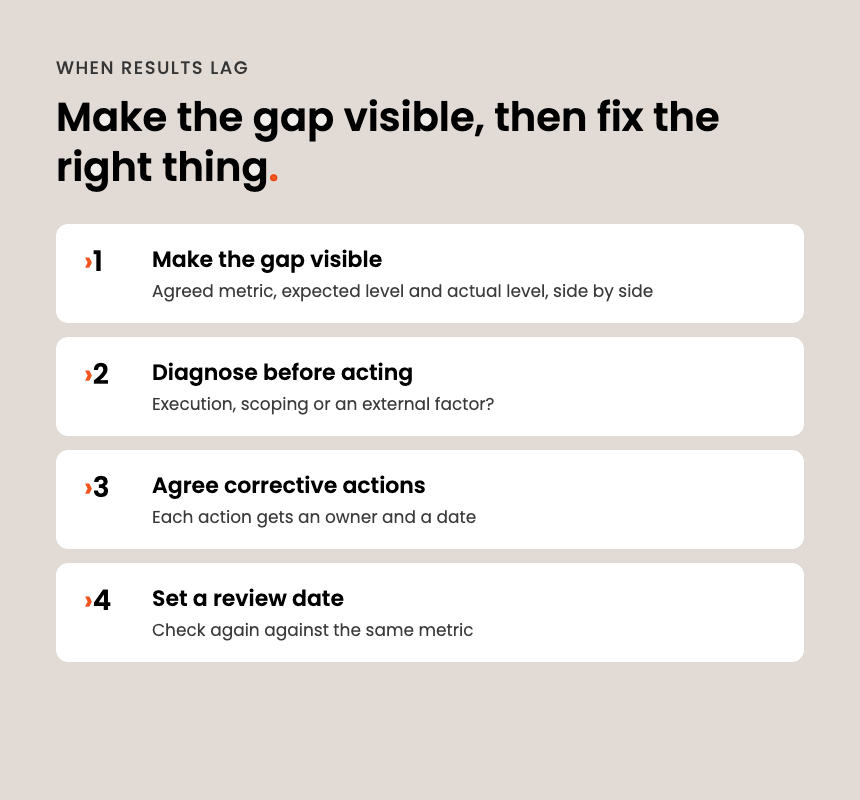
A good partner follows a fixed sequence: make the gap visible, diagnose the cause, agree actions, and review. Anders Björklund, Zooma's founder and CEO, describes it like this: "We make the gap visible, investigate the cause together and agree corrective actions, owners and a review date."
- Make the gap visible. Show the agreed metric, the expected level and the actual level side by side. No softening.
- Diagnose before acting. Separate execution problems (the plan is right but isn't being carried out), scoping problems (the plan was wrong or too narrow) and external factors (a reorganisation, a market shift, a lost key person).
- Agree corrective actions. Each action gets an owner, on your side or ours, and a date.
- Set a review date. Check again against the same metric, so the fix is measured too.
A diagnostic table you can use
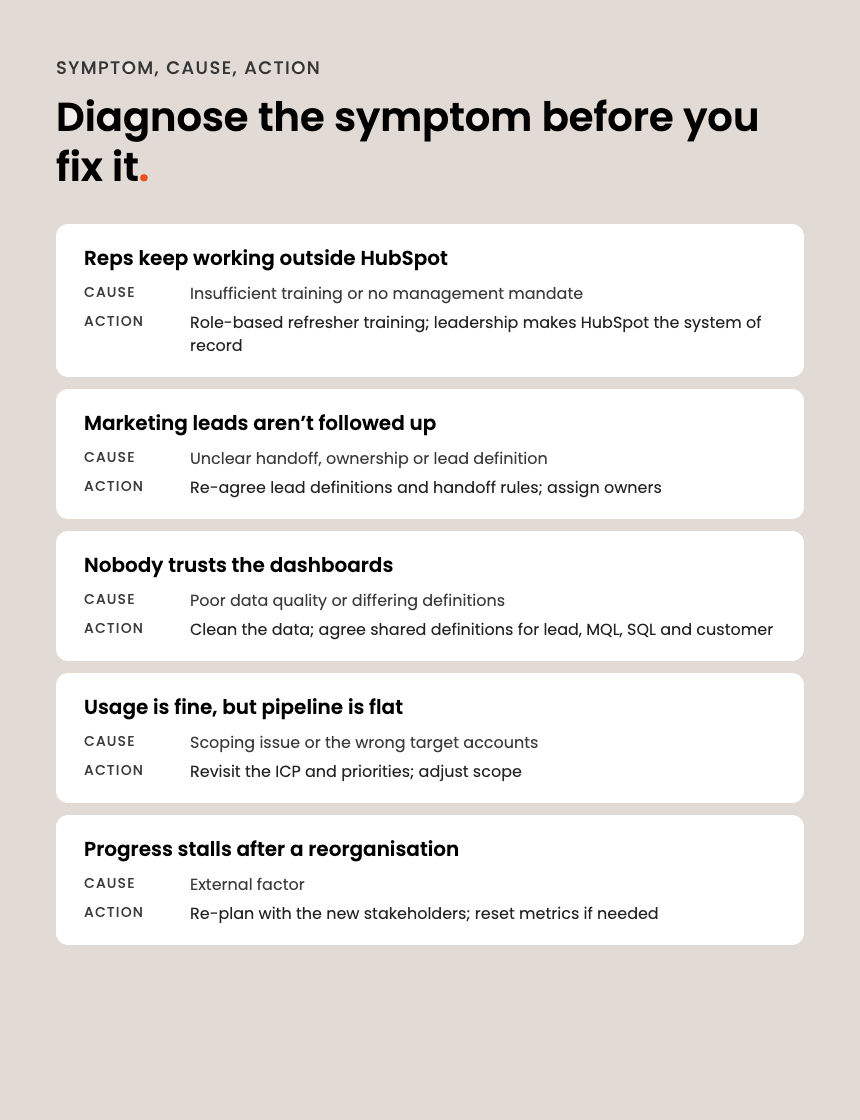
| Symptom | Likely cause | Corrective action |
|---|---|---|
| Sales reps keep working outside HubSpot | Insufficient training or no management mandate | Role-based refresher training; leadership makes HubSpot the system of record and measures on it |
| Marketing leads aren't followed up | Unclear handoff, ownership or lead definition | Re-agree lead definitions and handoff rules; assign owners and follow-up times |
| Dashboards exist but nobody trusts them | Poor data quality or definitions that differ between teams | Data clean-up; shared definitions for lead, MQL, SQL and customer |
| Usage is fine but pipeline is flat | Scoping issue or targeting the wrong accounts | Revisit ICP and priorities; adjust scope |
| Progress stalls after a reorganisation | External factor | Re-plan with the new stakeholders; reset metrics if the business case changed |
When should a project be changed, reduced or stopped?
When the evidence undermines the original business case, the honest move is to change, reduce or stop the work. My colleague Anders, founder and CEO at Zooma, is explicit about this: if circumstances or evidence undermine the business case, we discuss changing, reducing or stopping the work.
This is Zooma's position, and it's one a typical agency rarely states out loud: continuing a project that no longer makes business sense is worse for both parties than stopping it. A partner whose revenue depends on the project continuing has an incentive to keep going. That's why you should ask how they handle this before you sign.
Edge cases and exceptions
- If no outcome metrics were agreed at kickoff, none of this works yet. Your first step is to agree them now and set a baseline, then wait for the next checkpoint.
- If your sales cycle is longer than 12 months, commercial results won't come immediately. Judge the project on operational metrics and leading indicators.
- If the project is purely technical (for example a CRM migration with no process change), "results" means data integrity and system stability, not revenue.
- If the cause is on your side, such as no internal owner or no management backing, a partner can flag it and support you, but cannot fix it alone.
Actionable takeaways
- Before signing, agree two to five outcome metrics, a baseline and checkpoint dates in writing. This is the single highest-impact step and costs one meeting.
- At each checkpoint, check the operational clock first: adoption, data quality, follow-up speed. If those move, commercial results usually follow.
- When a gap appears, insist on a diagnosis before any new work is added. More features rarely fix an adoption problem.
- Make sure leadership visibly backs the new way of working. Without it, teams fall back to old habits.
- Ask your partner, in writing, how they handle a project that needs to be reduced or stopped.
Dare to ask your partner before signing:
- "Which metrics will we review, and how often?"
- "What happened the last time one of your projects fell behind?"
- "Who decides if we change scope, and how is that priced?"
- "Under what conditions would you recommend stopping?"
The method isn't magic. Checkpoints only work if both sides show up to them and are willing to act on what they see.