Your B2B website is talking too much about itself if most of its copy describes your company without connecting it to the visitor's problem, goal or decision. Two quick exercises show you where: the we test checks individual statements, and the mirror test checks whether a whole page helps visitors recognise their own needs.A customer-centric B2B website starts with the visitor's problem, goal or decision, then connects that need to relevant expertise and evidence. The aim is not to stop talking about your company. It is to make what you say about your company useful to the people you want to reach.
Why do B2B websites focus so much on themselves?
Most B2B websites are written from the inside out. Companies know their own capabilities well and assume visitors will translate those strengths into benefits for themselves, which visitors rarely do.
B2B buyers often research potential suppliers before contacting sales. They explore websites, compare alternatives, read third-party content, ask for recommendations and use AI assistants such as ChatGPT to find information. Your website therefore needs to do more than describe your products, services and capabilities. It needs to help visitors understand whether you can address their particular challenges.
Yet many B2B websites still read like company brochures. Consider these common statements:
- We deliver innovative solutions.
- We have more than 30 years of experience.
- Our people are our greatest asset.
- Our products meet the highest standards.
- We continually strive to improve.
These statements may contain useful information, but without context they leave one question unanswered: what does this mean for me as a potential customer?
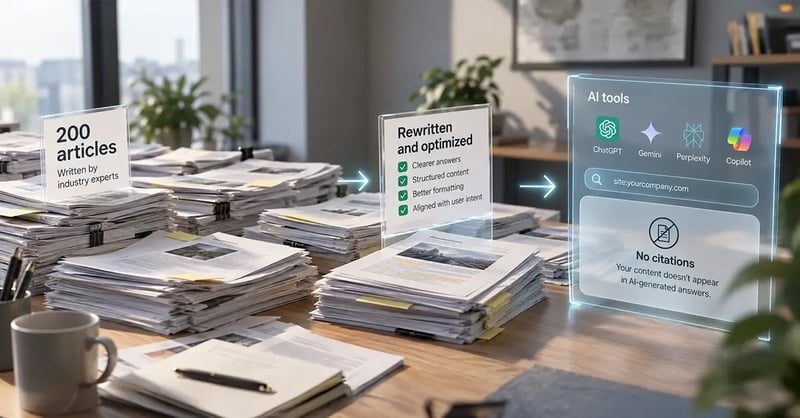
The same problem affects AI search. An AI assistant answering a buyer's question needs specific, standalone statements it can quote. "We deliver innovative solutions" gives it nothing to work with, so generic company-centric copy is less likely to appear in AI-generated answers.
What makes B2B website copy customer-centric?
Customer-centric B2B website copy connects a company's expertise, products and services to the challenges, goals and decisions of its potential customers. It keeps the company information, but explains why that information matters.
| Company-centric approach | Customer-centric approach |
|---|---|
| Describes a capability | Connects the capability to a customer problem |
| Lists product features | Explains the practical consequences of those features |
| Highlights company experience | Shows how experience helps reduce customer risk |
| Makes broad claims about quality | Provides evidence that buyers can evaluate |
For example, a logistics provider might write:
- Company-centric: "We provide innovative solutions for complex logistics challenges."
- Customer-centric: "When delays, bottlenecks or rising costs disrupt your logistics operation, the impact is felt throughout the business. We help you remove those obstacles and keep goods moving."
The second version connects the supplier's capabilities to a situation the customer may recognise.
Test 1: How does the we test work?
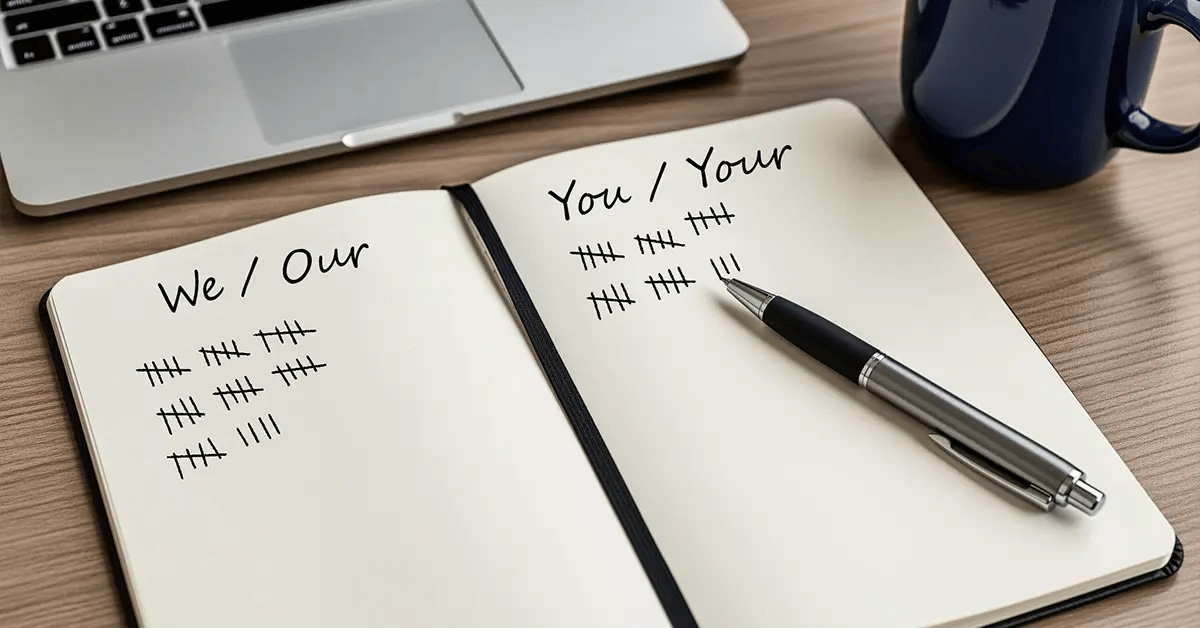
The we test shows whether your copy leaves visitors to work out why your company is relevant to them. You count company-focused and visitor-focused words, then read the statements around them to see whether each one explains why it matters to the visitor.
I run this test on almost every B2B website I review. The pattern I see most often is that companies assume visitors will translate their strengths into benefits. The opening paragraphs explain who the company is, how long it has existed and what it offers, and leave visitors to ask: "Is this relevant to my situation?"
For example, "We have 30 years of experience" may be useful. But what does that experience help the customer evaluate? Does it mean the supplier understands their requirements, can handle a difficult integration or has solved a similar problem before? The copy needs to make that connection and support it with evidence.
Counting "we" and "our" helps me spot the pattern, but the real question is whether the page makes visitors do all the work of establishing relevance. Simply replacing "we" with "you" does not solve that.
How to run the we test
Choose an important page, such as your homepage, a service page or a product page. Then follow five steps:
- Find the company-focused language by searching for "we", "our" and "us".
- Find the visitor-focused language by searching for "you" and "your".
- Read the statements in context, looking beyond how often each word appears.
- Identify what is missing: which statements describe your company without explaining why they matter to the visitor?
- Decide what to keep, rewrite or remove.
The word count is only a diagnostic. It is not a customer-centricity score.
Test 2: How does the mirror test work?
The mirror test checks whether a whole page reflects your company's view of itself or helps visitors recognise their own needs and priorities. Where the we test looks at individual statements, the mirror test looks at the page as a whole.
Many "About us" pages work like mirrors. They describe how organisations see themselves: their values, achievements, people, ambitions and capabilities. This information can be useful, but buyers are also looking for answers to questions such as:
- Can you solve my problem?
- Do you understand my situation?
- Have you addressed similar challenges before?
- Can you help reduce my risk?
- Can you help me achieve my goals?
If visitors cannot find those answers, the page may be telling the company's story without establishing its relevance.
How to run the mirror test
Choose a page and read it from the perspective of the person you want to reach. Then ask three questions.
1. Can visitors recognise their challenge? Does the page describe a problem, priority or situation your intended audience is likely to recognise? A manufacturing company looking for automation support may be concerned about production capacity, reliability, integration with existing systems or operational risk. Does the page address those concerns, or does it mainly describe the supplier's technology?
2. Can visitors understand how you help? Is the connection between the customer's challenge and your offering clear? Visitors should not have to interpret a long list of capabilities to understand what you can help them achieve.
3. Can visitors find evidence? Does the page support its claims with relevant examples, customer cases, technical information or other evidence? Understanding the customer's challenge matters, and so does showing that you can address it.
If a page answers all three questions, it is more likely to help visitors evaluate your company. If it does not, identify what is missing and whether the page's emphasis needs to change.
Which test should you use?
Use the we test to find weak statements quickly, and the mirror test to judge whether a page works as a whole. Most important pages benefit from both, in that order.
| We test | Mirror test | |
|---|---|---|
| What it checks | Whether individual statements explain why they matter to the visitor | Whether the whole page helps visitors recognise their challenge, see how you help and find evidence |
| Level | Sentence and paragraph | Whole page |
| Best for | Homepages, service pages and product pages with a lot of capability copy | About us pages, service pages and landing pages |
| Typical outcome | A list of statements to keep, rewrite or remove | A decision about what the page is missing or should emphasise |
| Watch out for | Treating the word count as a score | Assessing the page from your own perspective instead of the buyer's |
Before and after: turning company expertise into customer relevance
Customer-centric rewriting keeps the facts and adds the connection to the customer. Here is an illustrative example from an industrial automation supplier.
Before: company-centric copy
"We have been designing and delivering tailored automation systems since 1982. Our experienced team of engineers ensures every project meets the highest standards. Our mission is to exceed expectations through quality and innovation."
This provides company information, but much of it is generic. It tells visitors about experience and ambition without connecting them to customer needs.
After: customer-centric copy
"Your automation requirements are specific to your operation, so we tailor the system to the project, not the other way around. Our experienced engineers design and deliver automation systems based on those requirements, backed by experience dating to 1982."
The revised version keeps the company's experience and expertise, and explains why they may matter to a customer evaluating an automation supplier. It also avoids adding claims the company may not be able to substantiate. Rewriting copy to be more customer-centric should never mean exaggerating outcomes or inventing evidence.
When should a B2B website talk about the company?
Customer-centricity does not mean every page should focus on customer challenges. Different pages serve different purposes, and some should put the company first.
| Page type | Recommended emphasis |
|---|---|
| Homepage | Customer challenges, priorities and outcomes |
| Service or product page | Customer need, relevant capability and supporting evidence |
| About us page | Company background, expertise and why they matter to customers |
| Customer cases | Challenges, approach, results and evidence |
| Careers page | Company culture, people and employee proposition |
| Investor page | Company performance, strategy and investor information |
A potential customer checking your credentials may want to know specifically about your experience, qualifications and track record. That is entirely appropriate. The same applies to technical specifications and documentation, where visitors already know their need and want precise facts rather than benefit statements.
The question is always whether the information serves the visitor's purpose. A useful "About us" page, for example, explains who you are and why your background and approach might make you a suitable partner.
Three changes you can make to your website today
You do not need to rewrite your entire website to start improving customer relevance. Choose one important page and take these three actions.
- Review the opening paragraph. Check whether it establishes something relevant to the visitor or starts with a description of your company, and connect it more clearly to the customer's situation or the reason for their visit.
- Rewrite three company-focused statements. For each one, ask why a potential customer would care, which problem, outcome or decision it relates to, and what evidence supports it. Rewrite the copy where the connection is missing.
- Check what happens next. Once visitors understand how you can help, make sure there is a clear next step, such as a relevant service, a customer case, a comparison or a way to contact your team.
The takeaway
Your experience and capabilities matter to buyers when they help visitors judge whether you can solve their problem. The trouble starts when they become the whole story.
Start with one important page. Use the we test to review individual statements and the mirror test to assess the page as a whole. Then make the changes that show visitors why you are relevant to them.
Further reading: How to become a customer-centric company
Customer-centricity goes beyond your website. It also involves how your company listens to customers, makes decisions and builds relationships. Read my article on how to become a customer-centric company for practical steps towards a more customer-focused organisation.
Does your website communicate what matters to your customers?
Clear positioning starts with understanding your customers and connecting their needs to what your company offers. See how Zooma can help you build that foundation.
Frequently asked questions
What is customer-centric website copy?
Customer-centric website copy is copy that starts with the visitor's challenges, goals and decisions. It connects a company's products, services and expertise to relevant customer needs and gives visitors information that helps them evaluate their options.
What is the we test?
The we test is a quick diagnostic for finding company-centric language on a web page. You count "we", "our", "you" and "your", then check whether the surrounding statements give the visitor useful information. The word count is a signal, not a score.
What is the mirror test?
The mirror test checks whether a web page mainly describes the company or helps visitors recognise their own challenges, priorities and decisions. It asks whether the page establishes customer relevance, explains how the company can help and provides supporting evidence.
Does using more "you" make website copy customer-centric?
No. Customer-centricity depends on how relevant and useful the information is, not on the number of pronouns. A statement beginning with "we" can be valuable when it gives evidence that helps a buyer make a decision.
Does customer-centric copy help with AI search?
How does customer-centric website copy relate to B2B positioning?
Further reading: How to become a customer-centric company
Customer-centricity goes beyond your website. It also involves how your company listens to customers, makes decisions and builds relationships.
Read my article on how to become a customer-centric company for practical steps towards a more customer-focused organisation.