Thoughts, facts, and knowledge
The B2B Enablement Hub

Is your B2B website talking too much about itself? Two simple tests.
Your B2B website is talking too much about itself if most of its copy describes your company without connecting it to the visitor's problem, goal or decision. Two quick exercises show you where: the we test checks individual statements, and the mirror test checks whether a whole page helps visitors recognise their own needs.

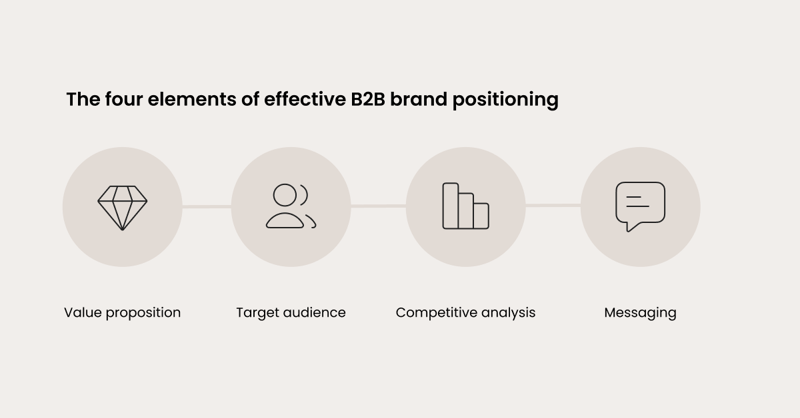
How to define B2B brand positioning that gives customers a reason to choose you
B2B brand positioning explains why a specific customer segment should choose your company over competitors or alternatives. Effective positioning combines four elements: a differentiated value proposition, a clearly defined target audience, an understanding of the competitive landscape, and consistent messaging.

Why your company's "helpful content" still doesn't get cited by AI
B2B content is harder for AI tools to reuse when key answers are buried, implicit, or poorly structured. Making those answers explicit and easy to isolate improves their extractability.

UNBOUND 2026 reflections: Why context is becoming the advantage in AI
AI capability is becoming easier for every company to access. The harder part is giving AI the context, knowledge and judgement it needs to create better outcomes. That was our biggest takeaway from UNBOUND 2026.

Your buyers are elsewhere. What should your marketing do?
Before we travelled to HubSpot's UNBOUND event in Boston, a customer asked us two questions: Is it advisable to invest in lead nurturing workflows when so much of the buying journey happens on other platforms? And while we build for AI, where, how and how much should we keep building directly for people? This article hopefully answers her and others asking the same questions.

Why “being number one” is not a B2B strategy
Being number one is not a strategy. It is an outcome. A strategy defines the capabilities, decisions, and execution required to create long-term leadership. Without those foundations, “being number one” is an ambition, not a plan.

Why ABM challenges are signals of maturity
In short, ABM challenges, scaling friction, sales misalignment, and capability gaps are usually signs that a programme is maturing, not failing. As ABM expands across more accounts, regions and teams, organisations naturally hit governance and alignment pressures that didn’t exist at a smaller scale. The organisations that treat these as renewal points, rather than red flags, are the ones that build ABM into a lasting commercial capability.
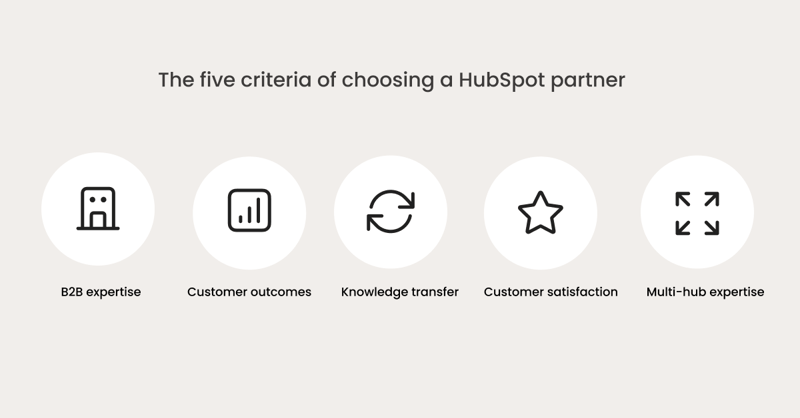
How do I choose the right HubSpot partner?
Choosing a HubSpot partner agency comes down to five criteria: sector depth, implementation track record, delivery model, strategic breadth, and cultural fit. These five criteria will help you uncover whether they understand B2B, not just HubSpot. If they can show real customer outcomes, not just certifications. If they build your capability or their dependency. If they have the knowledge to design a solution that fits your commercial strategies or to configure a default portal. If they will work as a long-term partner, not just as a project supplier. Taking a step further, NPS scores and reference calls reveal what sales conversations hide.


When AI in B2B is used for quality, not just efficiency
In B2B, AI creates the most long-term value when it improves the quality of decisions, customer experiences, insights, and communication — not only when it reduces time or cost.

How to align personal and company branding
Personal and company branding work best when they support the same market position. A personal brand builds trust through individual expertise, visibility, and relationships. A company brand creates consistency, recognition, and long-term credibility in the market.

The hidden AI risk most leadership teams ignore
When AI comes up in leadership discussions, silence is not a sign of alignment. It is often a sign of uncertainty, hesitation, or unspoken disagreement, which makes it a strategic risk.

Are you using structure to move faster or just proving you have it?
Mature B2B organisations no longer differentiate themselves by simply proving they have structure. They differentiate by how well that structure enables speed, clarity, and customer outcomes. That is what I think a small change in Zooma's logo helps illustrate.

Demand generation and revenue marketing for B2B enterprises
Demand generation and revenue marketing in a large enterprise work when marketing, operations, sales, and finance share definitions, trusted measurement, cross-functional governance, and connected systems. The biggest enterprise problem is usually not strategy creation. It is turning strategy into repeatable execution across fragmented teams, tools, and incentives.

Are sales teams often the last to embrace change?
When buyers are increasingly digitally savvy and market dynamics shift swiftly, sales teams should be at the forefront of adaptation. Yet, observations suggest that sales departments often lag in embracing change.
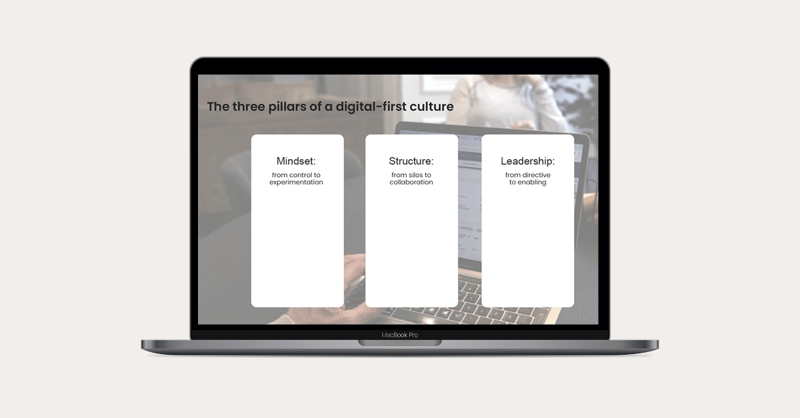
Digital transformation's biggest obstacle isn't technology - it's you!
In B2B, clinging to outdated methods is a surefire way to become obsolete. Digital transformation isn’t just a buzzword; it's the lifeline your organisation desperately needs. Yet many companies remain shackled by misconceptions, treating digitalisation as a mere IT upgrade rather than the radical overhaul it demands.