
- Learn
- The B2B Enablement Hub
- A letter to your sales department
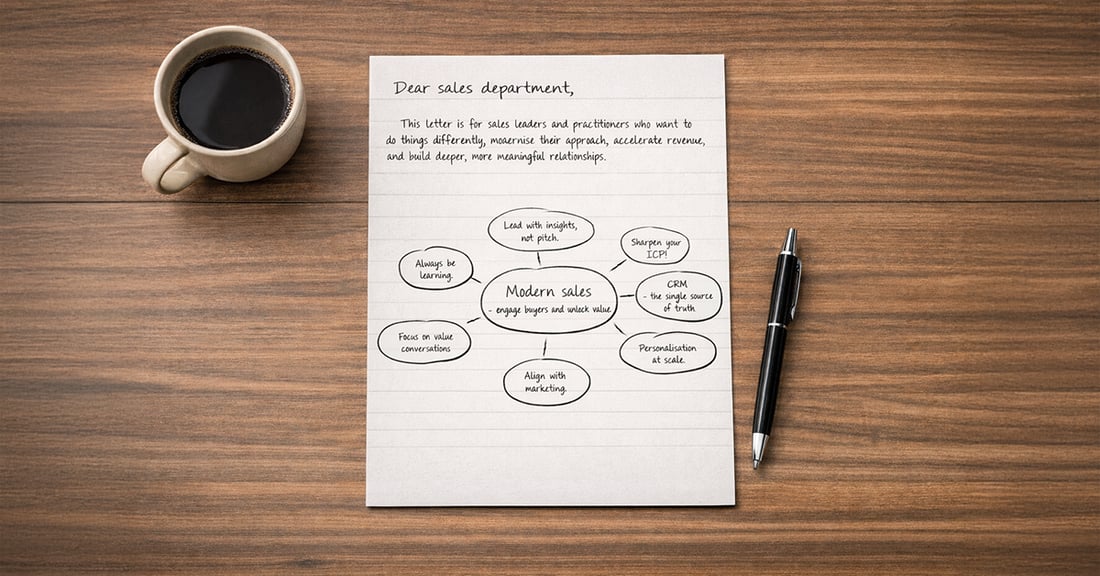
Sales today are not what they used to be. In B2B, buyers are more informed, more connected, and more empowered than ever. They research online, evaluate extensively before engaging, and expect conversations that respect their context, needs, and timing. If your sales team still relies on outdated playbooks—chasing volume over value, sending generic outreach, and relying on intuition rather than data—its competitors are already leaving it behind.
This letter is for sales leaders and practitioners who want to do things differently, modernise their approach, accelerate revenue, and build deeper, more meaningful relationships.
At Zooma, we help B2B organisations rethink how they sell in the digital era—not just how many deals they close, but how they engage buyers and unlock value.
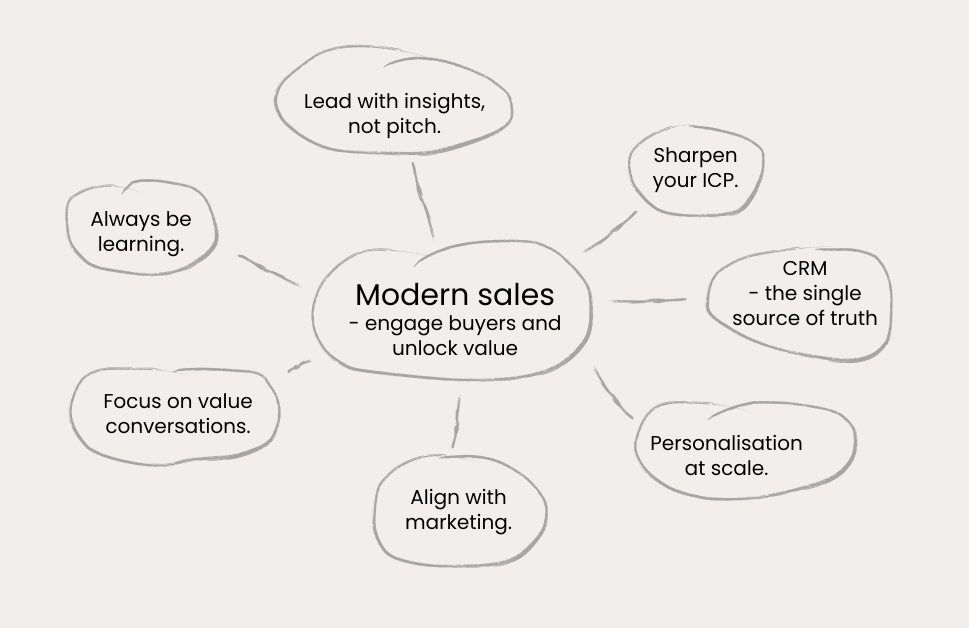
Lead with insight, not pitch.
Buyers don’t need another product demo—they need clarity and perspective. Most prospects have already seen your features, downloaded your PDF, and visited your pricing page before they speak to you. What they haven’t seen is your perspective on their challenges, industry trends, and the strategic opportunities you can help them unlock.
Insight selling begins with a conversation that reframes their thinking:
-
What hidden forces are affecting their business?
-
What assumptions are costing them time or money?
-
What opportunities are they overlooking?
When your first message educates, provokes thought, or reveals a blind spot, you position yourself as a trusted advisor — not a vendor. This shifts the dynamic from pitching to partnering and opens doors that traditional sales tactics cannot reach.
Sharpen your ICP.
Trying to sell to everyone is the fastest way to sell to no one. The loudest sales teams often spend the most time chasing poor fits.
A strong Ideal Customer Profile (ICP) does more than define target characteristics — it builds predictability into your pipeline. Define:
-
Who succeeds most with your services?
-
What measurable outcomes do they value?
-
Where do the strongest buying signals come from?
When teams understand who to prioritise and why, they can allocate effort where it matters most—improving conversion rates, shortening cycle times, and reducing wasteful activity.
Use CRM as your single source of truth.
Your CRM should be the engine of your entire revenue operation — not a graveyard for stale notes.
In modern B2B sales, CRM is a strategic platform that unifies data, informs decisions, and reveals patterns others miss.
To make your CRM truly valuable:
-
Standardise data practices across the team.
-
Capture both quantitative and behavioural signals (e.g., content engagement).
-
Use data to guide the best actions, not just to record past calls.
When CRM becomes a reliable system—not just an obligation—forecasting becomes more accurate, collaboration becomes easier, and sales performance becomes intentional rather than accidental.
Personalisation at scale.
Personalisation isn’t optional. Generic follow-ups are easily ignored; relevant, targeted messaging drives engagement.
Sophisticated sales teams use a blend of automation and intelligence:
-
Prospective research (company news, funding, and hiring trends).
-
Intent signals from marketing engagement (downloads, page visits).
-
Personalised sequences that adapt to behaviour.
The goal isn’t to flood inboxes with automated blasts. It’s to deliver the right message to the right person at the right time—consistently and contextually.
Align with marketing.
If sales and marketing talk about alignment but still operate in silos, you’re aligned in name only. Buyers don’t distinguish between your marketing content and your sales conversations — for them, it’s one continuous experience.
True alignment creates:
-
Shared definitions of a qualified lead.
-
Seamless lead handoffs with clear expectations.
-
Unified messaging that reflects buyer challenges throughout the entire journey.
Teams that work together on content, data, and goal-setting close more deals faster—and with less friction.
Focus on value conversations.
Conversations centred on features are quickly forgotten. Value conversations—those that quantify impact and link solutions to business outcomes—drive decisions.
Instead of asking:
“Do you want to learn more about our product?”
Try:
“If solving X freed up Y hours and reduced costs by Z%, what would that mean for your organisations next quarter?”
This kind of dialogue moves buyers from curiosity to commitment by making the implications of change—and inaction—clear.
Always be learning.
Top-performing sales organisations treat every interaction as a source of insight—not just a transaction.
Adopt a learning cadence that includes:
-
Analysing wins and losses helps extract patterns.
-
Updating playbooks based on real outcomes, not assumptions.
-
Investing in continuous training to enhance our modern sales skills.
A culture of learning creates sellers who quickly adapt to evolving buyer behaviours, industry shifts, and competitive pressures. When a team learn together, they improve together.
In closing.
Sales isn’t just about closing deals—it’s about creating value. In a world where buyers are more informed, discerning, and connected, the role of sales must evolve from transactional to transformational.
If your sales approach feels too familiar, predictable, or transactional, your buyers likely feel the same.
The question isn’t whether you can sell—it’s whether you can lead.
And leading starts with doing something meaningfully different.
To your sales success,
Anders
PS: Please book a meeting to dive deeper and discuss how these approaches can transform your business.

