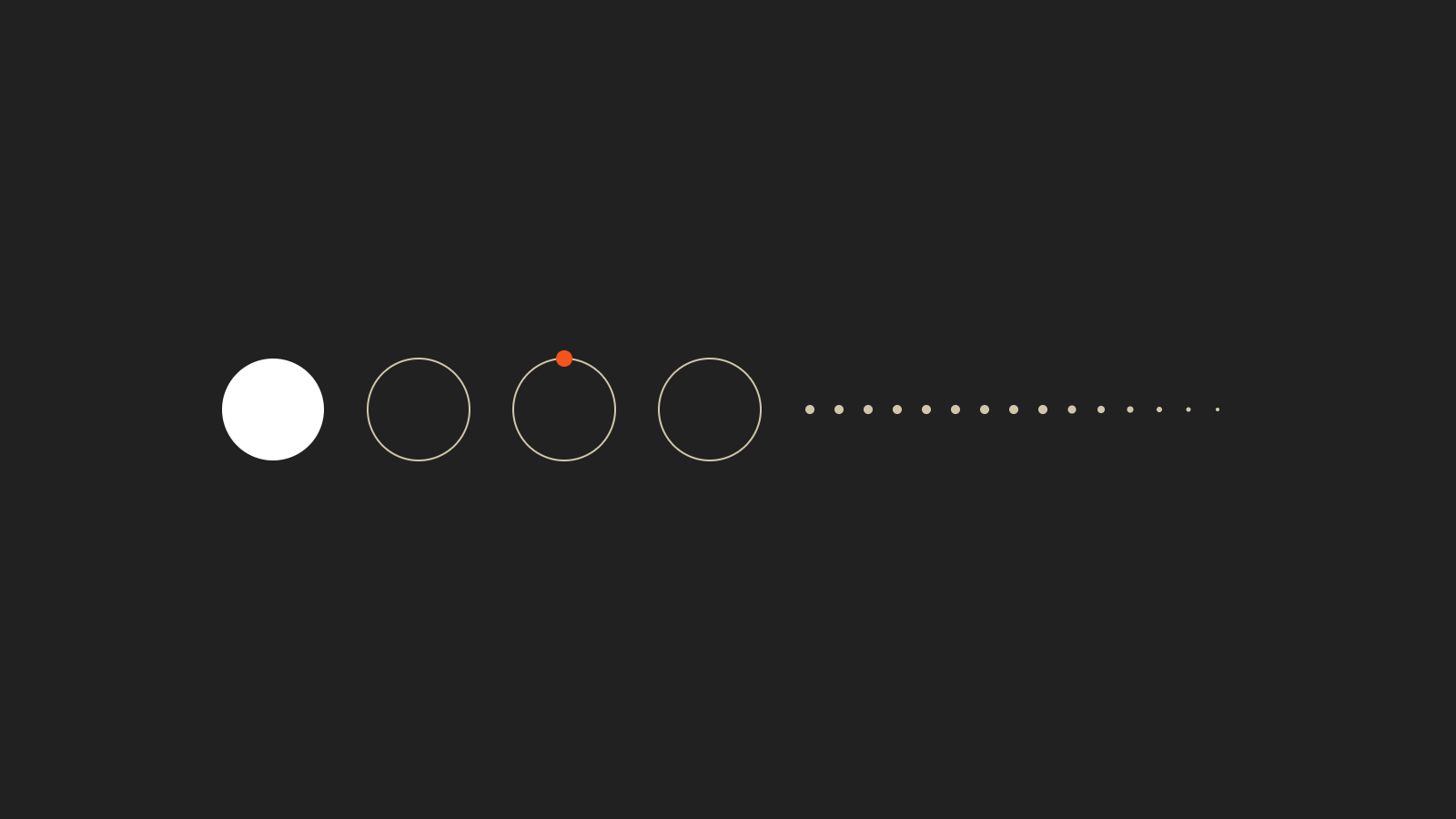
Organisational intelligence is an organisation’s ability to combine people, data, systems and AI to understand what is happening, make informed decisions, learn and adapt. It develops in five stages: Connected, Intelligent, Aware, Living and Beyond. The most useful question is not which stage you are at, but which capability limits you most right now.
I use the five stages as a diagnostic, not a ranking. An organisation can show traits of several stages at once, and later stages never replace the foundations laid earlier. Connected is the foundation. Intelligent, Aware and Living describe increasingly adaptive ways of working. Beyond is a direction rather than a place you arrive at.
Why does organisational intelligence matter more in 2026?
It matters more because AI now acts inside everyday business systems rather than beside them. Since 2024, CRM platforms such as HubSpot have built AI agents directly into marketing, sales and customer service tools. These agents answer customer enquiries, qualify leads and summarise records.
That changes the question leadership teams need to answer. When systems were separate, the main challenge was connecting them. Many B2B companies now run marketing, sales, and service on one platform, creating the challenge of deciding how the connected organisation should use its data and determining where AI should act independently versus where human decision-making is needed.
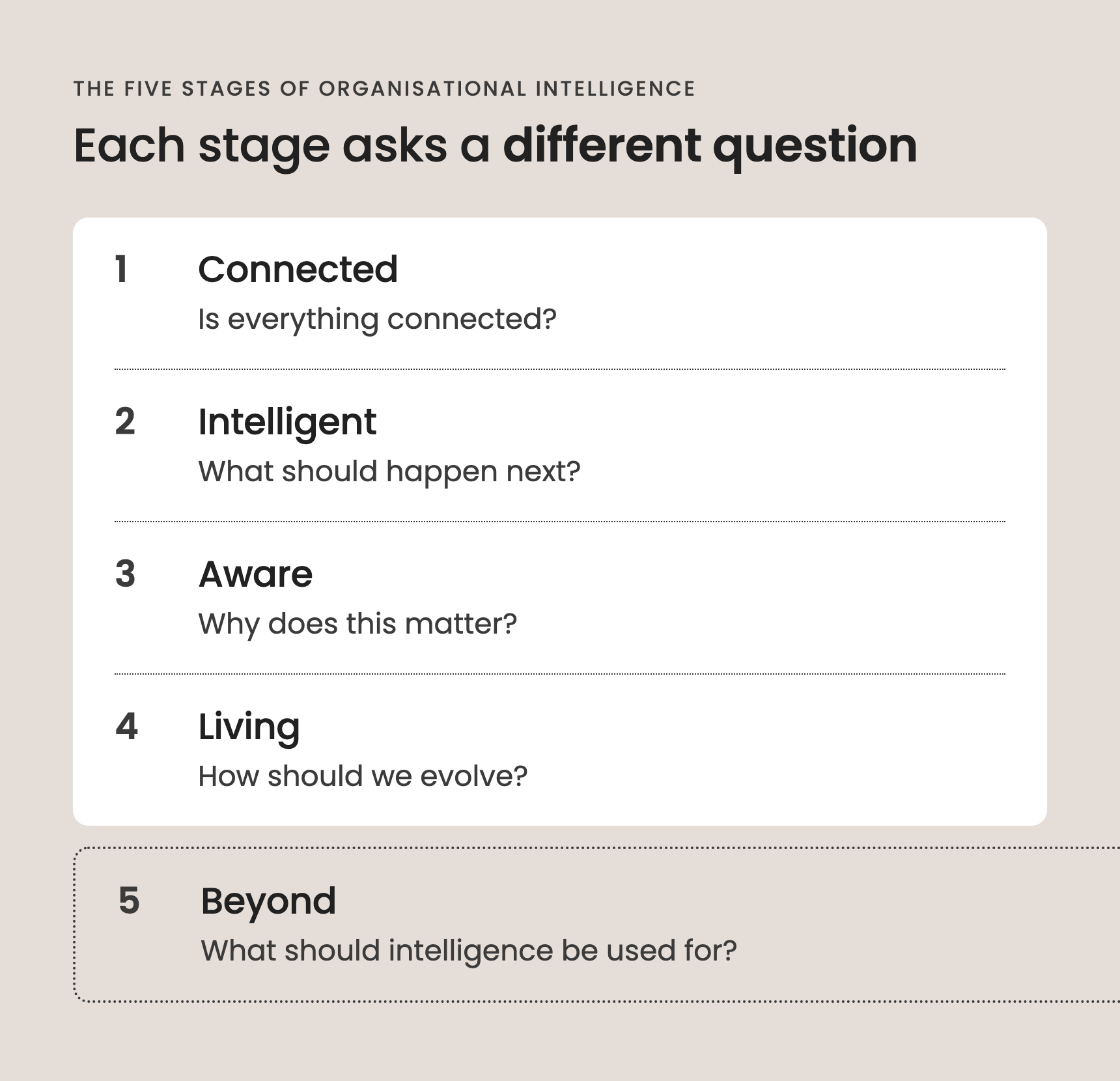
What are the five stages of organisational intelligence?
The five stages are Connected, Intelligent, Aware, Living and Beyond. Each adds a capability, changes AI’s role, and shifts what people are responsible for.
| Stage | Primary capability | Role of AI | Role of people | Main question |
|---|---|---|---|---|
| Connected | Integration | Automates routine work | Define and oversee processes | Is everything connected? |
| Intelligent | Prediction and adaptation | Identifies patterns and predicts outcomes | Interpret what predictions mean | What should happen next? |
| Aware | Contextual judgement | Provides predictions and context | Apply judgement and own consequences | Why does this matter? |
| Living | Continuous cross-functional learning | Connects knowledge across functions | Guide purpose and direction | How should we evolve? |
| Beyond | Ecosystem intelligence | Connects knowledge across organisations | Decide what shared intelligence should serve | What should intelligence be used for? |
Stage 1: Connected
You are at the Connected stage when customer data unifies, marketing, sales and service share one platform, and routine workflows automate. In a HubSpot setup, this typically means Marketing Hub, Sales Hub and Service Hub work from the same CRM records rather than separate databases.
At this stage, data replaces opinion in everyday decisions. Insights guide daily work rather than quarterly assumptions, and automation removes repetitive tasks.
The limitation is that connected data is mostly used to understand what has already happened. Connection makes an organisation more efficient. It does not make it adaptive.
Stage 2: Intelligent
You are at the intelligent stage if you use integrated data and AI to anticipate customer needs and adapt actions, rather than only running predefined processes. Marketing does not just generate leads; it predicts intent. Customer service does not just resolve issues; it anticipates them.
In practice, an intelligent organisation uses behavioural data to tailor experiences in real time and allows AI to recommend the next action.
The limitation is that prediction is not understanding. The system knows what is likely to happen, but not why it matters. When trust, consequences or competing priorities are involved, a prediction alone cannot decide the right action.
Stage 3: Aware
You are at the Aware stage if your decisions combine AI predictions with human judgement of context, trust and consequences. An Aware organisation knows when to act on an AI recommendation and when to question it.
In practice, customer interactions follow the customer's needs and circumstances rather than fixed scripts, and both people and AI agents adapt their responses to context. Decisions are judged by responsibility, relevance and impact, not only by ROI.
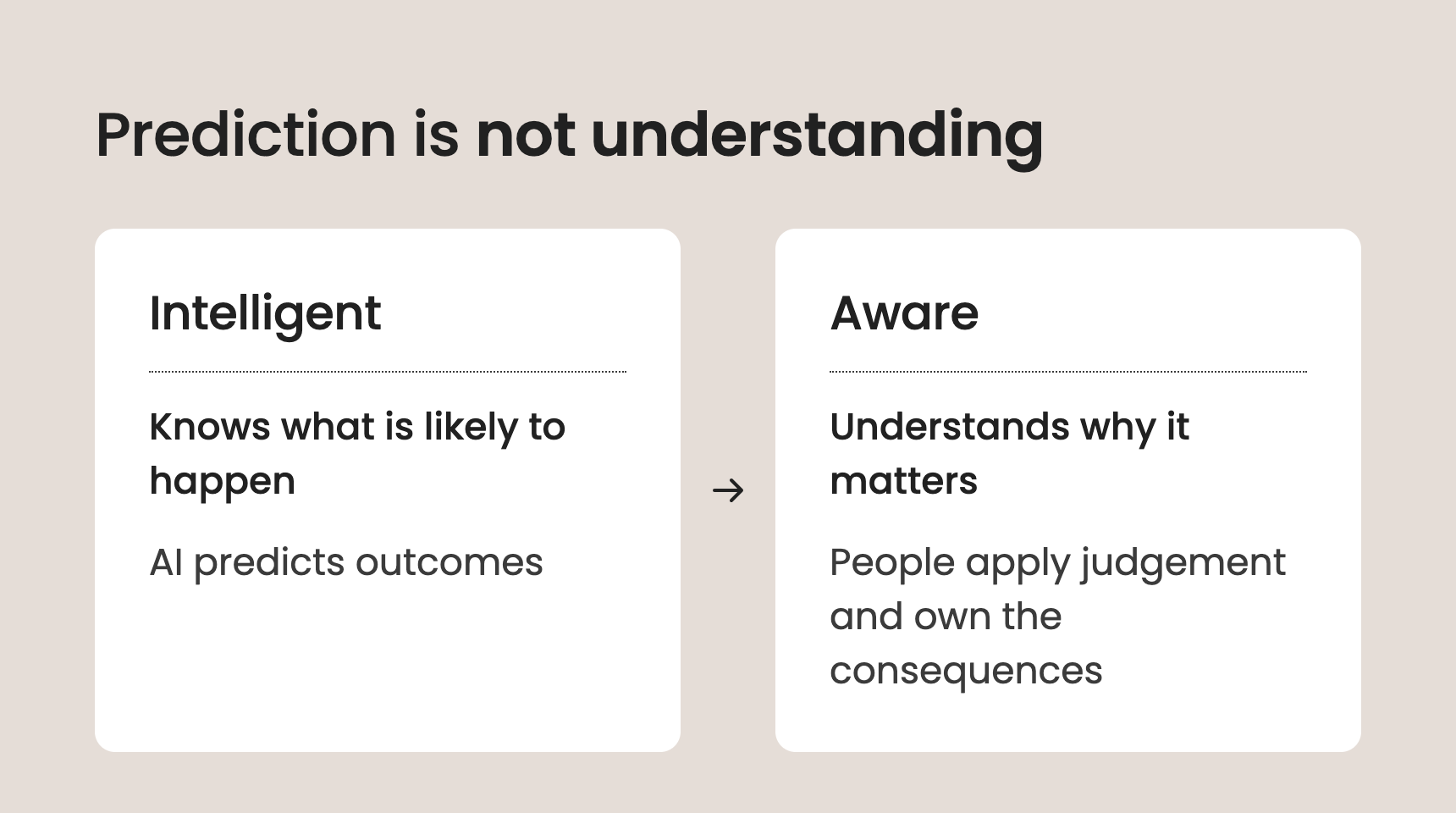
My view is that this is the stage that will separate organisations over the next few years. AI makes execution faster for everyone. The difference lies in judgement: deciding which predictions to act on and who answers for the outcome.
The limitation is that good judgement in individual decisions does not automatically spread. Awareness can stay inside one team or one process.
Stage 4: Living
You are at the Living stage if knowledge and learning flow continuously across functions, so the organisation adapts how it works, not only what it decides. AI agents and people share context across marketing, sales, service and product.
In practice, real-time customer feedback informs both product and communication development, experimentation is continuous, and failed experiments are treated as learning.
The limitation is that this learning mostly stays inside the organisation's own boundaries.
Stage 5: Beyond
Beyond is a direction in which intelligence extends across organisational boundaries, combining the knowledge of employees, customers, partners and AI. It is not a final state you can reach and then tick off.
Organisations moving towards Beyond involve customers in shaping products and services, work with partners on problems neither can solve alone, and use AI to connect knowledge across organisations. People remain responsible for judgement, purpose and consequences.
The defining difference from living is scope. A living organisation learns across its own functions. Beyond extends that learning to customers, partners and the wider ecosystem, so the question becomes what shared intelligence should serve.
Which capability should you develop next?
Develop the capability that currently limits you most, rather than automatically moving to the next stage in the sequence. Start with the symptom you recognise.
| If this describes your organisation | Focus on | A sensible first step |
|---|---|---|
| Customer data is spread across systems and teams disagree on the numbers | Connected | Agree shared definitions for core data, such as lifecycle stages, and consolidate customer records in one CRM |
| Data is integrated, but reporting only looks backwards | Intelligent | Choose one prediction that would change a decision, such as which leads sales should contact first |
| AI recommends or acts, but nobody owns when to override it | Aware | Define which decisions AI may take alone and which need a named person to review |
| Good insights stay inside the team that found them | Living | Create one regular feedback loop between functions, such as service tickets informing marketing content |
| Intelligence already flows across functions and you work closely with customers and partners | Beyond | Explore one shared initiative where customer or partner knowledge shapes what you build |
Different functions can have different answers. Marketing may already work at the intelligent stage, while finance is still connecting systems.
When is this framework inapplicable?
The framework assumes an organisation already uses digital systems, shared data and some automation. It is less useful in three situations.
- You have no shared CRM or customer data yet. Start with basic processes and data ownership. Discussing awareness or ecosystems before customer data is reliable creates ambition without foundations.
- You are a small organisation with few functions. The living stage is about learning across functions, so it matters less when one small team already shares everything informally.
- You want a score to compare yourself with competitors. The stages describe capabilities, not grades. Using them as a benchmark leads to debates about labels instead of investment decisions.
Regulated decisions are a special case. In areas such as credit, health or employment, rules on human oversight may already require Aware-stage practices, regardless of where the rest of the organisation stands.
Actionable takeaways
- Assess each function separately, because one company-wide stage hides the real constraint.
- Identify the single capability that limits you most, and focus your investment there before adding new AI features.
- If you are at the Connected stage, fix data quality and shared definitions first, because predictions built on unreliable data scale the errors.
- Before AI agents act on customer interactions, decide who reviews their output and when a person takes over.
- Pick one cross-functional feedback loop and run it for a quarter before building more.
- Revisit the assessment every six months, because the constraint moves as capabilities develop.
As William Gibson is often quoted as saying, "the future is already here, it's just not evenly distributed." The same is true inside most organisations. Reaching "there" is integration. Going beyond is evolution. The practical value of the five stages is not reaching Beyond, but knowing what to develop next.