
- Learn
- The B2B Enablement Hub
- What account-based marketing (ABM) framework should a B2B company use?
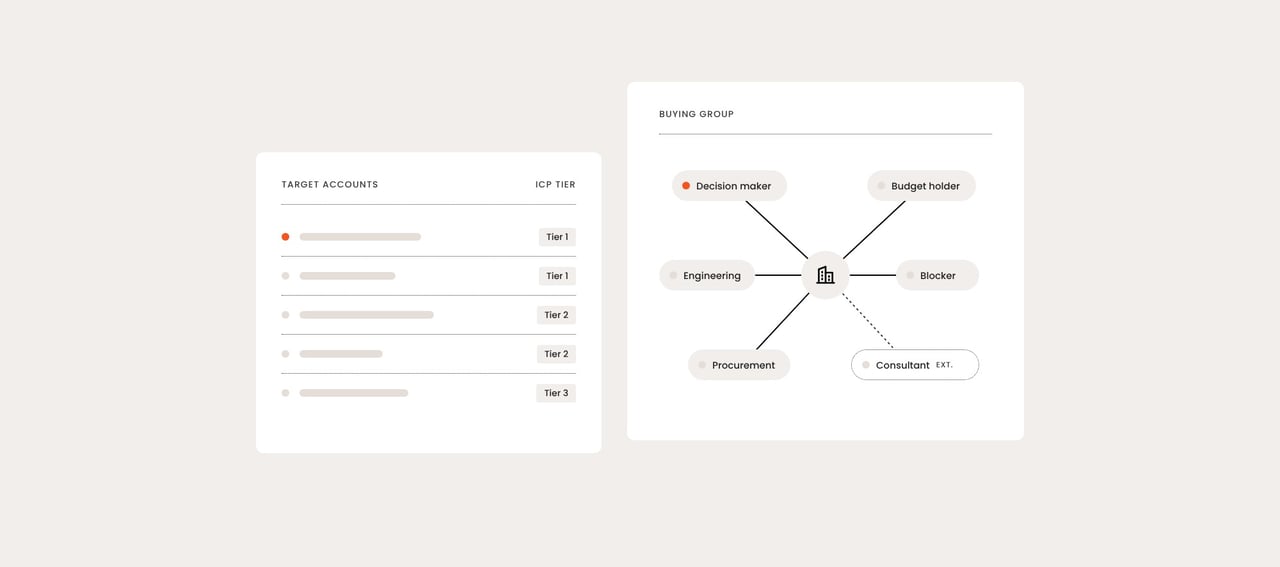
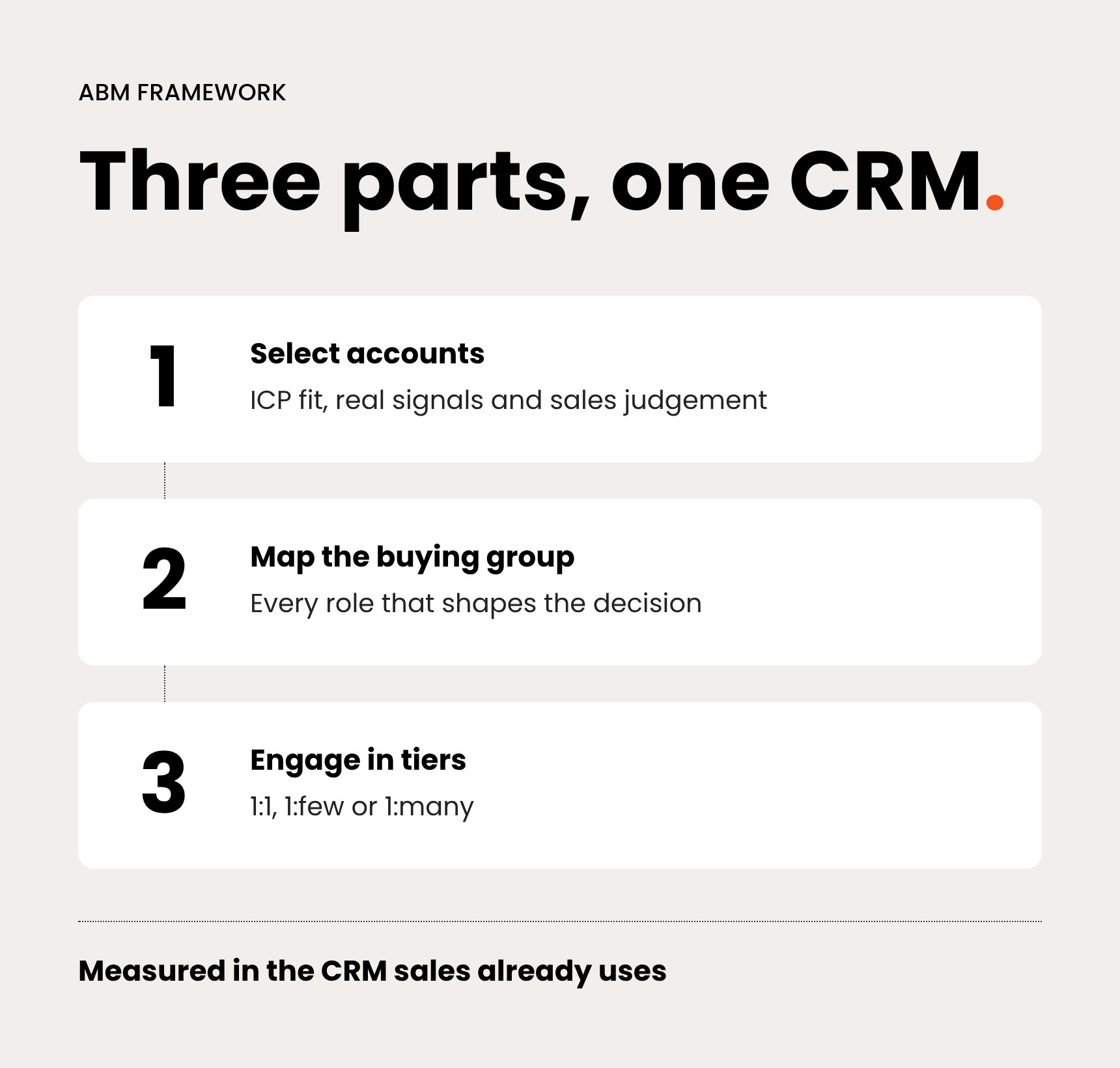
An ABM framework is not a campaign type. It is a decision system for where marketing and sales invest together. The framework we use at Zooma has three parts: select accounts on ICP fit and real signals, map the buying group in each account, then engage in 1:1, 1:few or 1:many tiers, measured in the CRM sales already uses.
This framework applies to B2B companies selling considered, high-value offerings to a definable set of organisations, typically in manufacturing, industrial tech, energy, technology or professional services. If your market is broad and your deal values are low, ABM is usually the wrong main strategy (see "Where this approach applies, and where it doesn’t").
Why do ABM frameworks need rethinking in 2026?
ABM frameworks need rethinking because the group you are trying to reach has grown, and much of it sits outside the account itself. Forrester’s Buyers’ Journey Survey 2025 found an average of 13 internal and 9 external participants per B2B purchase decision, with 73% of purchases involving three or more departments.
Three shifts follow from that:
- The unit of ABM is the buying group, not the contact. A framework that targets one decision-maker per account misses most of the people who shape the decision, including consultants, integrators and other external advisers.
- Signals are shifting from bought data to your own. 2026 industry commentary describes ABM moving away from third-party intent vendors towards first-party engagement data: what target accounts actually do on your website, in your emails and in conversations with your team.
- ABM now lives inside the CRM. Platforms like HubSpot include native ABM tools in Marketing Hub and Sales Hub (Professional and Enterprise), so account selection, tiering and reporting no longer need a separate system that sales never opens.
What does “account-based” mean in this context?
In operational terms, “account-based” means marketing and sales agree on a named list of accounts, agree on who in each account matters, and coordinate what each account experiences, all using the same data. Account-based marketing (ABM) is a B2B strategy in which marketing and sales treat selected accounts as individual markets rather than generating leads from a broad audience.
The word that matters is "agree". If sales didn’t help build a target account list, it becomes marketing’s list, and sales keeps working on its own. That is why the framework below starts with a joint decision, not a data export.
How do you choose target accounts?
Choose target accounts by combining three inputs: ICP fit, real signals of interest or need, and sales’ own knowledge of relationships and opportunities. Neither data nor sales intuition is sufficient on its own.
- ICP fit (firmographics). Start with the ideal customer profile (ICP): industry, company size, markets, buying-process complexity, and where your offering creates the most value. This step produces the long list.
- Signals. Add evidence that an account is active or ready: engagement with your content, visits from multiple people at the same company, open opportunities, service interactions, and business changes such as expansion or new leadership. Where you use intent data, treat it as one signal among several, not as the selection itself.
- Sales judgement. Review the list with sales. Which accounts have existing relationships, which have a realistic path to a first conversation, and which look promising on paper but have been tried and lost?
In HubSpot, mark the selected companies with the Target account property and assign them an Ideal customer profile tier (Tier 1 to Tier 3, with Tier 1 as the best match). Both properties then drive views, workflows and ABM reporting in the Target account home.
How do you map the buying group in each account?
Map the buying group by identifying every role that shapes the decision, not only the person who signs, and by recording what each role needs to see from you. In manufacturing and industrial tech, that typically includes engineering, operations, procurement, finance, IT and senior management, plus external advisers such as consultants or system integrators.
For each role, answer three questions:
- What does this person worry about? They worry about technical fit, risk, cost, implementation effort, or strategic direction.
- What evidence would convince them? Specifications, references, total-cost reasoning, security documentation, or an industry case study could provide the evidence that would convince them.
- Who at our company owns the relationship? Is it Marketing, a sales rep, a technical specialist, or the service team that owns the relationship?
Record roles in HubSpot using the Buying role contact property (values include Decision Maker, Budget Holder and Blocker), so the whole team can see which roles are covered and which are missing. Buying-group coverage matters because a deal with one engaged contact is far more fragile than one where several roles already trust you.
What’s the difference between 1:1, 1:few and 1:many ABM?
The difference lies in the level of personalisation and sales involvement for each account. 1:1 treats each account individually, 1:few groups small accounts with shared needs, and 1:many applies account-based principles to a broader relevant segment. Most B2B companies need a mix, not a single tier.
| 1: 1 (Strategic) | 1: few (clustered) | 1: many (programmatic) | |
|---|---|---|---|
| Who is it for? | A small number of accounts with the highest potential and an active or realistic opportunity | Groups of accounts sharing an industry, challenge or product need | A broader segment that matches your ICP but doesn’t justify individual plans |
| Personalisation | Account-specific messaging, content and offers | Cluster-specific messaging, for example, by sector or use case | Segment-level messaging, personalised by role and industry |
| Sales involvement | Named account owner, joint account plan with marketing | Shared plays per cluster, coordinated outreach | Sales engages when signals show real interest |
| Typical activities | Executive meetings, tailored proposals, bespoke content, workshops | Industry briefings, cluster-specific webinars and case studies | Targeted ads (for example, LinkedIn company audiences), nurtured by role |
| Cost per account | High | Medium | Low |
| Choose it when | Deal value and strategic importance justify the effort | Several accounts share a problem you solve well | You want account-based focus at scale without the cost of individual plans |
A practical rule: tier by potential and readiness, not by company size alone. A large account with no relationship and no signal often works better in 1:few or 1:many until it shows interest, then moves up.
How do marketing and sales coordinate at the account level?
Marketing and sales are coordinated by planning outreach per account, not per list, so each buying-group member gets a consistent, sequenced experience rather than uncoordinated messages from two teams. In practice, that means a joint account plan for 1:1 accounts, shared plays for 1:few clusters, and agreed triggers for when sales steps in on 1:many accounts.
Coordination depends on the same foundations as any marketing-sales alignment: shared definitions of what an engaged or qualified account means, one set of CRM data and a regular joint review.
As my colleague Stellan Björnesjö puts it:
"We build it in HubSpot's native ABM tools so tracking and reporting sit where sales already works."
That choice matters because an ABM programme that lives in a separate tool is invisible to the people who are expected to act on it.
How do you measure whether ABM is working?
Measure ABM at the account level, through relationships, qualified opportunities, and commercial progress, rather than lead volume. Counting MQLs from target accounts misses the point of an approach designed around fewer, better-coordinated conversations.
Useful measures, from leading to lagging:
- Buying-group coverage: how many relevant roles in each target account you know and engage.
- Account engagement: whether engagement spreads across roles and deepens over time.
- Qualified opportunities created in target accounts, compared with non-target accounts.
- Commercial progress: opportunity progression, deal size, sales cycle length and win rate in target versus non-target accounts.
- Relationship quality, including in existing customer accounts where the service team is part of the buying group.
Because sales cycles in industrial B2B often run 6–18 months, use leading indicators like coverage and engagement to guide your efforts in the first quarters. Revenue proof will follow later, so please agree on that timeline with leadership before launch.
Isn’t ABM just expensive personalisation for a few large accounts?
No. That objection describes poorly scoped 1:1 programmes, not ABM as a framework. To be fair to the counter-view, it has a point: 1:1 ABM is costly, slow to prove and deceptively simple to over-invest in, and companies that start with a dozen bespoke account plans often burn their budget before the first opportunity appears.
But the answer is not to drop ABM. It is to tier it. The 1:few and 1:many levels exist precisely so you can apply account-based focus without bespoke effort for every account. ABM also doesn’t replace inbound. Inbound content builds the credibility and the first-party signals that make account selection and outreach work, and ABM concentrates that content on the accounts that matter most.
What happens after the first ABM campaigns launch?
After launch, ABM becomes an ongoing account-management rhythm rather than a campaign with an end date. I often say that digital transformation isn't a project with a defined start and end. The same is true for ABM.
In practice, that rhythm includes:
- Re-scoring and re-tiering accounts as they engage, go quiet or change, and adding new accounts as your ICP sharpens.
- Reviewing buying-group relationships with sales and service, including which roles are still missing.
- Refining content, outreach and investment based on what is actually landing in each tier.
- Regular joint reviews with sales so the target list stays relevant and doesn’t become a historical document.
Where this applies, and where it doesn’t
This framework applies when you sell considered, high-value offerings to a definable set of organisations with multi-person buying groups. It doesn’t apply or needs adapting in these situations:
- If your market is broad and deal values are low, ABM costs more per account than the deals justify. Focus on inbound and demand generation, and at most use 1:many ABM principles.
- If sales has no capacity to work on named accounts, don’t launch 1:1 or 1:few tiers. ABM without sales follow-through produces engagement that goes nowhere.
- If your CRM data is unreliable (duplicate companies, missing industries, unlinked contacts), fix it first. Account selection and tiering are only as effective as the underlying company records.
- If you use HubSpot Starter, you won't have access to the native ABM tools. HubSpot’s ABM features require Marketing Hub or Sales Hub at the Professional or Enterprise level.
- If you operate in the EU, including the Nordics, verify the lawful basis for tracking and profiling individuals before using intent or engagement data at the contact level, and make sure cookie consent is configured correctly. Account-level signals carry less privacy risk than tracking individual people.
- If you work across several markets, keep one central target account list, tiering logic and reporting, and let local teams adapt messaging and plays per market.
Actionable takeaways
- This month (low effort): Sit down with sales and agree on the first target account list, starting from your ICP and removing accounts nobody believes in. Mark them in your CRM.
- This month (low effort): Assign every target account a tier based on potential and readiness, not size alone.
- Within a quarter (medium effort): Map buying groups for your Tier 1 accounts, record buying roles in the CRM, and identify the missing roles you need to reach.
- Within a quarter (medium effort): Build account-level dashboards for buying-group coverage, engagement and qualified opportunities, and baseline them before your first campaign.
- Ongoing (low effort, high impact): Hold a regular ABM review with sales to re-tier accounts and adjust plays. Treat the list as a living document.
- Choose 1:1 first only if you have a few high-value accounts with an active opportunity and a committed sales owner. Choose 1:few or 1:many first if you are new to ABM and want to prove the model before investing in bespoke account plans.
