
- Learn
- The B2B Enablement Hub
- How do you personalise ABM content at scale?

You personalise account-based marketing (ABM) content at scale by building modular content blocks that can be swapped based on buying role, industry, and buying stage, and then mapping them into a content matrix instead of writing unique content for every account. Save fully bespoke content for the one or two accounts where a single deal justifies the effort.
Why does personalisation at scale matter more in ABM today?
Because producing content variants is no longer the hard part. The challenge now is choosing the right message for each person.
Since generative AI tools like ChatGPT became widely used in 2023, producing ten versions of an email or landing page is cheap. This makes it tempting to personalise everything. In my experience, the result is often more content, not more relevance.
ABM targets buying groups, not single contacts. A buying group is the set of people inside a company who influence a purchase decision, for example, the CEO, the CFO, the Head of Marketing, the Sales Director and IT. Each of them asks different questions. A content matrix forces you to decide what each role actually cares about before you produce anything.
What is a content matrix, and how do you build one?
A content matrix is a table that maps your key messages and proof points to the segments you target, usually buying role, industry and buying stage. It lets your team assemble tailored assets from existing building blocks instead of starting from scratch for every account.
Most matrices use three types of building blocks:
- Opening paragraphs. Tailored to the challenges of a specific role or industry.
- Customer cases. Chosen because they match the account's industry or problem.
- Data points and examples. Swapped by company size or market.
To build one:
- List the buying personas and roles you need to reach in your target accounts.
- For each role, write down its main priority and the question it would ask you first.
- Assign one core message and one piece of proof per role and buying stage.
- Write each building block once, then reuse and combine blocks across accounts.
Here is an example of the structure.

What results can a content matrix deliver?
A content matrix expands how many people you talk to within each target account. Over one year, the team established contact with 6–15 previously unknown people at each target company. Of these new contacts, 3–9 people per company met with the team.
The matrix was built around the priorities of different buying roles. Each role received insights and examples relevant to its concerns, which we used to start conversations rather than push an offer.
| Per target account, over one year | Result |
|---|---|
| New contacts established | 6–15 |
| Of these, people who participated in meetings | 3–9 |
My position is that the best measure of personalised ABM content is not clicks, but how many relevant people inside an account you get to know. It is how many relevant people you get to know inside an account. A programme that only reaches one contact per account is fragile. One that reaches several roles gives you a real relationship with the company.
Which channels should carry ABM content?
Use the channels where your buying roles already spend time, and sequence them so each touchpoint builds on the last. A strong message that appears only once is simple to miss.
The most useful channels for ABM are the following:
- Email, both one-to-one and automated, personalised by role.
- LinkedIn, through personal messages, InMail and expert posts from your own specialists.
- Targeted display or social ads aimed at the target accounts.
- Webinars and short videos for roles that prefer watching over reading.
- Landing pages tailored by industry or buying role.
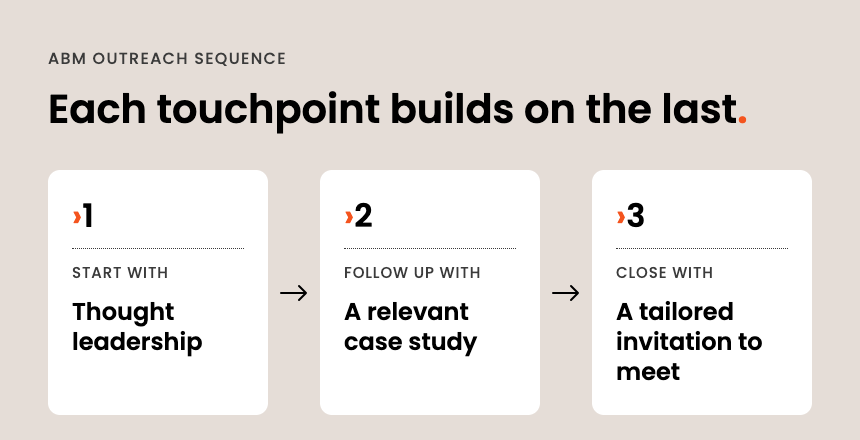
A simple sequence works well. Start with a relevant perspective, follow up with a customer case that matches the account, and close with a tailored invitation to meet.
If you use HubSpot, mark your target accounts and set the buying role on each contact. Then you can see how many people you reach in each account, not just how many emails you sent.
How do you know which ABM content is working?
Look at how many relevant people in each target account engage with you, not only at opens and clicks. Opens tell you that someone saw a message. They do not tell you whether the right people are paying attention.
Track these signals:
- New contacts per target account and which buying roles they hold.
- Repeat visits from target accounts to your website.
- Time spent on key pages, such as service pages and customer cases.
- Video watch rates for content aimed at specific roles.
- Asset downloads, such as guides and calculators.
Let behaviour guide what you produce next. If CFOs in manufacturing spend more time on ROI calculators than on ebooks, they should get more calculators. This is one reason CFOs often favour the account-based approach: it makes ROI easier to track and follow.
I also recommend heatmaps and session recordings on your most important ABM pages. They show where visitors stop reading, so you can improve the layout and copy based on what people actually do.
When doesn’t a content matrix work?
A content matrix is built for programmes that target several accounts with similar needs. It is the wrong tool in these situations:
- One-to-one ABM with a single strategic account. If one deal justifies the investment, write bespoke content for that account instead.
- You don’t know the buying roles yet. A matrix built on guesses produces confident but irrelevant content. Talk to your sales team and existing customers first.
- One or two people make every decision. If the buying group is that small, the matrix adds more structure than it saves.
- Nobody follows up. Content starts conversations, but someone in sales has to continue them. Without that, engagement data has nowhere to go.
These are not reasons to give up on ABM. As I have written before, ABM challenges are often signals of maturity.
Actionable takeaways
- Start by listing the buying roles in your target accounts and the first question each role would ask. This takes a workshop, not a project.
- Build a simple content matrix with one message and one piece of proof per role and stage before you produce any new content.
- Reuse your strongest customer cases across accounts in the same industry rather than writing new ones for each account.
- Sequence each account's touchpoints so a perspective comes first, proof second and an invitation to meet last.
- Report on new contacts and buying roles reached per target account, not only on opens and clicks.
In ABM, it is not about saying more. It is about saying the right thing to the right people in the right way.
Planning an ABM programme? Book a conversation with me about ABM.
