Sales enablement in practice is a recurring operating rhythm, not a project. Every week, someone follows up with the sales team on what is working and what isn't. Every month, content, pipeline data and lead handoffs are reviewed against what sales actually needs. Every quarter, the playbook is updated with lessons from won and lost deals. Each task has a named owner.
Why does month-to-month sales enablement matter now?
Sales enablement fails when it is treated as a launch. Most B2B companies I work with have done the big piece already: a HubSpot implementation, a new sales process, a set of sales materials. The problem shows up two or three months later, when nobody owns the follow-up.
Two things make a steady rhythm matter more in 2026. B2B buying groups involve more roles, so sales teams need content for more people at more stages. And many mid-sized B2B companies already run HubSpot Sales Hub or a similar CRM, which means the data to run enablement properly exists. What's missing is the rhythm that uses it.
Takeaway: sales enablement creates value through repetition, not through the initial setup.
What happens every week?
Weekly enablement is short, practical follow-up with the people doing the selling. It's also the part teams skip first.
- Follow up with relevant team members. Not the whole sales team in one meeting. Talk to the reps, the sales manager and the marketing contact who owns sales content.
- Ask two questions. What is working? What isn't? Document the answers where everyone can see them.
- Check open tasks. Every task needs an owner. A task with no owner is not a task, it's a wish.
- Look at the dashboard. Creating dashboards is easy. Looking at them is the hard part. (I have seen beautifully built HubSpot dashboards that nobody had opened in four months.)
Takeaway: if you only do one thing weekly, ask the sales team what isn't working and assign an owner to fixing it.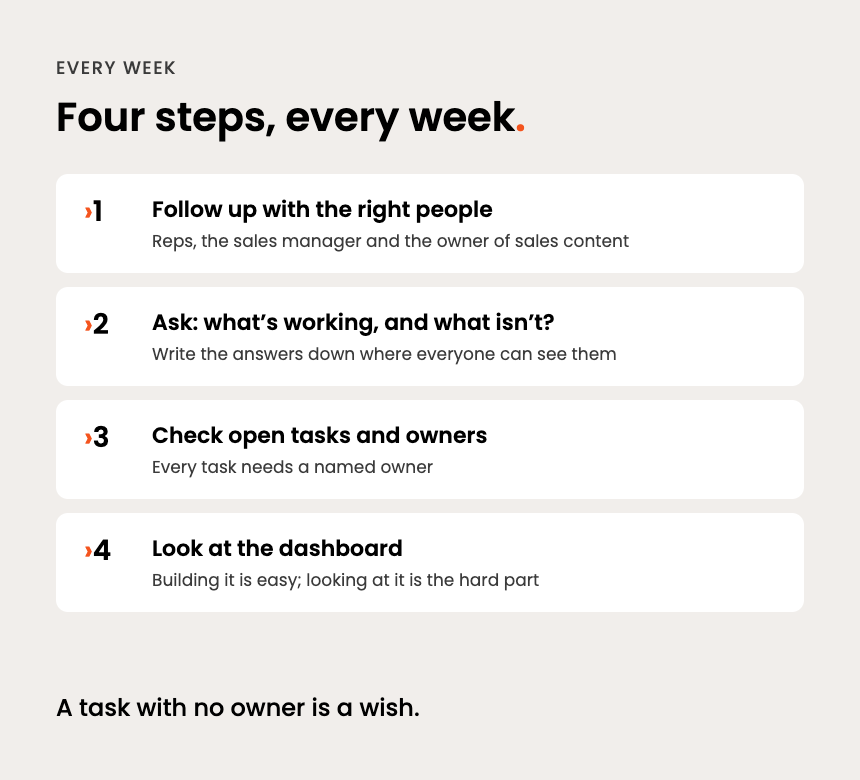
What happens every month?
Monthly enablement reviews whether marketing output, CRM data and lead handoffs still match what sales needs. This is where most of the improvement happens.
- Review the sales content. Is the content mapped to buying stages, and is sales using it? HubSpot Sales Hub shows which documents and templates reps open and send. Content nobody uses gets updated or removed.
- Check CRM and pipeline hygiene. Deals without a next step, deal stages that haven't moved, missing contact roles. Bad pipeline data makes every other report wrong.
- Review lead handoff and qualification. Do marketing and sales still agree on what a qualified lead is? Are leads followed up quickly? If definitions have drifted, fix them now, not at year-end.
- Look at stalled deals. Where do deals get stuck, and which buyer questions keep coming up? That tells marketing what content to create next.
- Share experiences across teams. Get sales, marketing and service to tell each other what they have learned. One rep's objection-handling trick is useful to everyone.
- Learn one new thing in HubSpot. A new report, a sequence, a playbook feature. Small, regular learning beats one big training day that everyone forgets.
Takeaway: the monthly review keeps marketing producing what sales uses, instead of what marketing assumes sales needs.
What happens every quarter?
Quarterly enablement is the strategic review. It looks at results, not activity.
- Review reports with sales leadership. Conversion between lead stages, sales cycle length, win rate and pipeline influenced by marketing.
- Run a win/loss review. What did won deals have in common? Why did lost deals go elsewhere? These lessons feed the playbook and content plan.
- Refine the sales playbook. Update qualification criteria, talk tracks and the content used at each stage.
- Re-check priority accounts. Are you still focusing on the right customers? If your ideal customer profile has shifted, enablement should shift with it.
Takeaway: quarterly reviews turn what happened in sales into changes in how marketing and sales work.
The operating rhythm at a glance
| Rhythm | Main activities | Typical owner |
|---|---|---|
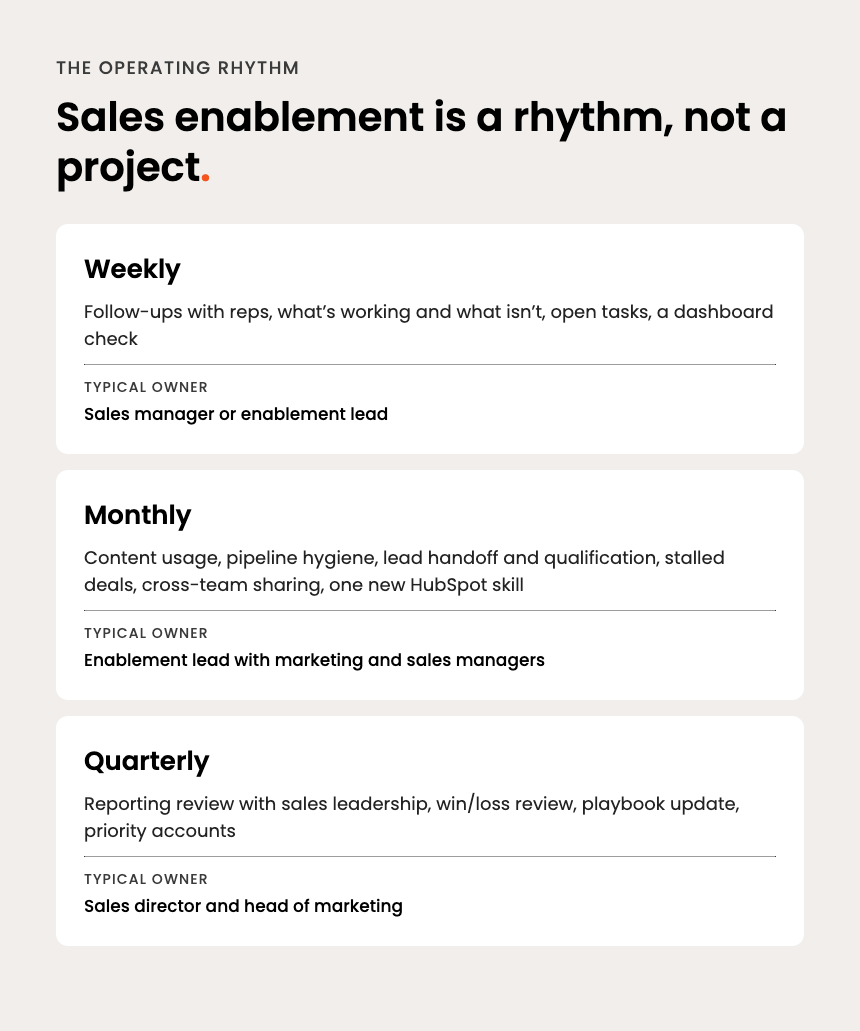
| Weekly | Follow-ups with reps, what's working/not working, open tasks, dashboard check | Sales manager or enablement lead |
| Monthly | Content usage review, pipeline hygiene, lead handoff and qualification check, stalled deals, cross-team experience sharing, one new HubSpot skill | Enablement lead with marketing and sales managers |
| Quarterly | Reporting review with sales leadership, win/loss review, playbook update, priority account review | Sales director and head of marketing |
Keep the weekly slot short and the quarterly review thorough. Larger organisations with several markets need more time, mainly for the quarterly review.
Who should own sales enablement?
One named person owns the rhythm, and every task in it has a named owner too. That can be a dedicated enablement manager, a RevOps lead or a sales manager with time set aside. It cannot be "marketing and sales together", because shared ownership usually means no ownership.
We at Zooma often run this rhythm with clients for the first months after a project. The goal is that the client's own team takes it over. If we're still running your weekly follow-ups a year later, something has gone wrong.
Takeaway: ownership decides whether the rhythm survives the first busy quarter.
When doesn't this apply?
This rhythm assumes a sales team, a CRM and some shared definitions are already in place. Adjust it if your situation is different:
- No CRM or messy CRM data. Fix the foundation first. A monthly pipeline review is pointless if deal stages don't reflect reality. Start with a HubSpot implementation or cleanup.
- Very small sales teams (one to three reps). Merge weekly and monthly into one fortnightly check-in. The activities are the same, the meetings are fewer.
- Marketing and sales don't agree on basic definitions yet. Start with alignment work (shared definitions of lead, MQL and SQL) before running enablement as a rhythm.
- Transactional or very short sales cycles. The quarterly win/loss review matters less. Focus on handoff speed and content usage instead.
Actionable takeaways
- Name one owner for the sales enablement rhythm this week. This takes ten minutes and has the biggest impact.
- Book a recurring 30-minute weekly follow-up with the sales team and ask what is working and what isn't.
- Open your HubSpot sales dashboards and check whether anyone has viewed them in the past month. If not, simplify them until someone will.
- Schedule the first monthly review and include content usage, pipeline hygiene and lead handoff.
- Put a quarterly win/loss review in the calendar with sales leadership.
None of this is magic. The rhythm only works if people show up, do their part and are honest about what isn't working. The framework makes that easier. It doesn't do it for you.