
- Learn
- The B2B Enablement Hub
- Demand generation and revenue marketing for B2B enterprises
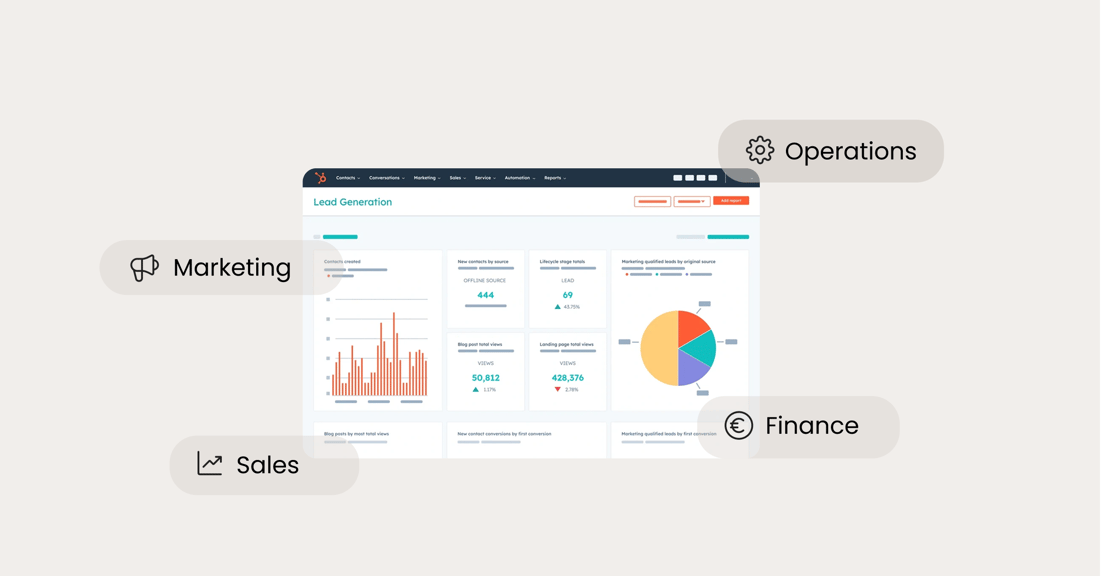
Demand generation and revenue marketing in a large enterprise work when marketing, operations, sales, and finance share definitions, trusted measurement, cross-functional governance, and connected systems. The biggest enterprise problem is usually not strategy creation. It is turning strategy into repeatable execution across fragmented teams, tools, and incentives.
For leaders who want marketing to contribute to pipeline and revenue more predictably, the first priority is not simply more campaign activity. It is building the operating model that connects campaign execution to business outcomes. In large B2B enterprises, demand generation is not just a campaign function. It is a cross-functional revenue capability.
Many organisations already have this ambition. They have growth targets, go-to-market plans, and large technology investments. What they often lack is the shared infrastructure needed to turn those ambitions into a system that teams can run consistently, measure accurately, and improve over time.
What demand generation and revenue marketing mean
Demand generation is the set of programmes, campaigns, processes, and handoffs used to create and progress demand throughout the buyer journey. Revenue marketing is the operating model that connects marketing activity to pipeline, revenue, retention, and expansion.
This article applies best to sales-led B2B enterprises with multiple teams, long buying cycles, and shared ownership across marketing, sales, finance, and operations.
This article is less relevant to very small teams or simple self-serve business models where a single team can manage most of the funnel without heavy coordination.
Why enterprise demand generation breaks down
Large enterprises rarely fail because they lack strategy. They fail because strategy is easier to approve than to operationalise.
A common enterprise pattern is a weak connection between marketing activity and business outcomes. According to WPromote research, 85% of B2B marketers struggle to connect marketing performance to business outcomes. The problem is usually not capability. It is infrastructure.
At the executive level, strategy is usually clear. Leaders can agree on target segments, value propositions, buyer motions, and revenue goals. The challenge begins when execution teams must translate those decisions into campaigns, workflows, dashboards, service-level agreements, reporting logic, and platform configuration across teams and regions.
That is where the breakdown usually happens. Teams compensate with spreadsheets, manual workflows, partially integrated systems, and local workarounds. This problem rarely stems from a lack of talent. It is usually caused by a lack of infrastructure, weak ownership, and the absence of a shared language for how demand should be created, measured, and handed over.
When this gap persists, three patterns appear:
- The strategy looks ambitious but is disconnected from day-to-day execution.
- Execution becomes reactive when teams spend time fixing process friction rather than improving performance.
- Business outcomes lag behind leadership expectations because the system supporting the strategy is too weak to sustain them.
A practical leadership takeaway is this: if execution still depends on manual handoffs and spreadsheet workarounds, improve process design and ownership before increasing campaign volume.
Why the tech stack often becomes a bottleneck
In large enterprises, the technology stack is often expensive, broad, and underused. Core platforms often remain only partially implemented, are configured differently across teams, or are disconnected from each other. The result is operational debt: the business pays for a capability it cannot fully access, then compensates with manual work.
This creates two core problems:
-
First, it creates visibility gaps. When systems are fragmented, leaders cannot reliably connect campaign activity to pipeline, revenue, and unit economics. Marketing performance is then judged through proxy metrics that do not reflect real business value.
-
Second, it creates execution risk. Manual processes slow teams down, introduce avoidable errors, and make it difficult to scale improvements. Teams spend too much time repairing workflows and too little time learning from results.
The goal is not to own more technology. The goal is to make the existing stack work as a strategic asset.
If leaders distrust marketing reporting, the next step is usually to purchase a different tool. It is better integration, stronger measurement logic, and clearer ownership of data quality.
The four capabilities leaders should build first
Most enterprise demand-generation problems can be traced to four capabilities. These are the areas leaders should strengthen first:
| Capability | What it changes | Start here if... |
|---|---|---|
| Data and measurement | Creates shared definitions, clearer attribution, and dashboards that connect marketing activity to revenue and unit economics. | Reporting is disputed, pipeline contribution is unclear, or teams use different funnel definitions. |
| Tech enablement | Reduces manual work, improves integration, and unlocks the value of existing platforms. | Teams rely on spreadsheets, duplicate tasks, or disconnected systems to execute campaigns. |
| Cross-functional governance | Creates accountability across marketing, sales, operations, and finance. | Teams have conflicting goals, broken handoffs, or no shared decision forum. |
| Outcome framing | Shifts focus from activity volume to business impact. | Marketing is still being judged mainly on lead counts or campaign activity. |
Together, these four capabilities improve enterprise demand generation by making the business easier to measure, govern, and improve.
How to decide what to fix first
The right starting point depends on the main bottleneck. If your most significant issue is:
- Low trust in reporting. Start with data and measurement. Define core funnel stages, improve attribution logic, and build dashboards that leaders will actually use.
- Slow execution. Start with process and governance. Clarify ownership, redesign handoffs, and remove unnecessary manual steps before launching more campaigns.
- Tool sprawl. Start with tech enablement. Audit unused capability, reduce redundancy, and prioritise the integrations that improve visibility and execution.
- Misaligned incentives. Start with outcome framing. Rebuild key performance indicators to focus on pipeline quality, conversion efficiency, and revenue impact.
This approach matters because enterprise demand generation rarely improves through effort alone. It improves when the organisation identifies the real constraint and fixes it first.
Demand generation succeeds between functions, not inside one function
Demand generation and revenue marketing depend on alignment across marketing, sales, operations, and finance. That is why the biggest enterprise breakthrough is rarely a new tool, another specialist hire, or an isolated initiative. The real breakthrough comes from integrating the functions that shape the pipeline into a single system.
Strong cross-functional alignment visibly changes the operating model.
- Shared key performance indicators replace siloed reporting.
- Dashboards reflect the full funnel rather than a single team’s local view.
- Investment decisions are based on revenue impact rather than vanity metrics.
- Teams use the same language for leads, opportunities, pipeline, and revenue contribution.
This alignment does not happen through organisational charts alone. It is built through governance forums, shared scorecards, agreed service-level agreements, and mutual accountability.
In most large enterprises, the people who drive the most meaningful change are not always the ones with the biggest titles. They are the ones who can build momentum across functions.
That usually requires three things:
- A shared value proposition so that each stakeholder understands how the change improves their team.
- Unified outcomes tied to revenue, efficiency, and customer growth.
- Visible metrics that are not just comprehensive, but trusted and actionable.
Change in this environment is rarely about dictating roadmaps. It is about creating sufficient clarity, evidence, and alignment for multiple teams to move in the same direction.
The cost of delay is strategic, not just operational
The financial case for resolving this issue is clear. Forrester research shows that aligned organisations achieve 2.4x higher revenue growth and 2x higher profitability than their misaligned peers.
When enterprise marketing remains trapped in execution silos, outdated processes, or disconnected systems, the consequences extend beyond marketing performance.
The risks are strategic.
- The business loses competitiveness as other organisations modernise their go-to-market models.
- The buyer experience suffers because teams cannot clearly see or manage the full journey.
- Investment becomes harder to justify because reporting does not reflect the true business impact.
- Decision-making slows down because leaders are working from partial or untrusted information.
The upside of resolving this issue is equally significant. When demand generation is treated as a strategic capability, the pipeline is easier to forecast, customer acquisition costs are easier to understand, and go-to-market decisions are more evidence-based.
A useful leadership question is not only, “What will change cost?" It is also,
"What is the cost of leaving this unresolved?"
How marketing and operations work as one revenue engine
Marketing and operations should not be treated as separate engines with separate goals. In large enterprises, there are two parts of the same revenue system.
Marketing brings audience insight, messaging, positioning, and go-to-market strategy. Operations brings process discipline, data quality, platform management, and execution consistency. Transformation happens faster when both sides design the system together rather than addressing issues sequentially.
A strong partnership usually includes four practices:
- This process includes agreeing on definitions for marketing-qualified leads (MQLs), sales-accepted leads (SALs), sales-qualified leads (SQLs), sales-qualified opportunities (SQOs), and service-level agreements (SLAs).
- Building shared dashboards so that we can review performance and data quality together.
- We co-design handoffs, escalation paths, and accountability rules.
- We should review friction points regularly rather than waiting for campaign failures or reporting disputes.
When this partnership is strong, execution is more consistent, decision-making is faster, and the organisation responds to market signals with less friction.
One of the most practical enterprise lessons is this:
The fastest gains often come from reducing friction between teams, not from launching more isolated campaigns.
Where this model applies and where it does not
This model applies best when the business is sales-led or hybrid, multiple functions influence the pipeline and revenue, and the buyer journey includes complex handoffs, long cycles, or attribution challenges. This model matters less when the team is small, one function owns most of the funnel, or the product is self-serve and operational complexity is low.
There is also a trade-off to manage. If speed is the priority, simplify governance and define only the most important metrics and handoffs first. If the priority is scale and consistency, invest more heavily in measurement, process design, and cross-functional controls.
In other words, the right operating model depends on the level of complexity the business needs to manage.
FAQ
What should a large enterprise fix first: data, process, or tech?
Start with the bottleneck creating the most friction. If reporting is untrusted, begin with data. If execution is slow, begin with the process. If systems are fragmented, begin with integration and enablement.
Who should own revenue marketing?
No single function should own it in isolation. Marketing may lead the agenda, but results depend on shared accountability with operations, sales, and finance.
How do you know alignment is weak?
Alignment is usually weak when teams use different funnel definitions, reporting is disputed, campaign execution relies on manual workarounds, or there is no shared forum for resolving revenue-related decisions.
Which metrics matter beyond lead volume?
Sales qualified opportunities, pipeline influence, conversion efficiency, revenue contribution, churn reduction, and expansion velocity are usually stronger indicators of business impact than activity counts alone.
What makes enterprise demand generation harder than demand generation in smaller companies?
Enterprise environments involve more systems, more handoffs, more stakeholders, and more competing incentives. That complexity makes shared definitions, governance, and trusted measurement much more important.
Your organisational revenue capability
Large enterprises do not usually struggle because they lack ambition. They struggle because their strategy, systems, and accountability are disconnected.
Demand generation becomes strategic when the organisation builds shared language, shared measurement, shared governance, and connected execution. When that happens, marketing becomes easier to trust, easier to measure, and more valuable to the business.
In that sense, demand generation is not just a marketing competency. It is an organisational revenue capability.
Stay ahead of the latest trends in B2B transformation. Subscribe to the B2B Enablement Hub for expert insights, frameworks, and strategies delivered directly to your inbox.

