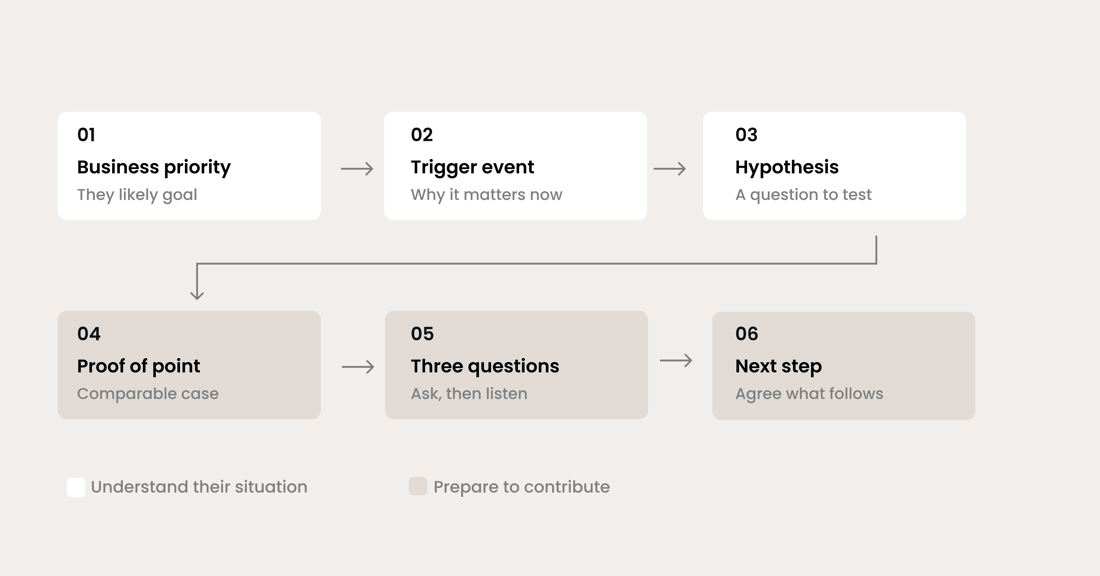
Preparing for a meeting with a B2B decision-maker means understanding their business priorities, forming a hypothesis you are ready to test, knowing why the conversation matters now and deciding what a useful next step looks like. The most important rule: spend more time on their situation than on your own presentation.
A B2B decision-maker is someone who can approve or strongly influence an important business decision, such as a CEO, CFO, CMO or Sales Director. In a 30-minute meeting, they want to know quickly whether you understand their situation and can contribute something useful. Below are the six areas to prepare, followed by a one-page checklist you can use before your next meeting.
Why does preparation matter more with senior decision-makers?
Preparation matters more because senior decision-makers give you little time and judge relevance quickly. Your preparation decides whether the meeting becomes a business conversation or a sales pitch.
Getting a meeting with someone who can influence an important decision is difficult. Decision-makers manage priorities across departments, markets and geographies, and they have heard many promises about growth and efficiency. They can usually learn the basics about your company before the meeting. What they cannot get from your website is a conversation about their own business.
What is the most common mistake when preparing for a decision-maker meeting?
The most common mistake I see is preparing what you want to say before considering what the other person needs from the meeting. People spend hours refining their presentation and choosing references, and far less time understanding the decision-maker's priorities and what would make the conversation useful to them.
A related mistake is treating research as confirmation that you already understand the problem. Good preparation gives you a hypothesis and a few thoughtful questions, while leaving you ready to change direction.
The takeaway: arrive well informed, but still curious.
1. What should you research before the meeting?
Research the decision-maker's business priorities, recent company developments and market conditions. Use what you learn to form a business hypothesis, not to prove what you already believe.
Combine company information with external market intelligence. Useful sources include:
- The company's annual report, quarterly results and investor presentations, which show what the leadership team is accountable for.
- Recent news, press releases and announcements about strategic initiatives.
- Leadership interviews, conference talks and LinkedIn posts, which show how the decision-maker describes their own priorities.
- Competitor activity and wider industry developments.
- Relevant regulatory or technology changes affecting their market.
- Your own CRM history, for example previous conversations, deals and website engagement recorded in HubSpot, so you don't ask about something your colleagues already know.
How do you turn research into a business hypothesis?
A business hypothesis is a well-founded assumption about a challenge or opportunity the decision-maker may be facing, which you are ready to test rather than assert. It gives the meeting a direction without locking you into one answer.
Here is a typical scenario. You are preparing to meet a B2B company that is expanding internationally, and your first assumption is that it needs more leads to support growth. The annual report, however, shows that profitability and the cost of expansion are the leadership team's main concerns.
That changes your opening question to: "As you expand, what is proving hardest about achieving profitable growth?" The answer might reveal that lead volume is sufficient, but sales teams spend too much time on opportunities that rarely convert. The conversation then shifts to qualification, commercial priorities and how marketing supports sales.
The point of preparation is not to prove your first assumption right. It is to ask a better question and recognise when the answer points somewhere else.
2. Which trigger events explain why the meeting matters now?
A trigger event is a change in the decision-maker's business that makes a challenge more urgent. Your hypothesis explains what the issue might be; the trigger event explains why it matters now rather than six months ago.
Look for events such as:
- An acquisition or merger.
- A change in the leadership team.
- Expansion into new markets.
- A restructuring or new operating model.
- A new product launch or move into a new segment.
- A new regulation or technology shift affecting the industry.
If you cannot find a trigger event, say so in your preparation. The timing may be less urgent than you thought, and your opening should be more exploratory as a result.
3. How do you prepare the first 90 seconds?
Start with their business, not your company presentation. The first 90 seconds should establish why the conversation is worth having.
If the decision-maker already knows enough about your company to accept the meeting, use that time for their priorities rather than your history. If they don't know you, explain briefly who you are and why you are relevant.
A useful opening does three things:
- It uses the decision-maker's language rather than your internal terminology.
- It explains why the conversation may matter now.
- It introduces your hypothesis without assuming you already know the answer.
For example: "I saw that you're expanding into several new markets. In similar situations, coordinating customer-facing teams can become more complex. How are you approaching that?" This invites the decision-maker to explain their situation, confirm your thinking or challenge it.
4. What evidence should you bring to a meeting with a B2B decision-maker?
Bring one strong, relevant proof point rather than several examples that don't connect to the conversation. Evidence should help the decision-maker judge whether your experience applies to their situation.
General claims about growth or efficiency are rarely enough. Choose evidence that matches the decision-maker on:
- Industry and business model.
- Company size and geographic presence.
- The business challenge you expect to discuss.
- The decision-maker's priorities and the outcome they want.
Useful evidence includes customer cases, quantified results, customer references, industry benchmarks and before-and-after examples. A case from an organisation with a similar challenge is usually more convincing than an impressive result from an unrelated company.
For example, if you are meeting a Head of Marketing responsible for several European markets, a relevant case would show how another international B2B organisation improved coordination or customer engagement across markets. The evidence doesn't need to promise the same results. It should show what was done, what changed and why the approach could be relevant.
5. What strategic questions should you ask a B2B decision-maker?
Prepare three questions that help you understand the decision-maker's priorities, the consequences of their challenges and what would justify action. You don't need 25 questions for a 30-minute meeting.
Choose from questions such as:
- Which business priority is taking most of your attention right now?
- What concerns you most about achieving it?
- What is preventing faster progress today?
- Which metrics matter most to the leadership team or board?
- What would need to change for you to invest time or resources in this issue?
- What would success look like?
Then listen, and use follow-up questions to explore what matters:
- To clarify: "Can you tell me more about that?"
- To understand the impact: "What effect does that have on the business?"
- To understand priority: "How important is this compared with your other priorities?"
- To understand consequences: "What happens if nothing changes?"
- To define success: "What would a better situation look like?"
The most valuable question is often a follow-up you didn't plan. A productive meeting should feel like a business conversation, not a discovery questionnaire.
6. How do you define the next step before the meeting?
Decide before the meeting what useful progress would look like afterwards. After a first meeting, the right next step is rarely a signed contract.
Realistic outcomes include:
- A follow-up conversation with a colleague or specialist.
- An introduction to other people in the buying group.
- A deeper review of a specific challenge or data set.
- Agreement to share a relevant case or analysis.
- A clear decision not to continue for now.
Having a preferred next step in mind helps you propose something concrete in the closing minutes, rather than ending with "let's stay in touch". Stay flexible: if the conversation shows that your preferred next step no longer makes sense, adapt it. A clear decision to pause is a better result than a vague promise to follow up.
Your one-page meeting preparation checklist
Before meeting a B2B decision-maker, make sure you can answer these six questions. If you can't answer most of them, you need more preparation.
| Preparation area |
What you need to know |
| Business priority and hypothesis |
What is the decision-maker probably trying to achieve, and what challenge or opportunity may be connected to it? |
| Trigger event |
Why might this matter now? |
| 90-second opening |
How will you connect what you know to a business issue worth discussing? |
| Relevant proof |
Which single piece of evidence best supports your relevance? |
| Strategic questions |
Which three questions will help you understand the decision-maker's situation? |
| Desired next step |
What would useful progress look like after the meeting? |
When should you adapt this approach?
This approach works best for consultative first or early meetings, where you need to understand business priorities before recommending anything. When the meeting has a different purpose, adjust your preparation to it.
| Meeting type |
What changes |
Focus your preparation on |
| Product demonstration |
The decision-maker has asked to see something specific |
The capabilities they want to evaluate and the outcomes they expect |
| Formal procurement process |
The agenda and criteria are set by procurement |
The agreed evaluation criteria, requirements and decision process |
| Existing customer meeting |
You already know the business |
The relationship history, previous discussions and current priorities |
| Buying committee meeting |
Several people with different priorities attend |
What each participant cares about and where their priorities differ |
| Late-stage commercial discussion |
The question is whether and how to proceed |
Decision criteria, risks, commercial terms and next steps |
The agenda changes, but the principle stays the same: connect your contribution to the decision the participants are trying to make.
What makes a meeting with a B2B decision-maker successful?
A successful meeting leaves both sides with a clearer understanding of the decision-maker's priorities and whether there is a good reason to continue. It doesn't need to end with a sales opportunity.
Sometimes the meeting leads to a deeper discussion or a defined opportunity. Sometimes it shows that the timing is wrong, the problem isn't important enough or you aren't the right partner. That is useful information too.
Actionable takeaways
- Write down your business hypothesis before you plan any slides, and phrase it as a question you can test in the meeting.
- Read the company's latest annual or quarterly report and look for one trigger event that explains why the topic matters now.
- Script your first 90 seconds around the decision-maker's business, and keep your company introduction to a sentence or two unless they ask for more.
- Choose one customer case that matches their industry, size or challenge, and leave the rest of your reference list out.
- Pick three questions from the list above and prepare the follow-ups you will use to go deeper.
- Decide on your preferred next step in advance, along with a fallback if the conversation goes in a different direction.