
- Learn
- The B2B Enablement Hub
- How do you align marketing, sales and service teams in practice?
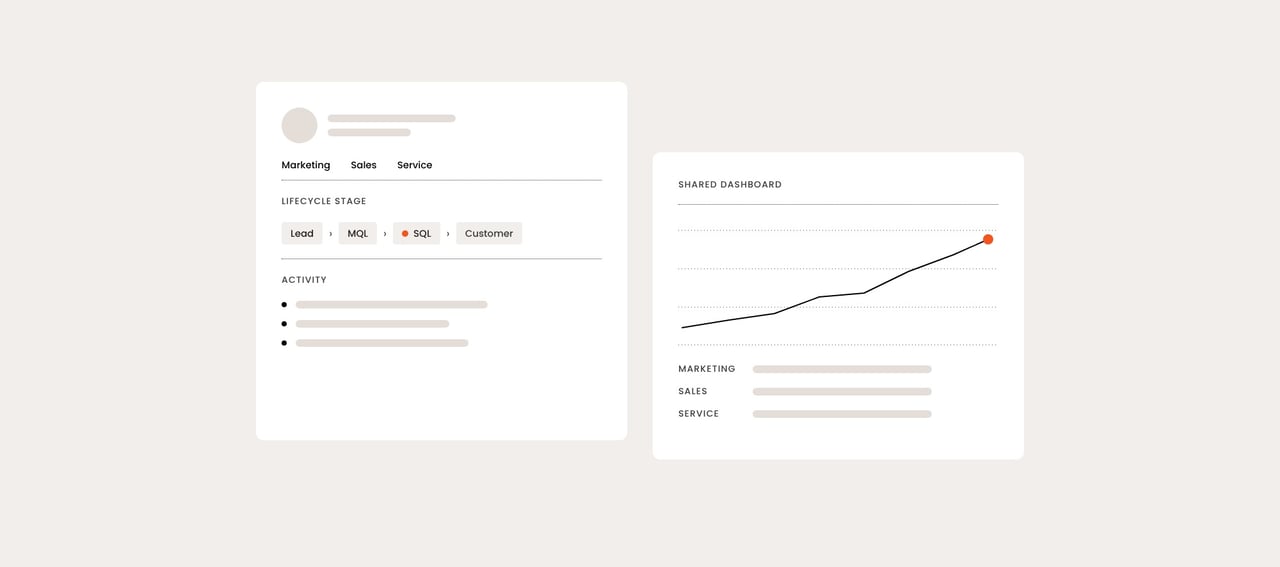
You align marketing, sales and service by building a shared operating system, not by running a workshop. In practice, that means six steps in order: a shared view of the customer, shared definitions, one set of CRM data, defined handoffs, shared dashboards and a recurring cross-functional review. The order matters because each step depends on the previous one.
This guide is for B2B companies with separate marketing, sales and service functions, typically mid-sized to large organisations with long sales cycles and several people involved in each purchase. If one person runs both marketing and sales, the principles still apply, but you can skip most of the formal handoff machinery (see “When this advice doesn't apply” below).
Why is aligning marketing, sales and service harder in 2026 than it used to be?
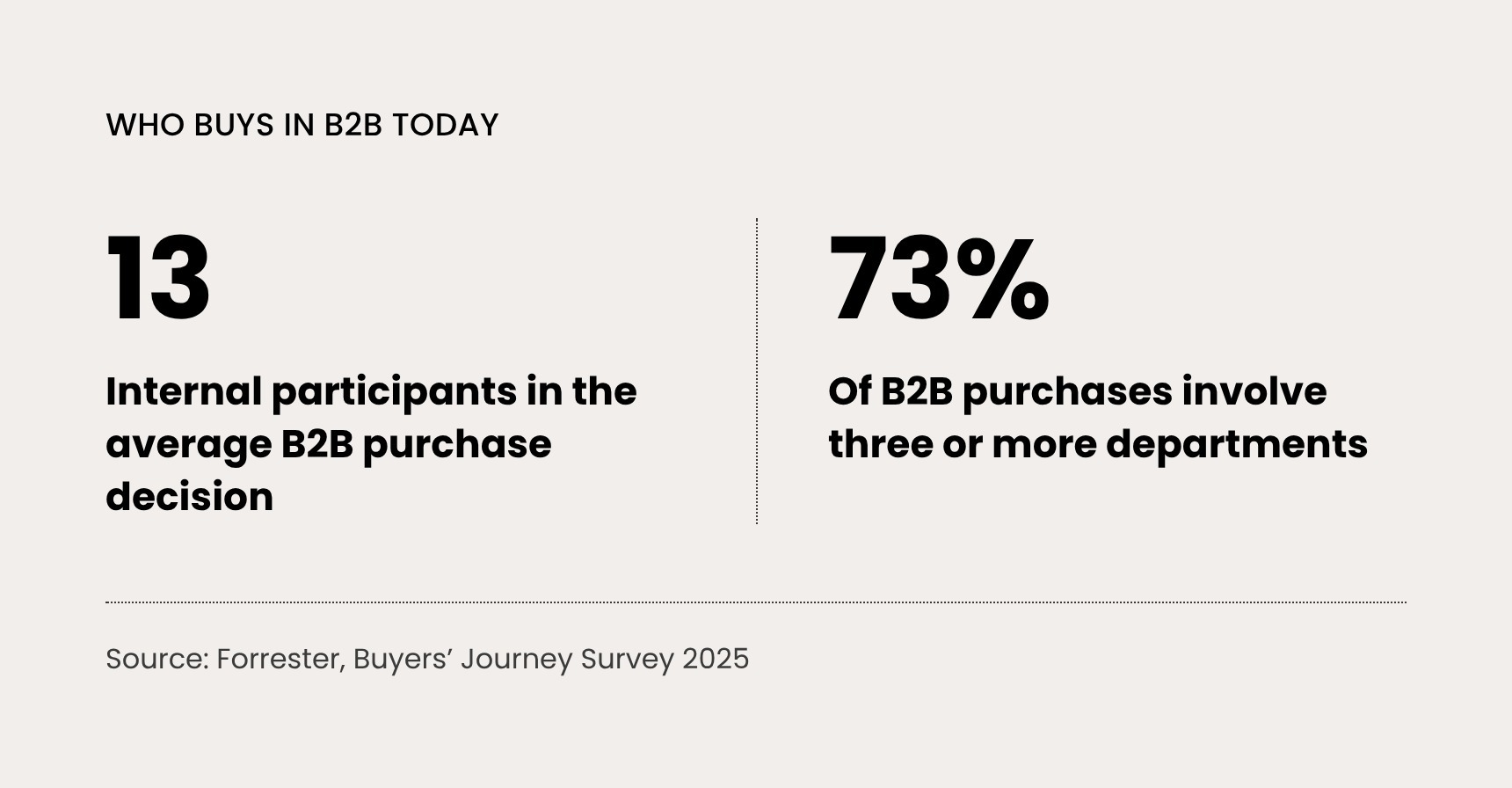
Alignment is harder in 2026 because more people touch every deal, and more of the buying happens before your teams can see it. Forrester’s Buyers’ Journey Survey 2025 found an average of 13 internal participants per B2B purchase decision, with 73% of purchases involving three or more departments.
That has three direct consequences for your own teams:
- Buyers meet all three of your functions, not just one. A procurement lead reads your content, a technical evaluator talks to sales, and an operations manager talks to your service team about onboarding. If those three conversations don't match, the buying group notices before you do.
- More research happens before contact. B2B buyers in manufacturing, industrial tech and energy research quietly and extensively, and in 2026 that increasingly includes AI search tools. Marketing therefore shapes expectations that sales and service have to live up to later.
- Alignment is becoming a formal function. Through 2025 and 2026, many B2B companies have started moving alignment out of "culture" and into a structured Revenue Operations (RevOps) model with shared data and shared KPIs. RevOps is the function that owns the processes, data, and systems connecting marketing, sales, and service around revenue.
Service belongs in this picture because retention and expansion revenue depend on what marketing and sales promised. When sales commits to something a service can’t deliver, the cost shows up months later as churn, not as a lost deal.
What does “aligned" mean in this context?
Alignment means the three teams agree on who the customer is, what each stage of the journey is called, who owns each step, which numbers define success, and work from the same data to prove it. You’ll find alignment described as a culture topic, a RevOps discipline or a technology question. After more than 15 years in online strategy, my working definition is this:
Marketing, sales and service are aligned when a customer can move from first touch to renewal without noticing where one team ends and the next begins, and when all three teams would give the same answer to "how are we doing?"
The test is simple, and I recommend running it before anything else: ask your marketing, sales and service teams separately who your priority customers are, what matters to those customers, and why they choose you. Different answers, inconsistent messages and unclear follow-up are the clearest signs that you need a shared commercial understanding and clearer responsibilities.
What are the six steps to align marketing, sales and service?
The six steps are to build a shared customer understanding, agree on shared definitions, unify CRM data, define handoffs, build shared dashboards, and run a recurring cross-functional review. At Zooma, we’re a small team, yet we follow these principles in this order because each step builds the foundation the next needs.
Step 1: Build a shared understanding of the customer
Start with a shared picture of your customers, their priorities, the buying roles involved and what they expect from you. Validate the important assumptions with real customer input (interviews, win/loss conversations, service feedback) rather than relying on what each team believes. This step matters because every later decision, from lead scoring to service onboarding, is only as good as the customer picture behind it.
Step 2: Agree on shared definitions
Agree, in writing, what a lead, a marketing qualified lead (MQL), a sales qualified lead (SQL) and a customer mean in your business. An MQL is a contact marketing has marked as ready for sales attention; an SQL is one sales has accepted as a real opportunity. In my experience, getting teams to agree on these definitions is harder than any technical work that follows, because each definition quietly decides who gets credit and who owns the follow-up. In HubSpot, these definitions become lifecycle stages and lead status values in HubSpot CRM, so everyone sees the same stage for the same contact.
Step 3: Unify your CRM data
Audit where the same data (contacts, company records, deal stages, tickets) diverges across systems, then define a single source of truth and governance rules for who edits what, how data syncs and what "clean" means. HubSpot’s shared object model, where marketing, sales and service work on the same contact, company, deal and ticket records, makes this easier, but it only works once Step 2 is done. If your CRM connects to an ERP system or to Microsoft or Google tools, decide at this stage which system owns which field.
Step 4: Define the handoffs
Define exactly when and how a customer moves between teams: from marketing to sales (e.g., MQL to SQL) and from sales to service (e.g., closed-won deal to onboarding). Some companies formalise this process with a service-level agreement (SLA), defined as a written commitment such as how fast sales follows up on an MQL and what marketing delivers in return. Handoffs deserve this attention because follow-up speed is one of the strongest predictors of conversion, and unowned handoffs are where leads go quiet.
Step 5: Build dashboards both teams actually use
Build a small set of shared dashboards, for example in HubSpot’s reporting tools, that marketing, sales and service leadership all use in their own meetings. A shared dashboard only works if it is built on the definitions from Step 2 and the data from Step 3. Otherwise, each team keeps its own spreadsheet, and the numbers never match.
Step 6: Run a recurring cross-functional review
Put a fixed, recurring review on the calendar where marketing, sales and service look at the same dashboards, agree what is and isn’t working, and adjust. This is the step most companies skip, and it's why alignment fades six months after a well-intended kickoff.
Alignment is an operating rhythm, not a one-off workshop.
Why does the order of the steps matter?
The order matters because each step enables the next, and skipping ahead creates expensive rework. Dashboards built before definitions are agreed show three different pipeline numbers. Automation built before the data foundation is clean simply moves poor data faster.
We see the same pattern repeatedly at Zooma: most struggling HubSpot instances were configured without a clear view of the buyer journey or the sales process. The result is messy data, pipelines nobody trusts and reports nobody opens. Most issues stem from the setup, not the platform. Our rule is to establish a data foundation and design processes before automation.
Where should you start? A diagnostic table
Start where your most visible symptom points, but check that the earlier steps are in place before investing further. Use this table to map what you see to the step that most likely fixes it.
| Symptom you see | Likely root cause | Start with |
|---|---|---|
| Sales doesn't follow up on marketing leads | No agreed definition of a qualified lead, no handoff owner | Step 2, then Step 4 |
| Marketing and sales disagree on what "qualified" means | Definitions were never agreed in writing | Step 2 |
| CRM and marketing data conflict | Multiple sources of truth, no data governance | Step 3 |
| Sales reps build their own prospect lists | Low trust in marketing's targeting and data | Step 1, then Step 3 |
| No one can state marketing's influence on revenue | No shared dashboard or attribution logic | Step 5 (after Steps 2–3) |
| New customers are surprised by what service delivers | Sales-to-service handoff is undefined | Step 1, then Step 4 |
| Alignment improved after a workshop, then faded | No recurring review | Step 6 |
If you recognise two or more of these symptoms, misalignment is almost certainly costing you pipeline, not just causing friction.
Three myths about marketing-sales-service alignment
The three most common myths are that alignment is a culture problem, that a new CRM will fix it, and that service can join later. Each one leads companies to invest in the wrong place.
Myth 1: “Alignment is a culture problem, so a workshop will fix it." A workshop creates goodwill, but goodwill fades without shared definitions, data and a recurring review. Culture follows structure: when teams share numbers and meet around them, collaboration improves. And finally, structure requires leadership that makes clear decisions.
Myth 2: "A new CRM will align our teams." A CRM like HubSpot is the enabler, not the solution. Implemented without agreed definitions and processes, a new platform reproduces the old disconnection in a more expensive tool.
Myth 3: “We'll bring service in once marketing and sales are sorted.” Leaving service out means the promises made in marketing and sales are never tested against what the business can deliver. Service data (tickets, onboarding feedback, renewal risk) is also some of the best input for improving marketing and sales, so include it from Step 1.
How long does alignment take, and how do you know it’s working?
In our experience, operational results such as clean data, working pipelines and usable reporting become visible within the first 4–8 weeks, while commercial results follow within one to two sales cycles. Anyone promising overnight revenue impact is overselling. With 6–18 month cycles common in manufacturing and industrial tech, commercial proof can take a year or more.
To know whether alignment is improving, baseline these measures at the start and track them over time:
- Lead follow-up speed and follow-up rate, which show whether the marketing-to-sales handoff works.
- Agreement between sales and marketing on lead quality, which shows whether the shared definitions hold.
- Marketing-sourced and marketing-influenced pipeline as a share of total pipeline, which shows commercial contribution.
- A short, recurring survey of all three teams, which captures whether collaboration feels better. The qualitative signal usually moves first, before the pipeline numbers do.
We treat alignment as a revenue metric, not a soft goal, because the cost of misalignment (unworked leads, slower follow-up, marketing optimising for volume instead of closeable deals) compounds every quarter.
When this advice doesn’t apply
This six-step approach works best for companies with distinct marketing, sales and service functions. In the following situations, adapt it:
- If one or two people handle marketing and sales, consider skipping formal SLAs and heavy governance. Keep Step 2 (definitions) and Step 3 (one CRM); they still prevent confusion as you grow.
- If leadership isn’t willing to support shared targets, address that first. Without a senior sponsor across all three functions, Steps 4–6 won’t hold, because each team will keep reporting to its own goals.
- If your real problem is capacity, not coordination, alignment work won’t help much. My guideline is to hire for capacity and bring in outside help for capability. If your teams agree on everything but simply can’t keep up, you need more people, not a new operating model.
- If you operate across several European markets, centralise definitions, the data model and reporting, and localise execution. Consent management under GDPR must follow the customer across every handoff, so build lawful-basis and consent records into Step 3 rather than retrofitting them.
- If you’re midway through a CRM migration, pause dashboard work (Step 5) until the data foundation is stable. Build on the new system, not the old one.
Actionable takeaways
- This week (low effort): Ask marketing, sales and service separately who your priority customers are and why they buy from you. Compare the answers; the gaps tell you where to start.
- Within a month (medium effort): Agree written definitions for lead, MQL, SQL and customer, signed off by the heads of all three functions, and configure them as lifecycle stages in your CRM.
- Within a quarter (medium to high effort): Audit and unify your CRM data, then define the marketing-to-sales and sales-to-service handoffs, with an SLA for follow-up speed where it's a known problem.
- Ongoing (low effort, high impact): Put a recurring cross-functional review on the calendar, built around one shared dashboard, and baseline your alignment measures before the first meeting.
- Choose the formal route (SLAs, governance, RevOps ownership) when you have separate teams, long sales cycles and multiple markets. Choose the light route (definitions, one CRM, a monthly conversation) when you are a small team where marketing and sales sit together.
