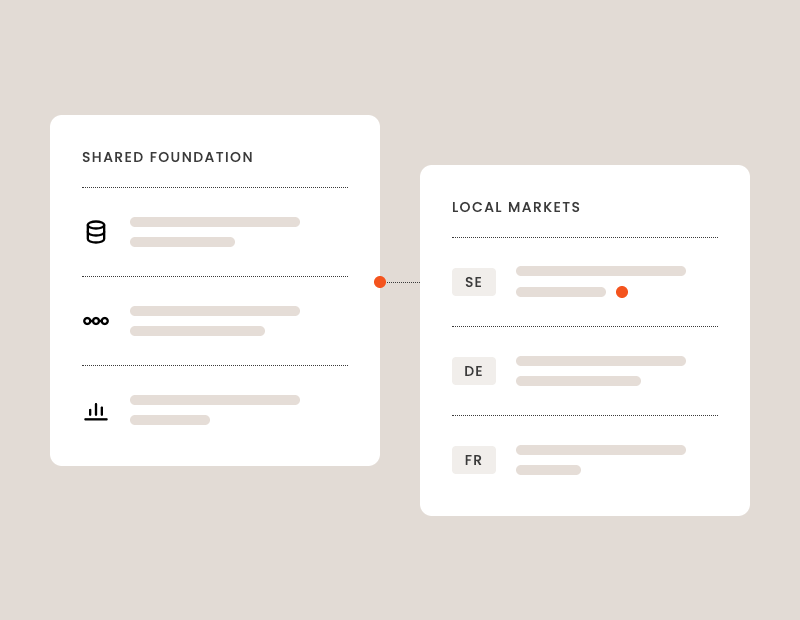
A marketing agency creates the campaigns, content and assets you ask for. A B2B enablement agency starts one step earlier: it brings marketing and sales together, finds the gaps between them, and builds the strategy, processes and content that help sales win deals. Choose a marketing agency when you know exactly what you need produced; choose an enablement agency when the problem is how your teams work together.
Why does this distinction matter now?
The difference matters because more B2B buyers now research on their own, including through AI search tools, long before they talk to sales. That puts pressure on marketing and sales to tell one consistent story across a long buying journey, not just to produce more content.
At the same time, many mid-sized B2B companies have invested in a CRM such as HubSpot and still see marketing and sales working as separate functions. When the real problem is disconnection, buying more campaigns from a marketing agency rarely fixes it. That is why "enablement" has become its own category of agency, and why it is worth knowing which one you are actually buying.
B2B enablement, in one sentence: B2B enablement is defined as aligning marketing, sales and service, and the processes, data, content and technology connecting them, so that growth becomes a repeatable system. (For the full explanation, see What is B2B enablement, and why does it matter for growth?.)
What does a marketing agency actually do?
A marketing agency delivers marketing activities and assets, usually based on a brief from the client. That typically means campaigns, content, design, brand work, paid media or SEO.
The model works like this: you define what you need, the agency produces it to a high standard, and the result is handed over — often ending at a lead passed to sales. The agency owns one function and is measured on that function's output, such as campaign reach, content volume or cost per lead.
This is not a weakness. When your strategy is clear, your sales process works and you simply need more or better execution, a strong marketing agency is often the most efficient choice.
What does a B2B enablement agency do differently?
A B2B enablement agency is accountable for the whole commercial engine, not one function. In my experience, the work starts by gathering sales and marketing in the same room to identify the gaps: which content sales is missing, where leads get lost, and what each team needs from the other. Then the strategy is built into the project itself rather than delivered as a separate document.
I describe it as a step beyond a marketing agency, with the strategy integrated into the project. In practice, that means we at Zooma are as likely to redesign your sales process or your CRM data model as we are to write a campaign brief.
An enablement agency typically works across:
- Marketing: strategy, content and lead generation built around what sales actually needs.
- Sales: sales processes, lead handoff, qualification criteria and sales content.
- Service: customer onboarding and service processes, so what marketing promises is what customers receive.
- CRM data and technology: shared definitions, data ownership and a platform such as HubSpot configured around how the business really works.
The goal is not only better output but a connected system your own team can run.
Marketing agency vs. B2B enablement agency: side-by-side comparison
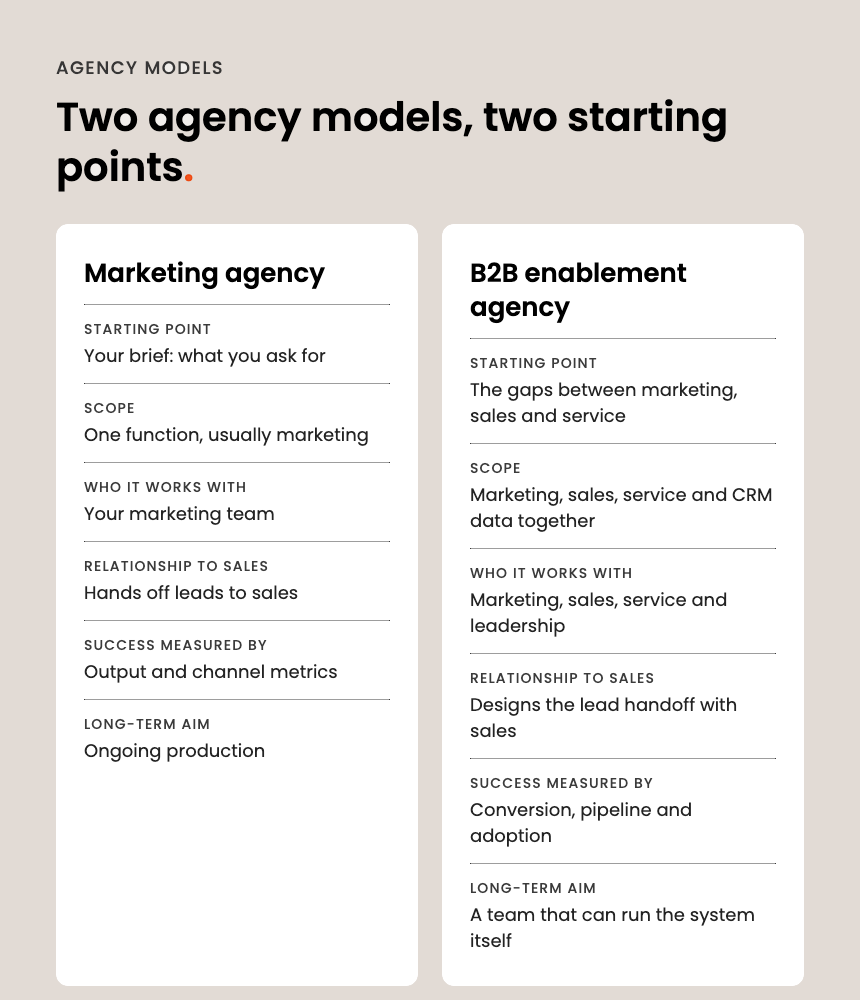
The core difference is scope of accountability: a marketing agency answers for its deliverables, while an enablement agency answers for how well marketing, sales and service work together.
| Dimension | Marketing agency | B2B enablement agency |
|---|---|---|
| Starting point | Your brief: what you ask for | The gaps between marketing, sales and service |
| Scope | One function, usually marketing | Marketing, sales, service and CRM data together |
| Typical deliverables | Campaigns, content, design, ads | Strategy, processes, sales content, CRM setup, training |
| Who it works with | Marketing team | Marketing, sales, service and leadership |
| Role of strategy | Often a separate phase or assumed | Integrated into the project from day one |
| Relationship to sales | Hands off leads to sales | Designs the lead handoff with sales |
| Success measured by | Output and channel metrics | Commercial outcomes, such as conversion, pipeline and adoption |
| Long-term aim | Ongoing production | A team that can run the system itself |
Which one should you choose?
Choose based on where your problem sits: in production capacity, or in how your teams connect.
Choose a marketing agency if:
- Your marketing strategy and positioning are already clear and agreed.
- Sales and marketing agree on what a good lead is, and leads are followed up.
- You need specific assets produced, such as a campaign, a video or a website refresh.
- You want to add production capacity, not change how teams work.
Choose a B2B enablement agency if:
- Marketing produces content that sales doesn't use, or doesn't know about.
- Sales and marketing define a qualified lead differently.
- You have invested in a CRM such as HubSpot, but teams work around it.
- Growth depends on several teams working together, for example with long sales cycles and large buying groups, as is common in manufacturing, industrial tech and energy.
- You want your own team to own the result rather than depend on an agency.
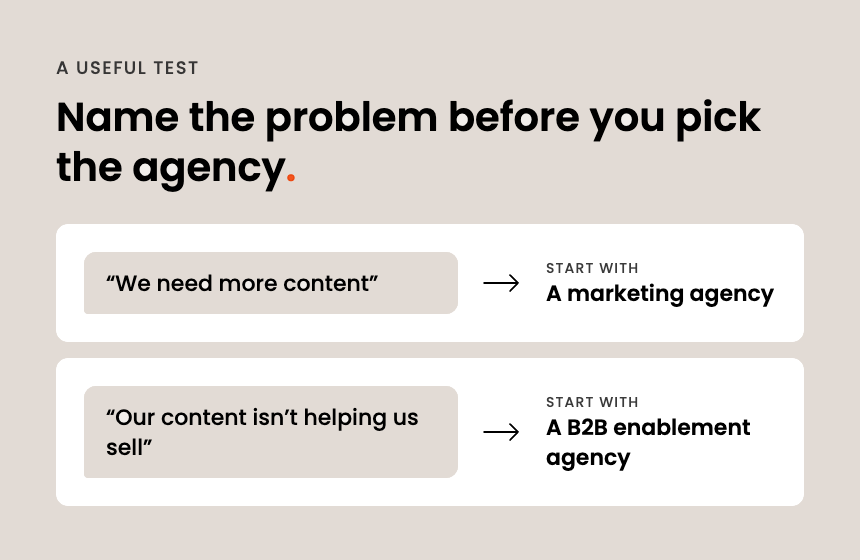
A useful test: if the honest answer to "what's wrong?" is "we need more content," start with a marketing agency. If the answer is "our content isn't helping us sell," you need enablement.
When doesn't this distinction apply?
This comparison doesn't clearly apply in every situation, and the labels can be misleading.
- Some marketing agencies do strategic work. A good marketing agency may run workshops and challenge your brief. The test is whether they take responsibility for sales and service outcomes, not whether they use the word "strategy."
- Small teams may not need enablement. If marketing and sales are two or three people who talk every day, alignment problems are usually small, and a capable marketing agency may be enough.
- Enablement is not a replacement for execution. If you already know exactly what to produce, paying for a discovery and alignment process adds cost without adding value.
- You can use both. Some companies use an enablement agency to fix the foundation and a marketing agency to scale production afterwards. That works when the two share the same definitions and goals.
Actionable takeaways
- Start by naming the problem, not the supplier. Write down whether your challenge is production capacity or connection between teams, because that decides which type of agency fits.
- Ask both teams one question. Ask marketing what input they get from sales, and ask sales which marketing content they actually use. Different answers point to an enablement need.
- Check how an agency measures success. If the proposal only promises output metrics, it is a marketing agency, whatever it calls itself.
- Ask who will be involved. An enablement agency should ask to meet sales, service and leadership, not only marketing.
- Ask what happens when the project ends. A good enablement partner will plan for your team to take over the work.