Poor marketing-sales alignment hurts revenue in three ways: qualified leads go cold before sales follows up, marketing spends budget on content and campaigns sales never uses, and leaders lose sight of which deals are actually winnable. None of these show up as one big loss. They leak quietly, every quarter, and the costs accumulate.
Why does this matter more in 2026 than it used to?
Because B2B buyers now do most of their research before they ever speak to sales, the handoff between marketing and sales has become the point where revenue is won or lost. Longer buying cycles and larger buying groups mean more touchpoints, more content and more leads passing between teams. Each extra handoff is another place where a disconnected marketing and sales organisation can drop the ball.
At the same time, most B2B companies have invested in a CRM such as HubSpot. That makes the problem more visible, not less: the data exists, but if marketing and sales use it differently, the numbers stop agreeing and nobody trusts them.
Where does the money actually leak?
Revenue leaks at five specific points, and almost every misaligned organisation has at least two of them. The table below shows what each leak looks like day to day and how it reaches the bottom line.
| Leak | What it looks like | Revenue effect |
|---|---|---|
| Unworked leads | Marketing hands over a lead; it sits in an inbox or a pipeline stage until it goes cold | Fewer opportunities from the same marketing spend |
| Slow follow-up | Sales reaches out days later, after doing its own research to fill gaps | Lower conversion, because follow-up speed is one of the strongest predictors of whether a lead converts |
| Unused content and tools | Marketing produces case studies, guides and campaigns sales doesn't know about, need or use | Marketing budget spent with no pipeline effect; reps build their own material instead |
| Wrong targets | Marketing optimises for lead volume; sales chases accounts that were never a good fit | Longer sales cycles, lower win rates, wasted sales time |
| Broken promises | Marketing and sales promise things service can't deliver | Churn, lower renewals and weaker references |
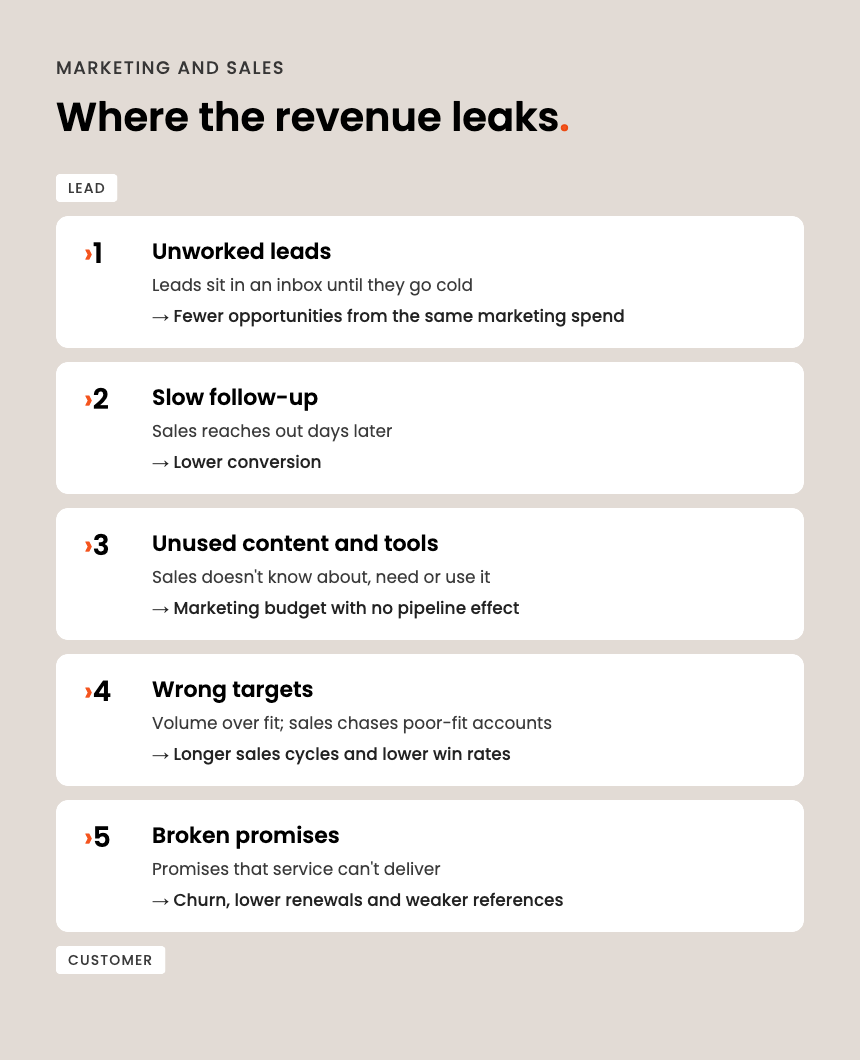
The point is that misalignment is not a "culture" problem with a vague cost. It is a set of operational failures, each with a direct line to pipeline, win rate or retention.
What happens when sales doesn't get the tools it needs?
Deals get missed. In my work with B2B teams, I see the same pattern again and again: revenue suffers when sales doesn't get, or doesn't use, the leads and content it needs to support its tasks. And it suffers just as much when marketing focuses on creating things that sales doesn't use, need or even know about.
Both sides are working hard. The problem is that the work doesn't connect. A sales rep who can't find the right case study for a manufacturing buyer improvises. A marketer who never hears which assets helped close a deal keeps producing more of the same.
Takeaway: when marketing and sales don't share what they need and what they produce, effort turns into cost instead of revenue.
Why does wasted effort cost more than it seems?
Because the cost lands twice: once in the time spent, and again in the opportunity that time could have created. My colleague Charlotte Björsjö puts it simply: "Spending time on non-relevant tasks costs money and time for everyone."
A marketer writing content that nobody uses, a sales rep rebuilding a prospect list marketing already has, a team lead reconciling two different reports before a meeting. Each of these is small on its own. Across a quarter, across a team, it adds up to a meaningful share of commercial capacity spent on work that doesn't move a single deal forward.
Takeaway: misalignment rarely shows up as a line item, but it consumes capacity that should be generating pipeline.
Why can't leadership see the problem in the numbers?
Because each team measures success differently, so win-rate and pipeline visibility disappear. When marketing reports on leads generated and sales reports on deals closed, with no shared definition of what a qualified lead is, nobody can answer the most important question: which marketing activity actually drives revenue?
That blind spot has a compounding effect. Without shared numbers, marketing keeps optimising for volume rather than for closeable deals, and sales keeps discounting marketing's leads. Every quarter the gap between activity and revenue widens, and every quarter it gets harder to fix.
We at Zooma treat alignment as a revenue metric, not a soft skill, for exactly this reason. If it can't be seen in shared numbers, it can't be managed.
Which leak should you fix first?
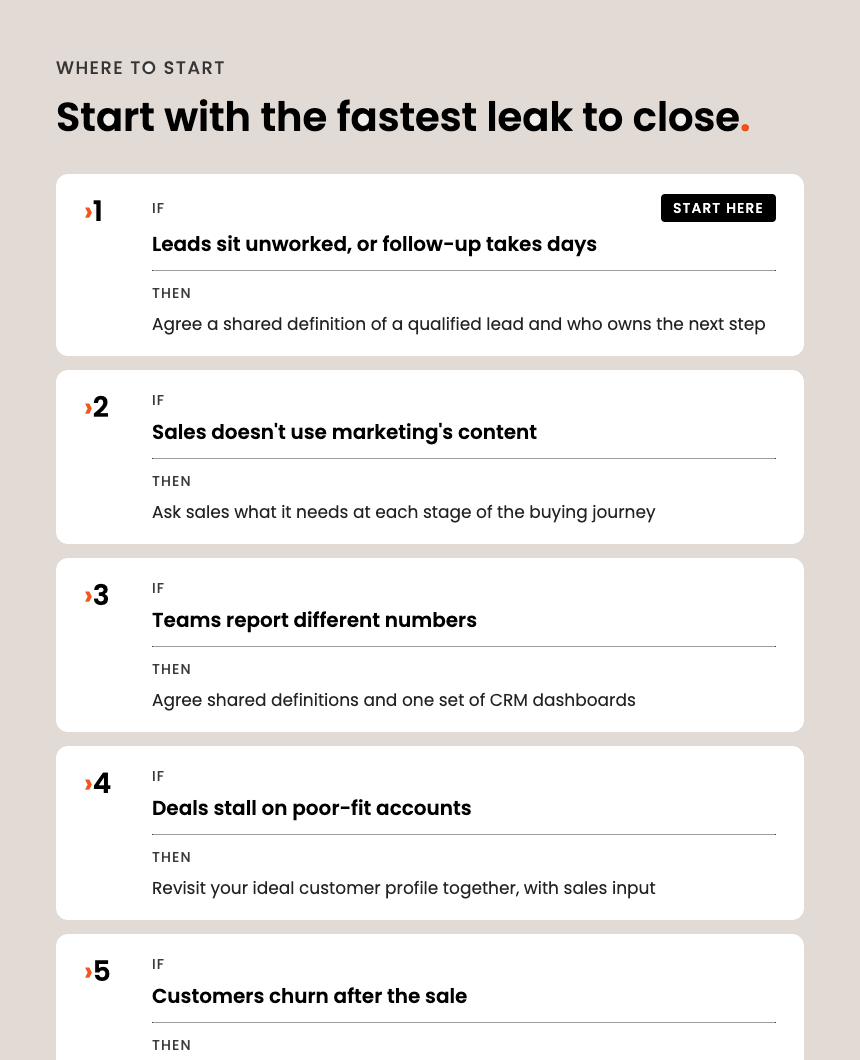
Fix lead follow-up first, because it is usually the fastest and cheapest leak to close. The decision path below helps you prioritise:
- If leads sit unworked or follow-up takes days: agree a shared definition of a qualified lead and a clear owner for the next step. This is where most quick wins are.
- If sales doesn't use marketing's content: ask sales what it needs for each stage of the buying journey, and build or reorganise content around that.
- If teams report different numbers: agree shared definitions (lead, MQL, SQL, customer) and one set of dashboards in your CRM that both teams use.
- If deals stall on poor-fit accounts: revisit your ideal customer profile together, with sales input on what a winnable account looks like.
- If customers churn after the sale: bring service into the conversation so promises made in marketing and sales are ones service can keep.
Operational improvements, such as faster follow-up and cleaner data, typically become visible within 4–8 weeks. Commercial results, such as higher win rates, usually follow within one to two sales cycles.
When doesn't this apply?
This analysis applies to B2B companies where marketing generates or nurtures leads that sales then works, typically mid-sized and larger organisations with considered purchases and multi-month buying cycles.
It applies less if:
- Sales is almost entirely relationship- or tender-driven, with marketing playing a pure brand role. The leaks still exist, but they sit more in content and messaging than in lead handoff.
- Marketing and sales are one or two people. Misalignment is still possible, but the fix is a conversation, not a process.
- The real problem is the offer or the market. If no amount of follow-up converts, alignment won't fix pricing or product fit. Diagnose that first.
Actionable takeaways
- Map your five leaks this month: for each one in the table above, ask marketing and sales separately whether it happens in your business. Two or more "yes" answers mean alignment is costing you pipeline.
- Agree on one shared definition of a qualified lead and who owns the next step, before you invest in new campaigns or automation. Low effort, high impact.
- Ask sales which three pieces of content they actually use and which they are missing, and redirect next quarter's content plan accordingly.
- Set up one shared dashboard in your CRM that both teams review together, so revenue effects become visible instead of debated.
- Treat alignment as a revenue metric: set a baseline now so you can show the improvement in one to two sales cycles.