
Self-reliance means your own team has the knowledge, access and confidence to run, update and maintain what an agency builds for you, without calling the agency for routine work. You should care because it decides where your budget goes. Money spent on tasks you could learn yourself is money not spent on the next strategic step.
Why does self-reliance matter more for B2B companies in 2026?
Self-reliance matters more in 2026 because B2B companies now own more of their commercial engine in platforms like HubSpot, and every routine change that needs an agency slows that engine down. When a lead form, a workflow or a sales dashboard can only be changed by an outside partner, your marketing, sales and service teams wait. Waiting costs pipeline.
Over the past few years, the work agencies do for B2B companies has shifted. It used to be mostly campaigns and websites. Now it is CRM architecture, lead handoff processes, reporting and sales enablement, which are things your teams use every single day. That shift changes the question from "what can the agency deliver?" to "what should we own ourselves once it is delivered?"
What does self-reliance actually mean in practice?
Self-reliance means your team can do three things without help: use the system as part of daily work, change it when the business changes, and explain why it is set up the way it is. If one of those is missing, you are not self-reliant yet. You are renting your own process back from your agency.
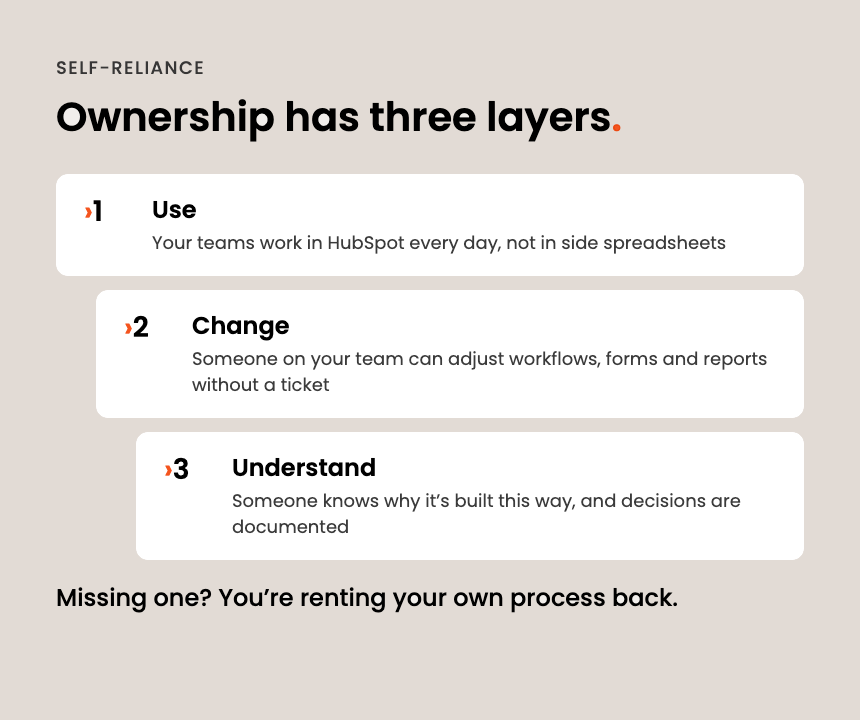
In practice, I look at it as ownership in three layers:
- Use. Your marketers, sales reps and service staff work in HubSpot every day, not in side spreadsheets. They know where to find what they need.
- Change. Someone on your team can build a new email, adjust a workflow, add a property or update a report without opening a support ticket.
- Understand. Someone on your team knows why things are built the way they are: the lead definitions, the lifecycle stages, the data model. Decisions and processes are documented, so that knowledge survives when a person leaves.
Self-reliance is not the same as doing everything yourself. It means you decide what to keep in-house and what to buy, instead of the agency deciding it for you by holding the knowledge.
What should you own, and what should you buy?
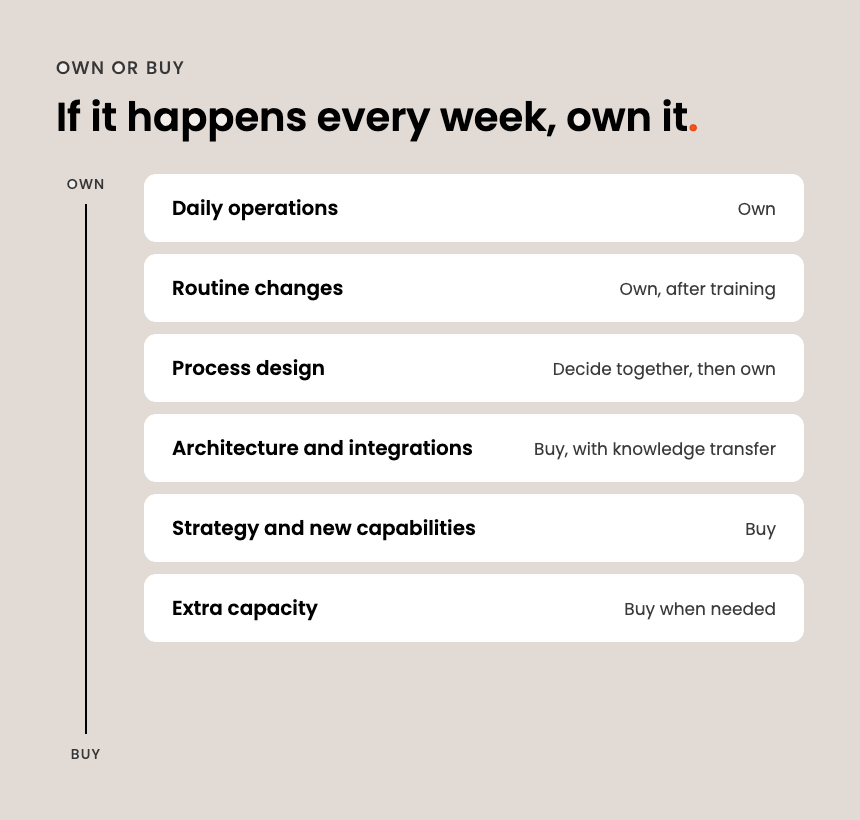
Own the routine work that happens every week. Buy the strategic and specialist work that happens rarely or needs experience you don't have. My own rule is simple: you should not buy anything from an agency that you as a customer can learn to do yourself. Use that money for the next strategic support instead.
That rule sounds harsh coming from someone who works at an agency. It isn't. An agency that does your weekly newsletter for you forever is not helping you grow. It is just billing you.
Here is how the split usually looks:
| Type of work | Typical examples | Own it or buy it? | Why |
|---|---|---|---|
| Daily operations | Sending emails, updating contacts, logging deals, building simple lists | Own | Happens every week; waiting for an agency slows everyone down |
| Routine changes | New forms, small workflow edits, new properties, updating dashboards | Own, after training | Cheap to learn, expensive to outsource over time |
| Process design | Lead definitions (MQL, SQL), lifecycle stages, handoff rules between marketing and sales | Decide together, then own | You must own the decision; an outside view helps you make it |
| Architecture and integrations | CRM data model, ERP integrations, multi-market portal setup, migrations | Buy, with knowledge transfer | Done rarely; needs specialist experience; document it so you can maintain it |
| Strategy and new capabilities | ABM programmes, new markets, new hubs such as Service Hub, AI search visibility | Buy | This is where outside expertise adds the most value per hour |
| Extra capacity | Peaks in content production, campaign launches | Buy when needed | Hire for capacity, not for capability you could build |
Takeaway: if a task happens every week, your team should be able to do it. If it happens once every few months, buying expertise is usually smarter.
Why should a buyer care about self-reliance?
You should care because dependency is a hidden cost. It does not show up as one big invoice. It shows up as many small ones, slow changes, and a system nobody on your team fully understands.
Dependency hurts you in four concrete ways:
- Budget leaks into routine work. Hours you pay for small fixes are hours you can't spend on strategy, new markets or better targeting.
- Speed drops. Every change waits for someone else's calendar. Marketing campaigns and sales processes move at the agency's pace, not yours.
- Knowledge leaves with the agency. If the agency holds the "why" behind your setup, switching partners or changing direction becomes risky and expensive.
- Adoption suffers. People who don't understand a tool stop trusting it. When teams don't feel they own the system, they work around it.
Self-reliance turns that around. Your team owns the foundation and the day-to-day basics. The agency becomes a partner you call for the next step, because it adds value, not because you have no other choice.
How do you know if you are self-reliant today?
You are self-reliant if your team can answer "yes" to most of these questions. If you answer "no" to three or more, you are probably paying for work you could own.
- Can someone on your team build and send a campaign email in HubSpot without help?
- Can someone change a workflow or a lead form without opening a ticket with your agency?
- Do you have admin access to every system the agency has set up for you?
- Are your lead definitions, lifecycle stages and handoff rules written down somewhere your team can find them?
- Could a new team member be trained using your own documentation?
- Do you know why your CRM is structured the way it is?
- When you last called your agency, was it for something strategic rather than routine?
A quick way to start: list everything you paid your agency for in the last six months. Mark each item "weekly", "occasional" or "rare". The "weekly" items are your training list.
When doesn't this advice apply?
Self-reliance is the right goal for most mid-sized and large B2B companies, but not for every task or every situation. It does not apply in these cases:
- You have no one to own it. If nobody on your team has time to learn and maintain HubSpot, training will not stick. Solve the capacity question first, either by hiring or by agreeing that the agency keeps the routine work for a defined period.
- The task is rare and highly specialised. Complex integrations, data migrations or a multi-market portal architecture are done so seldom that building deep internal skills for them rarely pays off. Buy the expertise, but insist on documentation.
- You are in the middle of a big change. During an implementation or a migration, it is normal to lean on your partner more. Self-reliance is something you build towards, not something you have on day one.
- Your strategy is to outsource a whole function. Some companies decide to outsource, for example, all content production. That is a valid choice, as long as it is a choice and not an accident of who holds the knowledge.
Actionable takeaways
- Audit what you buy (low effort, do it this month). Go through the last six months of agency work and sort it into weekly, occasional and rare tasks. Weekly tasks are candidates to bring in-house.
- Secure your access (low effort, do it now). Make sure your company holds admin rights to HubSpot and every connected system, not only the agency.
- Name an internal owner (medium effort). Give one person clear responsibility for the platform and the processes around it. Ownership without a name is not ownership.
- Ask for training as part of the scope (medium effort). In your next agency project, make training and documentation a deliverable, not an afterthought. Your team should practise in your real setup, not in a demo.
- Move budget up the value chain (ongoing). As your team takes over routine work, redirect the freed-up budget to strategy, new capabilities or new markets.
One honest note to end on: no framework makes a team self-reliant by itself. A checklist won't do it, and neither will a training day. It comes down to discipline, an owner who cares, and patience while people learn. The method isn't magic. The habit is what counts.