Handle change management as its own workstream, not as a training session at the end. Involve affected people in the design, pilot with a small group, train them before they work in the new process, and make leadership visibly back it. Then track adoption after launch, because old habits return quietly when nobody is looking.
Why is change management the part that decides whether a new process works?
A new sales or marketing process fails because of behaviour, not configuration. In my experience, the technical rollout rarely goes wrong. What goes wrong is that people keep working the way they did before, around the new process instead of through it.
That has become more visible as B2B companies have moved more commercial work into one shared platform, such as HubSpot. When marketing, sales and service share one CRM, one person's old habit becomes everyone's data problem. A rep who logs deals in a spreadsheet doesn't just skip a step. He breaks the pipeline report leadership relies on.
My colleague Charlotte Björsjö puts the core problem plainly: "It's hard to change behaviour." The tool is usually easy to learn. Changing the daily routine is not easy.
Takeaway: a process rollout succeeds or fails based on whether people change how they work, so change management needs the same planning as the build.
Isn't good training enough?
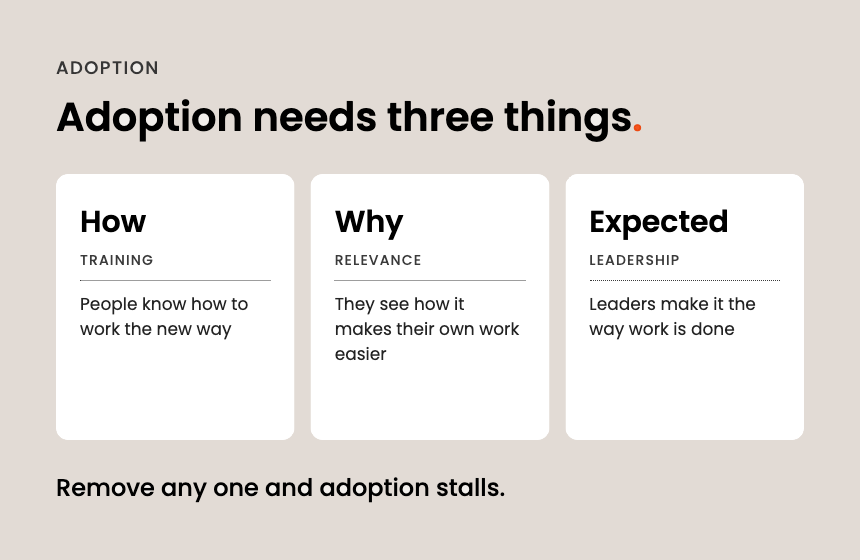
No. Training is necessary, but it only solves one of three problems. People need to know how to work the new way (training), why it's worth it (relevance) and that it's expected of them (leadership). Remove any one of the three, and adoption stalls.
To be fair to the counter-view: training is the most common reason adoption fails. Sheila Ghamkhar, who leads implementation projects at Zooma, sees it often. "People are more likely to adopt change when they have time to learn and use the system before they're expected to work in it, and when they can clearly see how it makes their work easier," she says.
But well-trained teams still fall back when management doesn't reinforce the change. Sheila is just as clear on that point: without management support, teams easily return to familiar ways of working.
Takeaway: Training answers "how", but adoption also needs a clear "why" and a visible "this is expected".
How do we involve people without slowing the project down?
Involve frontline sales and marketing people in the design, not just in the launch. Stellan Björnesjö, strategist at Zooma, treats this as a fixed part of the work: "We treat change management as its own workstream. We involve frontline sales and marketing in the design and pilot with a small group before full rollout."
Involvement does two things. It produces a better process, because the people doing the work know where the friction is. And it creates early owners who defend the new way of working when colleagues push back.
This approach doesn't mean everyone votes on everything. It means the people affected help shape the handoffs, fields, and routines they will use every day, and they hear early what’s changing and why.
Takeaway: People defend what they helped design, so involve a few frontline users early rather than many late.
What does a good rollout look like, step by step?
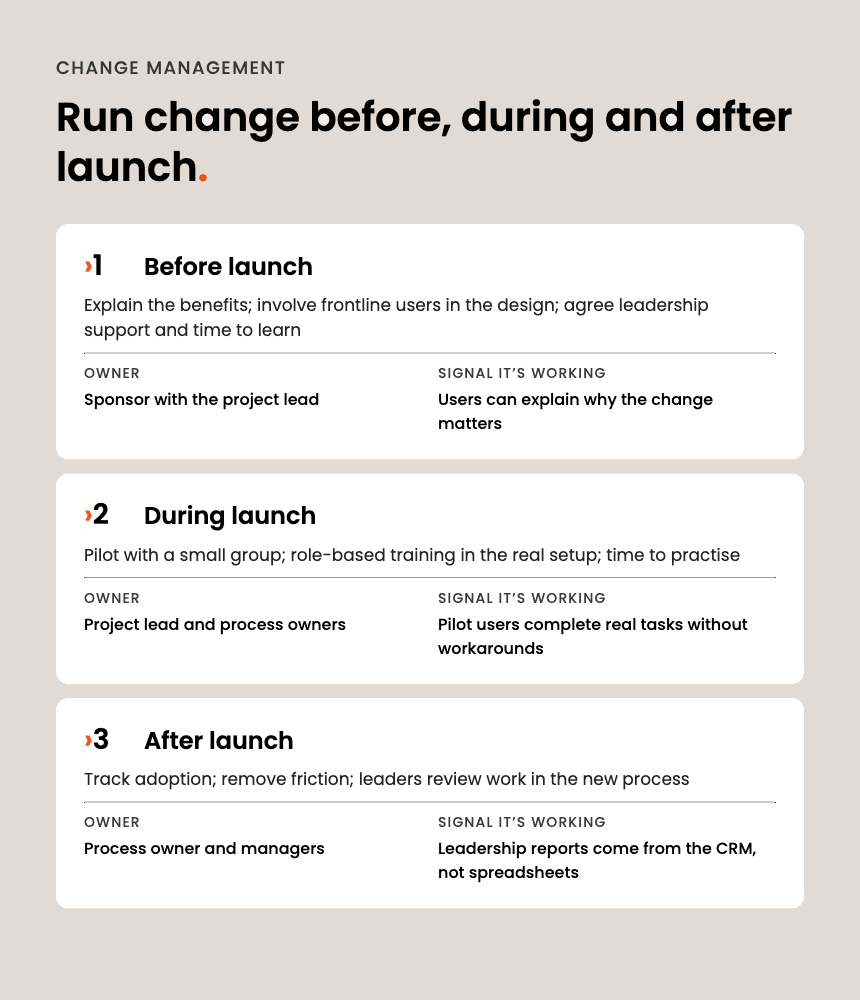
A good rollout runs in three phases: prepare before launch, pilot and train during launch, and track and adjust after launch. The table shows what happens in each phase, who owns it and how you know it's working.
| Phase | Key actions | Owner | Signal it’s working |
|---|---|---|---|
| Before launch | Explain the customer and business benefits; involve frontline users in the design; agree on leadership support, ownership and time to learn; and state what changes explicitly and what stays. | Sponsor (CMO, Sales Director or CEO) with project lead. | Users can explain why the change matters in their own words. |
| During launch | Pilot with a small group; run role-based training in the real setup, not a demo; give people time to practise before switching off the old way. | Project lead and internal process owners. | Pilot users complete real tasks in the new process without workarounds. |
| After launch | Track adoption; collect feedback and remove friction; leadership reviews work in the new process, not outside it. | Process owner and sales/marketing managers. | CRM data is complete, and leadership reports come from the system, not spreadsheets. |
A typical HubSpot implementation takes 8–16 weeks to reach core launch, and operational results usually appear within 4–8 weeks after that, once teams are using the platform. Change management should cover that whole period, not only the last week.
Takeaway: Spread change management across before, during and after launch, with a named owner and a visible signal in each phase.
What is leadership’s role?
Leadership's role is to make the new process the expected way of working and to measure people on it. Charlotte Björsjö says management needs to clearly direct that this is now the tool to use and that people are measured on specific outcomes tied to it.
In practice, that means leaders run their pipeline reviews from the CRM, ask for updates in the system rather than by email, and stop accepting the old report. If leaders keep accepting the old way, the team hears that the new way is optional.
Takeaway: Leadership must work in the new process for anyone else to succeed.
Why do teams slip back after launch, and how can we prevent this?
Teams slip back because launch is when attention moves on, not when behaviour has settled in. Stellan's view is direct: post-launch adoption tracking matters as much as launch, because old habits creep back.
The solution is to keep watching after go-live. Track a few adoption signals, such as whether deals are logged, whether leads are followed up as agreed, and whether dashboards are used. Then address the friction that people report, rather than repeating the training.
I'd add one reframe. Digital transformation is not a project with a defined start and end. The same goes for a new sales or marketing process: the launch date is a milestone, not the finish line.
Takeaway: Plan for the weeks after launch, because that is when adoption is won or lost.
How does this process compare with a "launch and train" approach?
| Launch and train | Change management as a workstream | |
|---|---|---|
| When people get involved | At launch. | During design. |
| Training | One session near go-live. | Role-based, in the real setup, before the old way is switched off. |
| Leadership role | Announces the launch. | Works in the new process and measures people on it. |
| Pilot | None, big-bang launch. | Small group first, then wider rollout. |
| After launch | Project closes. | Adoption tracked, friction removed. |
| Typical result | Workarounds and parallel spreadsheets. | The new process becomes the default way of working. |
Where this applies, and where it doesn't
This approach applies when a change affects how several people or teams work every day: a new lead handoff, a new pipeline structure, a HubSpot rollout, or a new way for marketing and sales to qualify leads.
It's heavier than you need for small, contained changes. Adding a field or adjusting one workflow for a three-person team doesn’t need a pilot. A clear message and a short walkthrough are enough.
It also won't rescue a process that doesn’t fit the business. If teams resist because the process makes their work harder, the problem is the design, not the change management. Sheila sees the issue with clients whose previous implementations weren’t aligned with what the business needed. In that case, let's prioritise fixing the process first.
Actionable takeaways
- Name a sponsor in leadership and a process owner before launch, and agree on what each will do differently. This is low effort and high impact.
- Involve two or three frontline sales and marketing users in the process design, so they become early owners.
- Pilot with a small group and address what they find before the full rollout.
- Train people in the real setup, role by role, and give them time to practise before switching off the old way.
- Decide on three adoption signals to track after launch, and review them with sales and marketing managers.
- Ask leaders to run their own reviews of the new process from day one.