
- Learn
- The B2B Enablement Hub
- Do we need external help or should we hire internally? How B2B companies should decide

Hire internally when you need more capacity for work that recurs every week. Bring in external help when you need capability you don't have and won't use often, such as redesigning how marketing, sales and service work together. For most mid-sized B2B companies the honest answer is both, in sequence. External experts build and test it. Internal people own and run it.
Why is this decision harder in 2026 than it used to be?
It's harder because the work has changed shape. A few years ago, "marketing help" mostly meant producing campaigns and content. In 2026, much of the work B2B companies need is connected: CRM architecture, lead handoff between marketing and sales, reporting that leadership trusts, and processes that span several teams.
That kind of work doesn't properly fit into one new job description. A single hire rarely has strategy, HubSpot configuration, data design and change management at the level a transformation needs. An agency alone can't run your daily operations either. So the question is not "agency or employee?" It is "which parts of this do we need to own, and which parts do we need to borrow?"
What is the simplest rule for deciding?
Hire for capacity; bring in outside help for capability. This is the rule we at Zooma use with clients, and it holds up in most situations.
- Capacity means more hands for work you already know how to do and will keep doing: publishing content, managing campaigns, keeping CRM data clean, handling inbound leads.
- Capability means expertise you lack and need only occasionally: designing a sales process, building a data model, implementing HubSpot, planning a multi-market rollout.
Redesigning how marketing, sales and service work together is typically a once-every-few-years job. Hiring a full-time specialist for it means paying for a skill set you'll use intensively for a few months and then only lightly. Bringing in experts for that phase is usually faster and gives better results, because they have done the same work many times before.
The reverse also applies. If what you really need is more hands for recurring work, a good partner should tell you so. Hiring is then the better long-term investment.
Start with what you need to own long-term
Before deciding who does the work, decide what your company must own after the work is done. In my experience, this question settles most of the debate.
Things a B2B company should normally own internally:
- Day-to-day use of HubSpot across marketing, sales and service.
- Lead follow-up and pipeline management.
- Content and campaign execution that runs every month.
- The definitions your teams agree on, such as what counts as a qualified lead.
Things that are often better borrowed:
- The initial strategy and process design.
- Platform architecture, migration and integrations.
- Specialist skills used a few times a year, such as advanced automation or ABM programme design.
- Extra capacity during peaks, such as a launch or a new market.
Takeaway: If you will need a skill every week for years, build it in-house. If you need it intensively for a few months, borrow it, and make sure the knowledge stays with you afterwards.
Why "only external" rarely works
External help on its own fails more often than people expect, and the reason is almost always internal capacity.
When I work on enablement projects, the pattern I see is consistent. External specialists can handle strategy, implementation and extra support well. But the project still needs people inside the company who support it, make sure decisions get made and things get done, and handle daily tasks while the new setup is being built. When those people don't exist, or don't have time, the project slows down. Not because the build is wrong, but because no one internally can test it, decide on it or adopt it.
There is also a practical reason. Companies need to move fast to get results, and it is hard to free up time for training and exploration. If no one internally has dedicated time, the new processes are designed but never really learned.
Takeaway: An external team can build a system, but only your own people can make it part of how your company works. Plan internal time into the project from day one.
Why "only hiring" rarely works either
Hiring alone struggles for the opposite reason. A new hire joins an organisation with established habits, unclear definitions and a CRM that may not match how the business actually sells. One person, however skilled, has to diagnose the problem, design the solution, configure the platform and persuade several teams to change, often without the authority to do so.
Recruiting also takes time. Finding a senior HubSpot or revenue operations specialist can take months before they even start, and their first months are spent learning the business. By then, an external team could have completed a core HubSpot implementation, which typically takes 8–16 weeks from kickoff to launch.
What does "both, in sequence" look like in practice?
The most reliable model is a phased handover: external experts lead the build, internal people work alongside them, and responsibility moves inside as the setup is tested.
| Phase | External team's role | Internal team's role |
|---|---|---|
| 1. Discovery and design | Leads interviews, process mapping and architecture | Provides knowledge of customers, processes and priorities; makes decisions |
| 2. Build and configuration | Configures HubSpot, migrates data, builds integrations | Tests in the real portal; flags what doesn't match daily work |
| 3. Testing and training | Trains teams on their own setup, by role | Practises real tasks; the internal owner learns the admin side |
| 4. Handover | Documents decisions and hands over ownership | Takes over daily operations |
| 5. After launch | Optional support for new needs, scaling or peaks | Runs the system; calls in help for specialist work |
This sequence is built into how we work. Once things are properly tested and set up, the external team hands over and trains the internal staff, so the knowledge stays in the company rather than with the agency.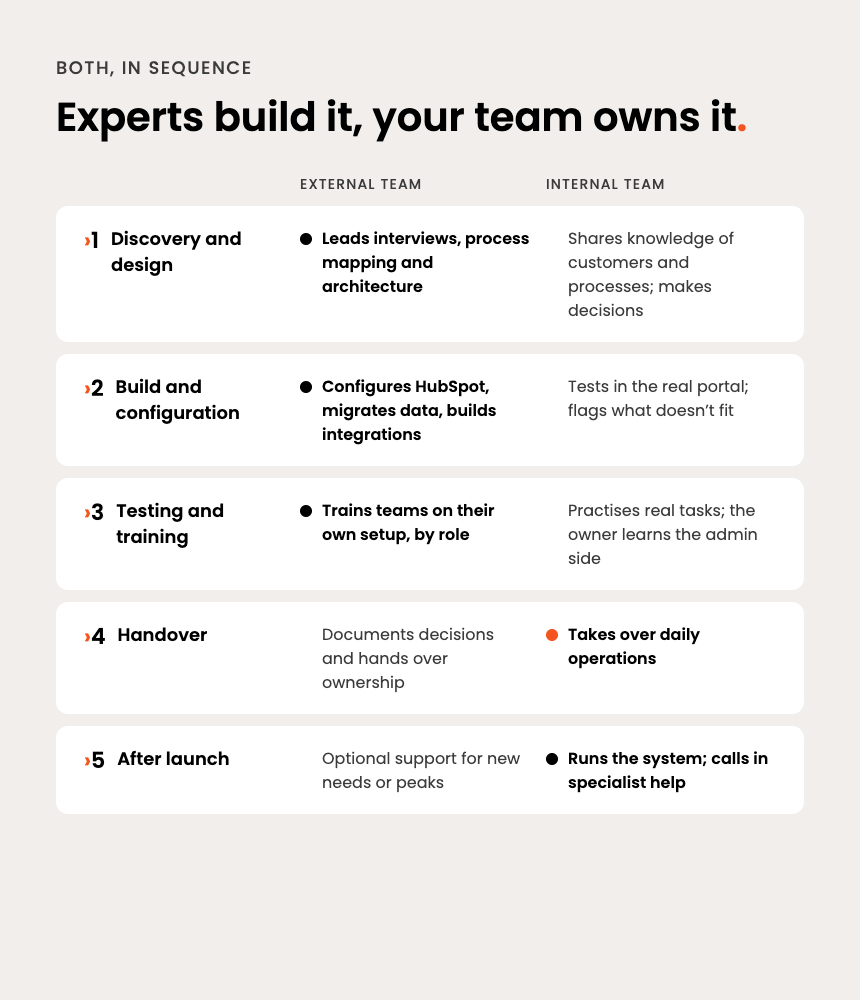
Who should the internal owner be?
Every project that uses external help needs one named internal owner. This is the single most important resourcing decision, and it's the one most often skipped.
The internal owner:
- Has enough authority to make decisions or get them made quickly.
- Has clear allocated time for the project, not just "when there's a gap in the calendar".
- Understands how marketing and sales actually work day-to-day.
- Will be responsible for the system after handover, including onboarding new colleagues.
The owner doesn't need to be a HubSpot expert at the start. They need to become one during the project. If no one in your organisation fits this role, that is a strong signal that your first hire should be this person, before or alongside bringing in a partner.
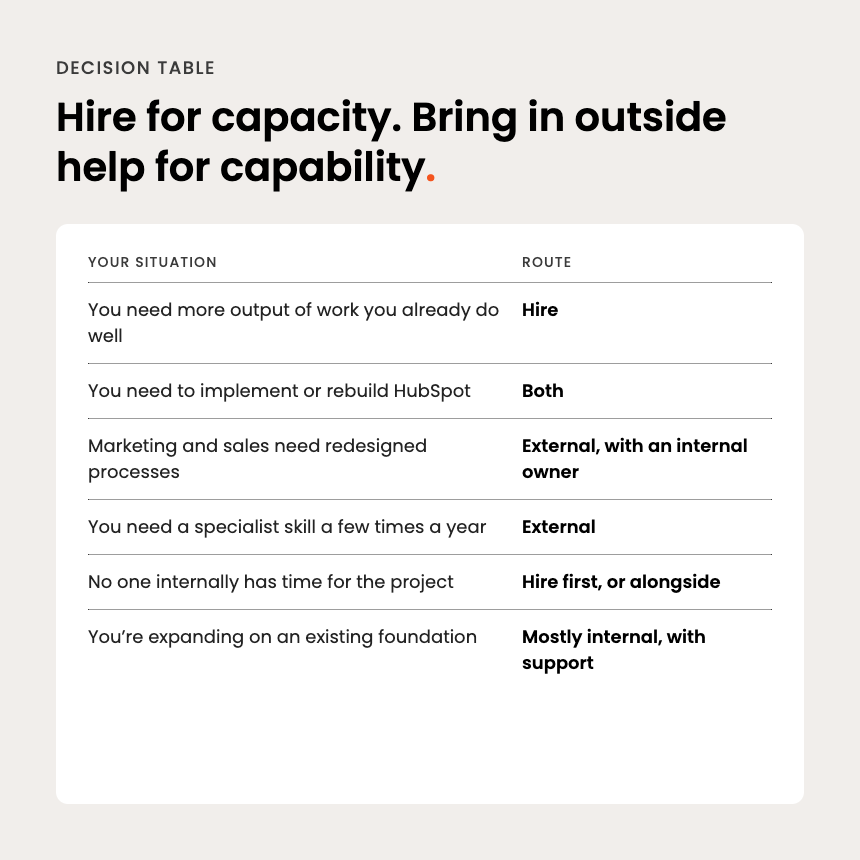
Decision table: hire, external help or both?
| Your situation | Recommended route | Why |
|---|---|---|
| You need more output of work you already do well (content, campaigns, data upkeep) | Hire | This is recurring capacity, so in-house is cheaper and builds knowledge over time |
| You need to implement or rebuild HubSpot | Both | Experts build it; an internal owner must exist to run it afterwards |
| Marketing and sales are misaligned and processes need redesigning | External, with an internal owner | It is a once-every-few-years capability that needs an outside view |
| You need a specialist skill a few times a year (advanced automation, ABM design) | External | A full-time hire would be underused |
| You have no one internally with time for the project | Hire first, or alongside | Without internal capacity, external work won't be adopted |
| You're expanding to new markets or teams on an existing foundation | Mostly internal, with external support | The foundation exists; you mainly need help with the new parts |
When doesn't this advice apply?
The "both, in sequence" model is not always right.
- Very small teams. If your marketing team is one or two people, a full enablement project may be too large. A smaller, scoped piece of help, or a well-chosen hire, may be enough.
- Purely tactical needs. If the only gap is more content or more ads, and your processes and CRM work, you don't need an enablement partner. Hire or use a production resource.
- Highly regulated or confidential operations. Some companies can't give external parties access to certain data. Then the internal team needs to do more of the hands-on work, with external experts advising rather than building.
- No leadership backing. If management hasn't decided that the change is a priority, neither a hire nor an agency will fix it. Resolve that first.
Actionable takeaways
- List what you must own in two years' time. Use that list to decide which roles to hire for. This takes an afternoon and saves months of debate.
- Separate capacity gaps from capability gaps. Hire for the first; bring in outside help for the second.
- Name an internal owner before signing with a partner. Give them dedicated time, not leftovers. Without this, external work stalls.
- Plan the handover from the start. Agree what the external team will document and train, and when your team takes over.
- Review after launch. Once daily operations run internally, decide whether you need ongoing support or only occasional specialist help.
