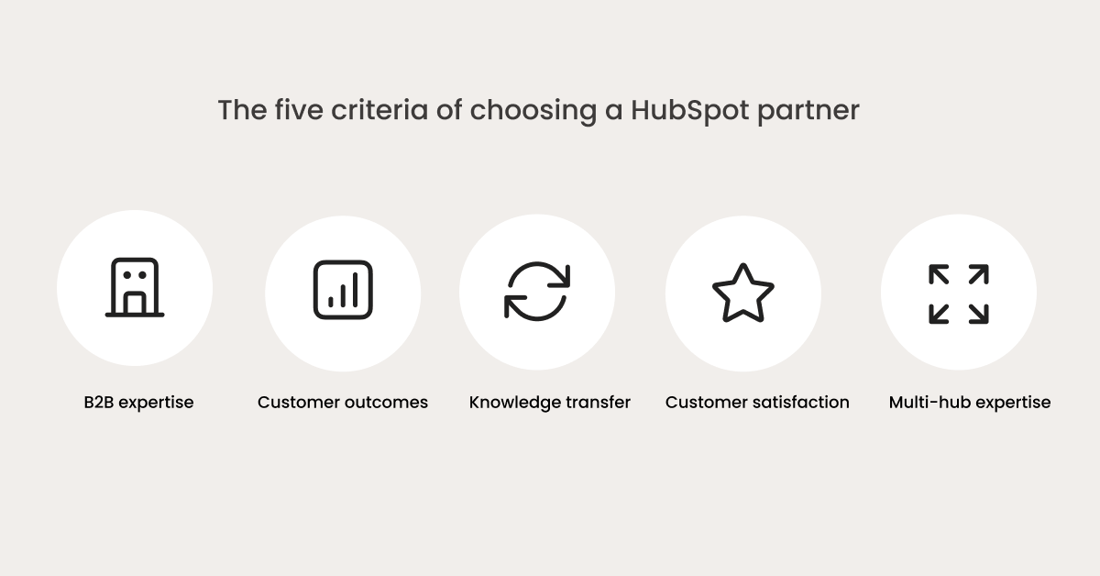
Choosing a HubSpot partner agency comes down to five criteria: sector depth, implementation track record, delivery model, strategic breadth, and cultural fit. These five criteria will help you uncover whether they understand B2B, not just HubSpot. If they can show real customer outcomes, not just certifications. If they build your capability or their dependency. If they have the knowledge to design a solution that fits your commercial strategies or to configure a default portal. If they will work as a long-term partner, not just as a project supplier. Taking a step further, NPS scores and reference calls reveal what sales conversations hide.
Why this decision matters more than most businesses realise
Choosing a HubSpot partner is not like buying a software licence. The partner you select will shape how your revenue processes are designed, how your teams work, and how dependent your business becomes on external support. A poor choice here can result in a technically functional HubSpot that nobody actually uses or processes, built around the agency's convenience rather than your commercial reality and benefit.
The HubSpot partner ecosystem has grown rapidly. There are now thousands of certified partners globally. Although certifications are good, the honest truth is that they tell you almost nothing about whether an agency can deliver outcomes for a complex B2B business.
Here is what actually separates effective and experienced partners from ineffective ones.
| Criterion |
Strong partner |
Warning sign |
| B2B expertise |
Can challenge commercial strategy |
Only discusses HubSpot features |
| Customer outcomes |
Shows metrics and references |
Only polished case studies |
| Knowledge transfer |
Builds internal capability |
Creates long-term dependency |
| Customer satisfaction |
Shares NPS methodology |
Avoids references |
| Multi-hub expertise |
Connects Marketing, Sales and Service |
Focuses on one hub only |
Criterion 1: Do they genuinely understand B2B, not just HubSpot?
There is a fundamental difference between an agency that knows how to configure the basics of HubSpot and one that understands how B2B companies go to market and build an architecture for it. The best HubSpot partners for B2B work are those who can challenge your commercial strategy, not just execute a brief or wishlist.
Questions to ask your potential partner:
- What percentage of your customers are in the B2B industry?
- What sectors have you worked in that are relevant to ours?
- How big or small have your customers been that you've supported?
- Can you provide an example where you pushed back on a client's approach because you thought the strategy was wrong?
An agency that only tells you what you want to hear is not a strategic partner. The pushbacks and questions are where the real experience of shaping your HubSpot strategy begins.
Criterion 2: Can they show real customer outcomes, not just case studies?
Marketing-polished case studies tell you what an agency wants you to believe. What you need are verifiable outcomes, specific metrics, timelines, and, ideally, direct contact with a reference customer in your sector or similar business conditions.
Dare to ask:
- What was the measurable revenue impact for a customer similar to us?
- How long did it take for that customer to see ROI?
- Did anything go wrong during the project, and how did you handle it?
The last question is particularly revealing. Every implementation hits road bumps and complexity. Agencies that can speak honestly about what went wrong, how they handled it, and what they learned are far more trustworthy than those that present a flawless track record.
At Zooma, typical customer outcomes include 20-40% shorter sales cycles and 2–4x ROI within 18 to 24 months. One manufacturing customer grew marketing-influenced revenue from 18% to 47% in 18 months. These are the kinds of specifics a credible and experienced partner should be able to provide.
Of course, outcomes also depend on getting the implementation right from the start. See what a realistic HubSpot implementation timeline looks like and what happens at each stage.
Criterion 3: Do they build your capability or their dependency?
This is the criterion that most buyers don't think to ask and the one that makes the biggest long-term difference.
Some HubSpot agencies, consciously or not, build retainer dependency. They configure workflows in ways only they understand. They hold knowledge that your team never fully receives. The result is a customer who is perpetually dependent on external support for day-to-day operations.
A genuine partner does the opposite. They transfer knowledge explicitly and clearly. They train your team to understand and manage what they have built, and to maintain it independently. They measure success partly by how self-sufficient your team becomes.
Ask directly: "What is your explicit process for knowledge transfer? What does a client's internal capability look like at months 6, 12, and 24 of working with you?"
At Zooma, our goal is for customers to be 70–80% self-sufficient within 6-9 months of go-live. Most customers still choose to keep us for strategic sparring, advanced optimisation, or peak support, but it's always their choice, not a necessity. We believe that's the only model that creates genuine long-term trust.
Criterion 4: NPS and reference calls, the truth behind the pitch
Ask every agency you are evaluating for its customer NPS score. Request the methodology (how many clients, what time period, and how it is calculated). NPS is difficult to fake at scale, and established agencies follow up to have the numbers to share.
Zooma has maintained an average NPS above +59 since 2015, and its most recent survey (H1 2026) came in at +93. For context, the average NPS for B2B professional services is around +30–40. A high NPS sustained over a decade means customers are not just satisfied; they are advocates.
With excellent knowledge and high ambition in online communication, brand building, and digitalisation, Zooma has helped our company take a gigantic leap forward.
– Mattias Sjöstrand, Head of Brand and Communication at Mölndal Energi
With a proven track record, it's no trouble to ask for two or three reference calls: one from a customer in your sector, one from a customer who has been with the agency for 3+ years, and one from a customer whose implementation was particularly complex. These three calls will tell you more than any proposal document.
Criterion 5: Strategic breadth vs. single-hub specialists
Many HubSpot partners specialise in a single hub, typically the Marketing Hub. If your ambition is to align marketing, sales, and service around a single revenue engine (which it should be if you are thinking about RevOps), you need a partner with genuine expertise across all hubs and how they are connected.
Ask your potential partner: "Which HubSpot hubs do you regularly implement and optimise? Can you show examples of customers where you have configured Revenue Hub and Service Hub alongside Marketing Hub?
Single-hub specialists can deliver quick wins in a narrow area but lack the expertise to understand the interconnectivity between hubs. Full-ecosystem partners can deliver commercial transformation.
A note on size: bigger is not always better
Large international agencies bring scale and resource capability. Smaller local agencies bring proximity and agility. The question is not which is better; it is which agency best fits your organisation's complexity, budget, and internal culture.
Zooma deliberately operates at a size (25+ specialists) that allows deep strategic engagement without the bureaucracy of large agency networks. For mid-to-large B2B companies in the Nordic and European market, that combination of knowledge depth and access, including direct access to senior practitioners, not just subject specialists, is often the difference that matters.