
- Learn
- The B2B Enablement Hub
- How to define B2B brand positioning that gives customers a reason to choose you
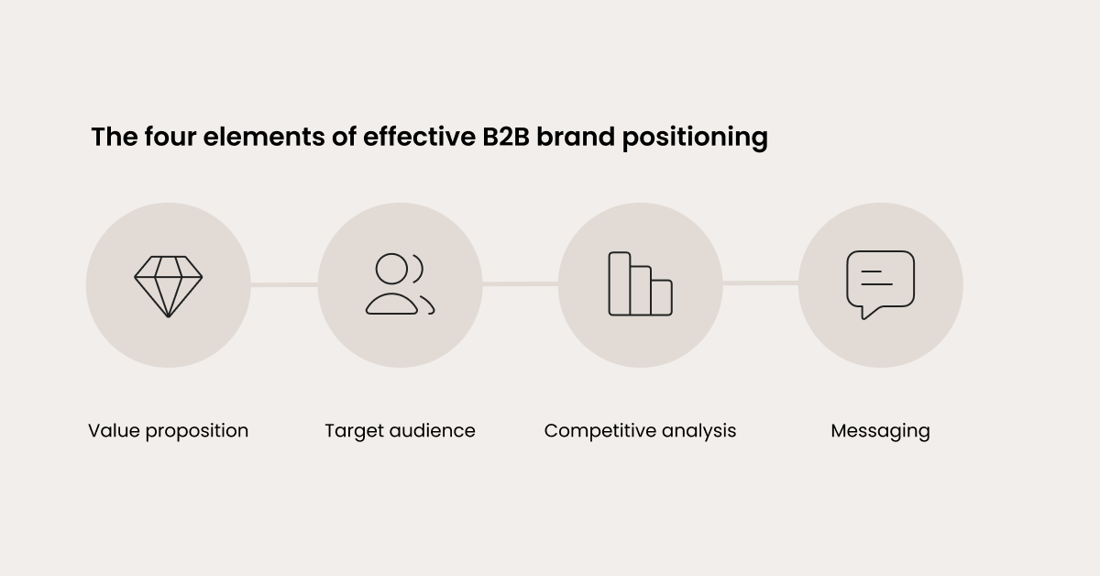
B2B brand positioning explains why a specific customer segment should choose your company over competitors or alternatives. Effective positioning combines four elements: a differentiated value proposition, a clearly defined target audience, an understanding of the competitive landscape, and consistent messaging.
For B2B companies, positioning helps establish a distinct place in the market and gives customers a clear reason to consider, trust, and ultimately choose your brand.
Understanding B2B brand positioning
B2B brand positioning is the process of defining how you want your target market to perceive your brand relative to competitors and other alternatives.
Positioning is therefore more than describing what your company offers. It connects your customers' needs with the value you can credibly deliver and the available alternatives.
One of the most common mistakes I see is companies starting with what they want to say about themselves before deciding which customers they want to be relevant to and why those customers should care. The result is often a list of qualities such as expertise, innovation, and quality that competitors could claim as well.
Positioning needs to give specific customers a credible reason to choose you.
The four elements of effective B2B brand positioningValue proposition
Your value proposition explains the relevant value you provide and why customers should choose you over competitors or alternatives.
Depending on your business, differentiation might come from product quality, innovation, customer experience, industry expertise, service, or another capability your customers value.
A useful test is whether a potential customer can understand three things from your value proposition: who you help, what outcome you help them achieve, and why your approach is relevant or different.
Prioritise differences that influence customer decisions. A capability should not be central to your positioning just because competitors do not offer or mention it. The difference must also matter to your target customers.
At the end of this step, you should be able to state the customer outcome you create and explain why your approach to creating it is relevant or different.
Target audience
Effective B2B positioning requires a clearly defined target audience. Understanding your target customers' needs, challenges, priorities, and preferences helps you position your brand around issues that actually influence their decisions.
The more precisely you understand the audience, the easier it becomes to determine which aspects of your offer deserve emphasis.
This does not mean your company can only serve one type of customer. It means your positioning should be specific enough for your priority audience to recognise that your company understands their situation.
If different customer segments choose you for fundamentally different reasons, one positioning statement may not be sufficient. In that situation, define the brand's overarching position and consider whether individual segments, offers, or business areas require more specific propositions.
At the end of this step, you should be able to identify the priority audience whose needs should shape your positioning.
Competitive analysis
Competitive analysis helps you understand what customers can choose instead of your brand and where meaningful differentiation opportunities exist.
Assess competitors' strengths, weaknesses, claims, and market positions. Include alternatives that customers may choose instead of buying from a direct competitor, such as maintaining their current approach, solving the problem internally, or deciding not to act.
Use this analysis to identify positions that are both valuable to customers and credible for your company to occupy. A difference is not useful positioning simply because competitors do not mention it.
If competitors make similar claims, look beyond wording. Differences may exist in customer outcomes, approaches, expertise, service models, customer experiences, or evidence supporting the claim.
At the end of this step, you should be able to explain why a target customer should choose your company instead of the alternatives available to them.
Messaging and communication
Messaging translates your positioning into language customers can understand.
From your website and marketing materials to sales presentations and customer interactions, your messaging should consistently communicate who you help, the value you provide, and why your approach matters.
Positioning and messaging are closely connected, but they are not the same.
Positioning defines the place you want your brand to occupy in the market; messaging determines how you communicate that position to your audience.
Do not try to solve an unclear positioning problem by changing slogans, campaigns, or website copy. If different teams cannot agree on the priority audience, what value matters most, or why customers should choose you, clarify those strategic choices before refining the messaging.
At the end of this step, marketing, sales, and other customer-facing teams should be able to communicate a consistent, shared position.
B2B brand positioning vs. value proposition and messaging
Brand positioning, value proposition, and messaging are related, but each answers a different question.
| Concept | Question it answers | Typical output |
|---|---|---|
| Brand positioning | How should customers perceive us relative to their alternatives? | A strategic definition of the position the brand wants to occupy |
| Value proposition | What valuable outcome do customers receive, and why should they choose us? | A clear articulation of customer value and differentiation |
| Messaging | How do we communicate that position and value? | The words, themes, claims, and proof used across marketing and sales |
The sequence matters: positioning guides the value proposition, and both guide messaging.
A strong value proposition or memorable campaign cannot compensate for unclear positioning. The underlying strategic choice must be clear before you can communicate it consistently.
How to choose your B2B brand positioning
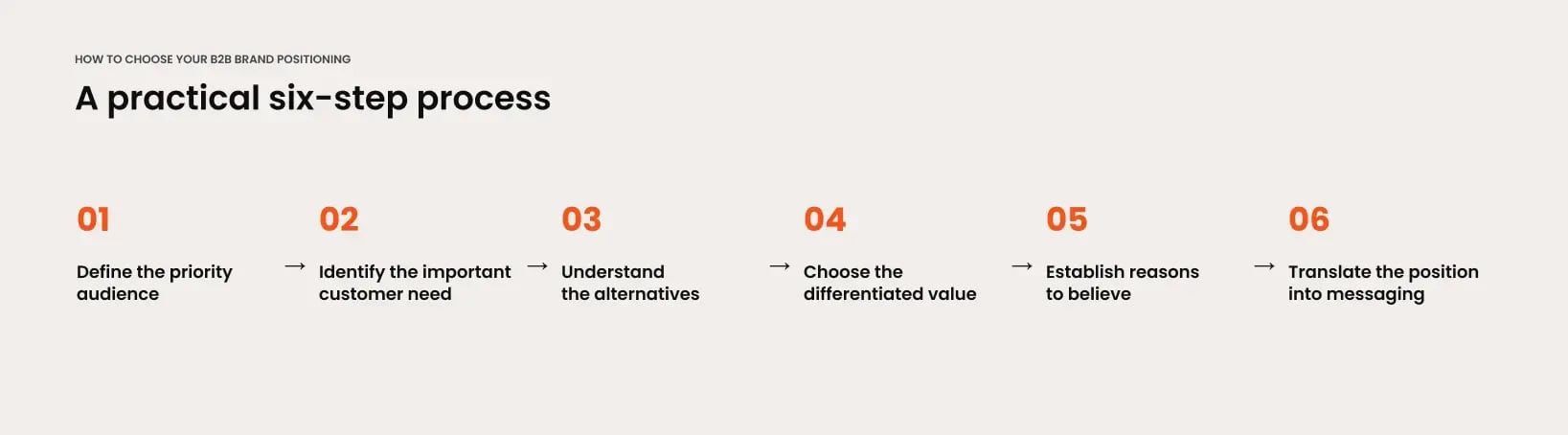
Choosing a position requires deciding which customers, needs, and differences matter most. A practical sequence is:
- Define the priority audience. Decide which customer segment the positioning primarily needs to influence.
- Identify the important customer need. Focus on a problem, ambition, or priority that materially affects the customer's decision.
- Understand the alternatives. Identify both direct competitors and other ways the customer can address or avoid addressing the need.
- Choose the differentiated value. Determine what you can provide that is relevant to the customer and meaningfully distinguishes you.
- Establish reasons to believe. Identify evidence, capabilities, experience, or other proof that makes the position credible.
- Translate the position into messaging. Communicate the same strategic idea consistently across marketing, sales, and customer interactions.
If you cannot identify meaningful differentiation, changing the wording is unlikely to solve the problem. Reconsider the audience, customer need, offer, or capabilities until you can identify a position that is both relevant and credible.
Likewise, don't build positioning around differences that customers don't value. Distinctiveness alone is not enough; the distinction needs to influence customer choice.
One thing I have learnt is that positioning needs to hold up in a customer conversation, not just look convincing in a presentation. Involve sales and customers early. Ask what customers are trying to achieve, what alternatives they consider, and what evidence they need to believe you.
Internal agreement is useful, but it does not prove external relevance.
How to evaluate your B2B brand positioning
Strong B2B positioning should help customers quickly understand why your company is relevant to them.
Ask:
- Can customers identify who your company is primarily trying to help?
- Is the customer need or challenge you address clear?
- Can customers understand the value you provide?
- Is there a meaningful reason to choose you instead of a competitor or alternative?
- Can your organisation credibly support the claims it makes?
- Do marketing and sales communicate the same basic position?
If several of these questions are difficult to answer, the problem may not simply be your messaging. Your underlying positioning may need clarification.
When positioning is not the problem
Rewriting your positioning will not solve every relevance or growth problem.
If the underlying issue is unclear customer priorities, an inconsistent customer experience, or an offering that does not deliver enough value, changing the positioning or messaging will not fix it.
In these situations, I would start with a small number of existing and desired accounts. Understand their situations, what they are trying to achieve, what alternatives they consider, and how they experience your current offer. Then test the proposed positioning in real conversations before rolling it out more broadly.
A consistent core position is still important, but the emphasis and evidence can vary across buying roles and markets. A CEO, marketing leader and sales leader may need different evidence even when the underlying position remains the same.
The practical boundary is simple: positioning can clarify and communicate relevant value, but it cannot compensate for value that customers do not experience.
Examples of effective B2B brand positioning
The following examples illustrate how established B2B brands connect an audience, customer needs, value propositions, and differentiated market positions.
IBM
IBM has positioned itself as a partner for enterprise technology and transformation, supported by its long-standing association with innovation and enterprise technology.
Its positioning connects complex organisational challenges with capabilities in areas such as artificial intelligence, cloud computing, and data and analytics.
The positioning principle connects audience, need, and credibility. The audience consists of organisations with complex enterprise technology needs; the value derives from technology and transformation capabilities; and IBM's enterprise focus provides context and credibility for these capabilities.
The broader lesson is that innovation becomes a stronger positioning idea when it connects to a specific audience and business need, rather than being presented as an end in itself.
HubSpot
HubSpot has established a position around helping organisations attract, engage, and serve customers through connected marketing, sales, and customer-facing activities.
Its messaging has historically been closely associated with inbound methodology: creating valuable content, building relationships, and providing relevant customer experiences.
HubSpot's positioning works because the company does more than communicate software functionality. It connects its products with a recognisable approach to how organisations can market and sell.
The positioning lesson is that a distinctive approach to solving a customer problem can provide differentiation, even when competitors offer similar technology categories.
Adobe
Adobe has established a strong position around creativity and digital experiences, serving audiences ranging from creative professionals to marketers and businesses.
Through offerings such as Creative Cloud and its enterprise digital experience products, Adobe connects its technology with the creation and delivery of digital experiences.
Adobe demonstrates that a broad product portfolio does not necessarily require an equally broad or fragmented position. Different products can reinforce a consistent overarching idea when they connect to a common customer outcome or capability.
The positioning lesson is that companies with multiple products can maintain a recognisable market position when their individual offerings reinforce the same strategic idea.
When should you revisit your B2B brand positioning?
Brand positioning should not change just because you're launching a new marketing campaign. However, it is worth reassessing when important aspects of the business or market change.
For example, revisit your positioning when:
- You are targeting a significantly different customer segment.
- Customer priorities or buying behaviour have changed.
- New competitors or alternatives have changed the market.
- Your company's offering or business model has changed substantially.
- Customers consistently misunderstand what makes your company different.
- Sales and marketing teams describe the company's value in noticeably different ways.
Do not change positioning simply because a competitor launches a new campaign or because you want fresher messaging. Messaging can evolve while the underlying position remains consistent.
However, if the audience, customer needs, competitive alternatives, or value your company provides have materially changed, changing messaging alone may not solve the problem. You should also reconsider the underlying positioning.
Mastering B2B brand positioning
Effective B2B brand positioning gives a defined audience a clear and credible reason to choose your company over competitors or alternatives.
Start with the audience and the problem you solve. Understand the alternatives customers have, define the value you can credibly provide, establish why customers should believe your claims, and turn those choices into consistent messaging.
Positioning does not require your company to be entirely unique. It requires you to make a relevant, differentiated, and credible choice about the place you want to occupy for the customers who matter most.
What should you do next?
Review your current positioning from your customer's perspective. Can they quickly understand who you serve, what you help them achieve, why your approach is different, and why they should believe you?
If not, identify the gap before changing individual campaigns or content:
- If your target audience is unclear, revisit it.
- If what customers gain is unclear, revisit your value proposition.
- If why they should choose you is unclear, revisit your competitive differentiation.
- If why they should believe you is unclear, strengthen your evidence and reasons to believe.
- If the strategy is clear but customers still do not understand it, revisit your messaging.
- If the offer itself does not create enough customer value, address that before rewriting the positioning.
Is your B2B positioning giving customers a clear reason to choose you?
Assess how your audience, value proposition, differentiation, proof, and messaging work together, and identify any gaps.
