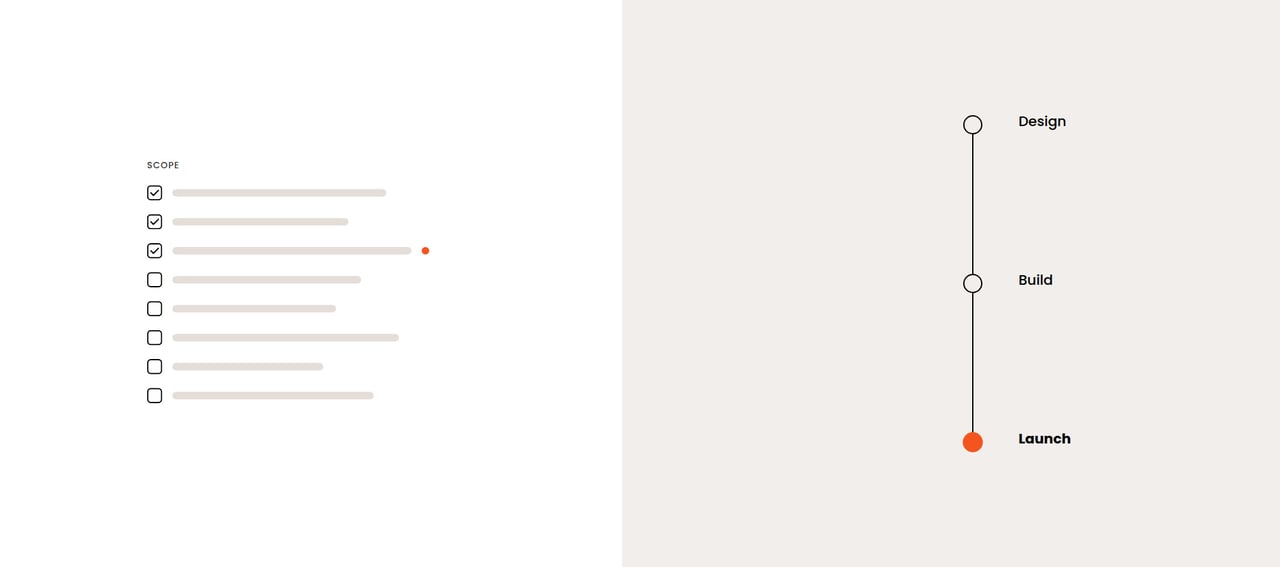
A full HubSpot implementation covers eight workstreams: business objectives, process and data design, hub configuration, data migration, integrations, workflows and automation, reporting, testing and training. The order matters more than the list. Process and data design must come before automation, and the work should run in phases so your teams get working capability early.
This checklist is for marketing, sales and digital leaders scoping a new HubSpot rollout or a rebuild of an existing one. If you only need a single hub for a small team, the same workstreams apply, in a much lighter form.
Why does the scope decide whether HubSpot works?
The scope decides it because most implementations that fail don't fail on technology. Many B2B companies struggle with HubSpot because they buy a technical tool and receive a standardised setup rather than adapting it to their actual operations. When I review a proposal, I look first at whether the scope shows any sign of adapting to how the business actually works.
HubSpot covers marketing, sales, service, content, data and commerce in one platform. That breadth only helps if the scope decides which parts you need, in what order, and who will use them.
The eight workstreams to check in every proposal
Use the table as a checklist. A proposal that skips a workstream, or puts automation before process and data design, is a warning sign.
| # |
Workstream |
What it includes |
Output you should get |
| 1 |
Business objectives |
Why you chose HubSpot, what should improve, who is affected |
Agreed goals, scope and launch criteria |
| 2 |
Process and data design |
Buyer journey, sales process, handoffs and data model |
Process maps, definitions, data architecture |
| 3 |
Hub configuration |
Marketing Hub, Sales Hub, Service Hub and Content Hub as relevant |
Configured pipelines, properties, and permissions |
| 4 |
Data migration |
Cleaning and moving contacts, companies, deals and history |
Clean, deduplicated data in HubSpot |
| 5 |
Integrations |
Connecting tools such as Microsoft 365, Google Workspace or your ERP |
Working data flows with clear ownership between systems |
| 6 |
Workflows and automation |
Lead routing, nurturing, notifications and tasks |
Automation built on clean data |
| 7 |
Reporting |
Dashboards for leadership, marketing, sales and service |
Reports teams actually use |
| 8 |
Testing and training |
User acceptance testing, role-based training and documentation |
Enable teams to work in the platform |
Stellan Björnesjö sums up the sequencing rule in why so many B2B companies struggle to make HubSpot work: data foundation and process design before automation. Automating a broken process only makes it break faster.
Strong scope vs. warning sign
| Area |
Strong scope |
Warning sign |
| Starting point |
Begins with your goals, definitions and ways of working |
Begins with a feature list or a standard package |
| Sequence |
Process and data design before configuration |
Configuration and automation first, custom solutions for operations last |
| Data |
Migration includes cleaning and deduplication |
"We'll import your existing data as is" |
| Rollout |
Phased, with an early working core |
One big-bang go-live |
| Users |
Users test before launch |
Users see the system for the first time at training |
| After launch |
Ownership and support planned in the original scope |
Support discussed only after launch |
Questions to ask: "Before you configure anything, how will you learn how our sales process actually works?"
Questions to ask: "Which workstream would you cut if the budget were 20% lower, and what would that cost us later?"
What makes the project management work?
It works when responsibilities and launch criteria are agreed up front, around the tasks your people need to perform. Always include a plan for support and ownership after launch in the original scope, not as an afterthought.
From my side as a project manager, three habits make the biggest difference:
- Start with how the business actually works: your definitions, team structures and ways of working, before discussing features.
- Phase the rollout: launch a working core first, for example, the marketing-to-sales handoff, then extend.
- Involve users early: the people who will use HubSpot should learn and test it before launch.
The takeaway: a HubSpot implementation is a business process project that happens to use a platform. Scope it that way.
Where this applies, and where it doesn't
- Migrations from another CRM add weight to workstreams 4 and 5. Plan more time for data cleaning.
- Single-hub projects, such as Marketing Hub only, can lighten workstreams 2 and 3, but should still define the handoff to sales.
- Multi-market companies need an extra decision in workstream 2: what is shared centrally and what is local.
- Rebuilding a struggling instance starts with an audit of what exists before redesigning.
Actionable takeaways
- Before you request proposals (low effort): Write down why you chose HubSpot and what should be different in 12 months.
- When comparing proposals (low effort): Check each one against the eight workstreams and the warning signs above. For the partner itself, use how to choose the right HubSpot partner.
- In planning (medium effort): Agree launch criteria and a phased plan with an early working core.
- Before launch (low effort): Name internal owners for each hub and for data quality.