
- Learn
- The B2B Enablement Hub
- How do you measure success in a B2B enablement engagement?
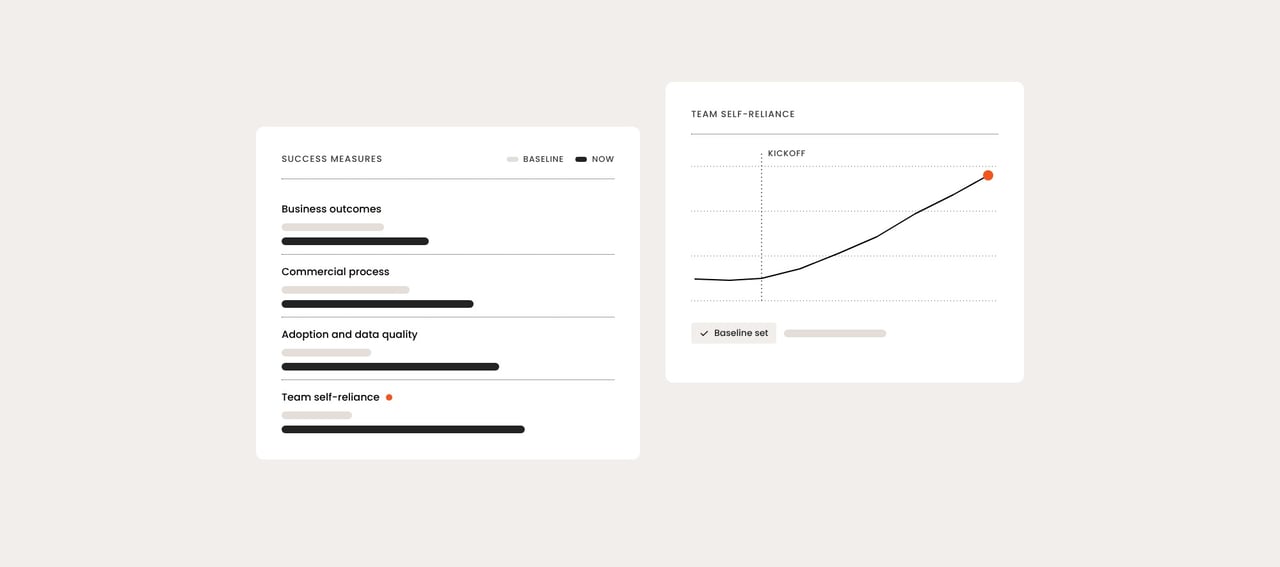
Success in a B2B enablement engagement is not a delivered project. It is a measurable change in how your company wins and keeps customers. Measure it on four levels, agreed and baselined before kickoff: business outcomes, commercial process, adoption and data quality, and your team’s ability to sustain the change without outside help.
This approach applies to engagements that change how marketing, sales and service work together, typically for mid-sized and large B2B companies with long sales cycles. For a narrow, tactical project, such as a single HubSpot configuration task, a smaller set of operational measures is enough.
Why does measuring enablement matter more in 2026?
Measurement matters more in 2026 because B2B leaders are under growing pressure to justify every investment in concrete commercial terms. Forrester’s 2026 buyer research highlights exactly that pressure. Activity reports showing content produced, workflows built and workshops held no longer convince a CFO.
At the same time, many companies are moving marketing-sales alignment into a formal Revenue Operations (RevOps) model with shared KPIs across teams. That shift makes it both possible and expected to measure enablement engagement against the same revenue numbers that leadership already tracks.
What “enablement” actually means here
B2B enablement means connecting marketing, sales, and service, and the people, processes, content, and technology behind them, so your company creates more customer value, grows profitably, and becomes increasingly self-reliant. That definition determines how you measure success.
If enablement were only about output, you would count deliverables. Because it is about changed behaviour and lasting capability, you have to measure two things: whether business results improve, and whether your organisation can keep improving them after the engagement ends.
What should you measure? The four levels
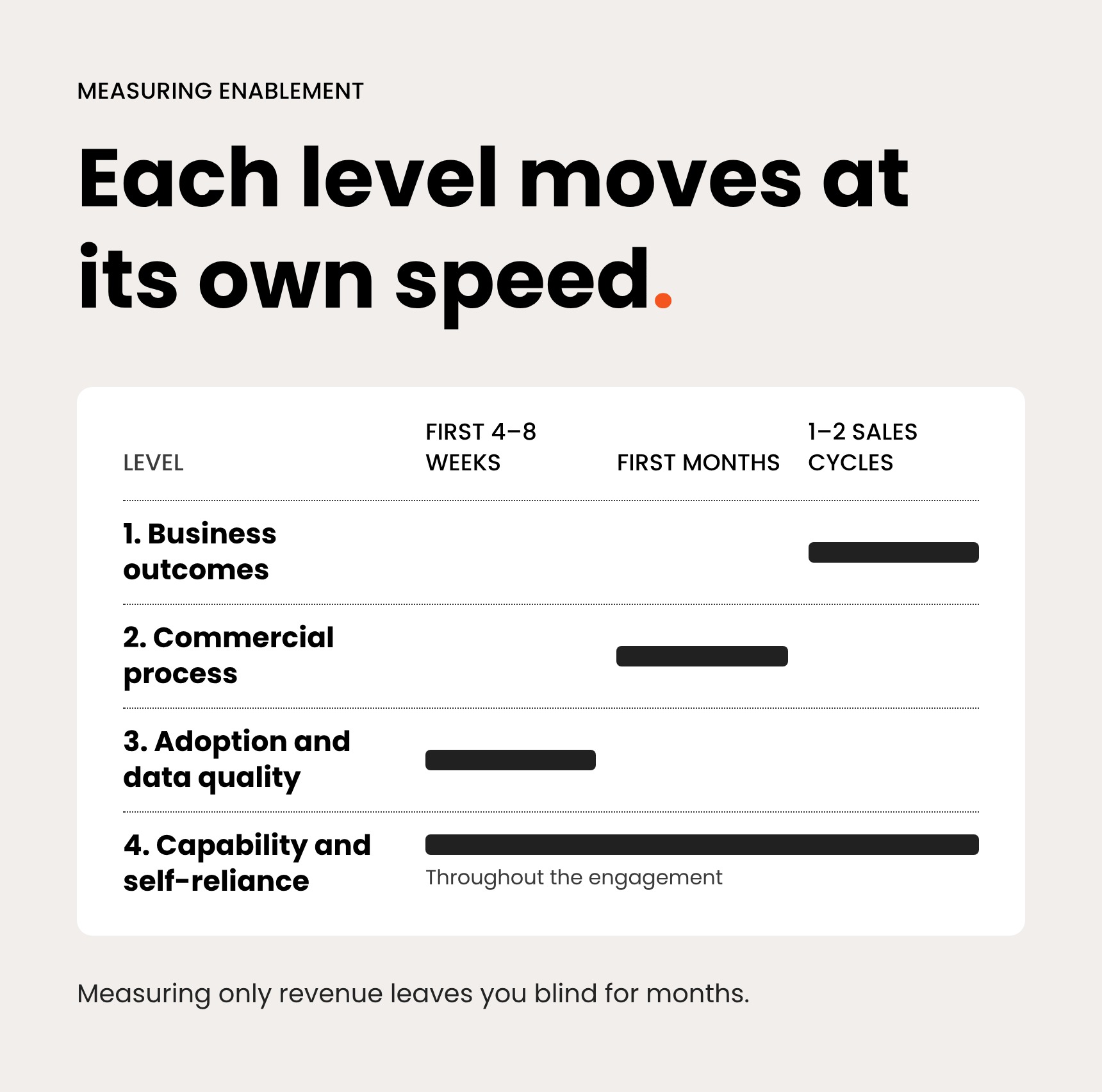
Measure all four levels at once, because each moves at a different speed and tells you something different. Measuring only revenue leaves you blind for months. Measuring only activity tells you nothing about impact.
| Level | Example measures | When it typically moves | Owned by |
|---|---|---|---|
| 1. Business outcomes | Pipeline growth, marketing-influenced revenue, win rate, customer retention, customer acquisition cost (CAC) | Within one to two sales cycles | Leadership |
| 2. Commercial process | Qualified opportunities, MQL-to-SQL conversion, lead follow-up speed, sales cycle length | Within the first months | Marketing and sales leads |
| 3. Adoption and data quality | Active platform usage, data completeness and accuracy, reports actually used in meetings | Within the first 4–8 weeks | Internal platform owner |
| 4. Capability and self-reliance | Tasks your team completes without outside help, time to make routine changes, named internal owners in place | Throughout the engagement | Internal owners, supported by the partner |
Across all four levels, add the customer’s perspective: customer experience and feedback, for example, through NPS or post-onboarding surveys. Enablement that improves your numbers but makes you harder to buy from or work with is not success.
Two principles hold the levels together:
- Data quality comes first. Bad data invalidates every other number, so level 3 underpins reporting on levels 1 and 2.
- Self-reliance is a measure of success, not a side effect. At Zooma, we measure our success partly by how quickly clients stop needing us for routine changes. If capability doesn’t stay in your organisation, the results fade when the engagement ends.
How do you set the baseline and targets?
Set the baseline and targets before kickoff by agreeing on what should improve for your customers and your business, then measuring where you stand today. Without a baseline, any later result is an opinion.
In practice, this involves four steps:
- Agree on the outcome. What should be different in 12 months, for customers and for the business? More qualified opportunities, shorter cycles, better retention, and less manual effort?
- Choose a small set of measures per level. Three to five in total at the business-outcome level is usually enough. More than that, and nobody follows them.
- Baseline them. If the data needed for baselining doesn’t exist or can’t be trusted, building a reliable baseline is the first deliverable.
- Set milestones that respect your buying cycle. Operational improvements show before revenue does. Commercial expectations must reflect how long your customers take to buy.
When calculating return, include the full investment, including internal time, fees, and licences. Also separate financial return from marketing influence. “Marketing-influenced pipeline” is a useful measure, but it is not the same as revenue caused by marketing, and treating it as such undermines trust in every other number.
How do you keep measurement honest during the engagement?
Keep it honest by reviewing progress against the agreed measures at regular checkpoints and by acting on gaps rather than explaining them away. The measures should be live dashboards calibrated to your baseline, not a report compiled at the end.
When a measure isn’t moving as expected, we at Zooma follow the same sequence every time:
- Make the gap visible to both sides as early as possible.
- Diagnose the cause: execution, scoping or external factors such as a market shift or a reorganisation.
- Agree on corrective actions, each with an owner and a review date.
- Change, reduce or stop the work if the evidence undermines the business case.
That last point matters. An engagement that isn’t delivering should be changed or stopped; it can’t quietly underperform.
Shouldn’t you just measure deliverables instead of success?
No. Deliverables are inputs, not success. To be fair to the counter-view, it has a real point: revenue depends on factors no partner controls, including market conditions, pricing, product and your own sales capacity. Using an agency solely for revenue can be unfair and push both sides toward short-term tactics.
That’s why the four levels exist. Levels 3 and 4 measure what the engagement directly controls. Level 2 measures whether that work changes commercial behaviour, and level 1 shows whether it pays off. You need all four to separate "the work didn't happen" from "the work happened but didn’t change behaviour" and from "behaviour changed, but the market moved against us."
How does Zooma measure its performance?
We apply the same logic to ourselves. Alongside the outcome measures agreed with each client, we measure client experience with a Net Promoter Score (NPS). In May 2026, our client NPS was +93. NPS is a useful indicator of how a partnership feels, but it is not a substitute for the business results it should sit alongside.
Where this applies, and where it doesn’t
- Short, tactical projects (a single configuration task or a data clean-up) should be measured mainly on levels 3 and 4. Holding them to revenue targets creates false expectations.
- Very long sales cycles, 12–18 months in some industrial and energy sales, mean level 1 results may arrive after the engagement itself. Agree in advance which leading indicators at level 2 will count as evidence.
- When no reliable data is currently available, the baseline should be established first. Set measurable revenue targets.
- Multi-market companies need shared definitions of each measure across markets, or local reporting won’t add up centrally.
- Disputes about attribution usually mean definitions were never agreed. Clarify what “sourced” and "influenced” mean before anyone reports on them.
Actionable takeaways
- Before kickoff (low effort, high impact): Agree on three to five business outcomes and baseline them. If you can’t baseline them, please make that the first task.
- In the first month (low effort): Add level 3 measures (adoption and data quality). They are the earliest signal that the engagement is working.
- Throughout (medium effort): Review all four levels at fixed checkpoints and assign an owner and review date to every gap.
- Before the engagement ends (low effort): Check level 4. Which routine tasks can your team handle alone now, and which still need help?
- Choose revenue-based targets for broad, transformation-scale engagements.
- Choose operational and capability targets for narrow, tactical projects.
