
- Learn
- The B2B Enablement Hub
- UNBOUND 2026 reflections: Why context is becoming the advantage in AI

AI capability is becoming easier for every company to access. The harder part is giving AI the context, knowledge and judgement it needs to create better outcomes. That was our biggest takeaway from UNBOUND 2026.
As access to capable AI becomes commonplace, competitive advantage will increasingly depend less on access to AI tools and more on what an organisation knows, how well that knowledge is maintained and connected, and how effectively people can use it.
For established B2B companies, that is a significant challenge. Customer knowledge is often scattered across CRM records, conversations, systems, teams, markets and people's memories.
Making that knowledge reliable and usable may matter more than giving employees another AI tool.
What are the six main lessons from UNBOUND 2026?
How should companies rethink work before adding AI?
Companies should question how work is organised before using AI to automate it. AI can create more value by helping redesign a workflow around the desired outcome than by simply making every existing step faster.
The first wave of AI adoption often focused on familiar tasks: write the email faster, summarise the meeting faster, analyse the data faster.
There's value in that. But Richard Seroter from Google raised a more fundamental question at UNBOUND: before automating a process, should we be doing it the same way at all?
Years of internal processes have created workflows that make sense departmentally but not necessarily from the customer's perspective. Marketing hands off to sales, sales to implementation, implementation to service.
AI creates an opportunity to rethink some of those boundaries.
The question shifts from “How can AI make this task faster?” to:
What are we trying to achieve, and how should the work be organised now that AI exists?
For B2B companies, the practical starting point is to define the desired customer or business outcome before deciding which parts of an existing workflow to automate.
Why does organisational context matter for AI?
AI doesn't fix weak information foundations. It makes their consequences more visible because an AI assistant can only work with the context available to it.
Incomplete CRM data means AI works from an incomplete picture. When customer information is scattered across disconnected systems and people's memories, important context disappears.
One observation from the event stood out:
When an agent lacks context, your team works harder to compensate.
A CRM record might show a job title, company and deal stage but say little about what the customer is trying to accomplish, what other stakeholders are concerned about, or why they remain unconvinced. AI cannot retrieve knowledge that the organisation never captured.
We can think of this as organisational context for AI: the reliable customer, commercial and operational knowledge an AI system needs to interpret a task and produce a useful result.
That context can exist across CRM data, meeting notes, emails, product information and employees' experience. This makes CRM hygiene, clear definitions, information architecture and ownership more important, not less.
If AI outputs repeatedly lack relevance, examine the quality and availability of organisational context before assuming the problem is the AI itself.
How should content change when people and AI are your audience?
B2B content increasingly needs to work for two audiences: human buyers and the AI systems that try to understand, summarise and represent that information accurately. Search behaviour is shifting as Google answers more questions directly and buyers use ChatGPT, Gemini, Perplexity and other AI services for research.
AI search in numbers from UNBOUND 2026
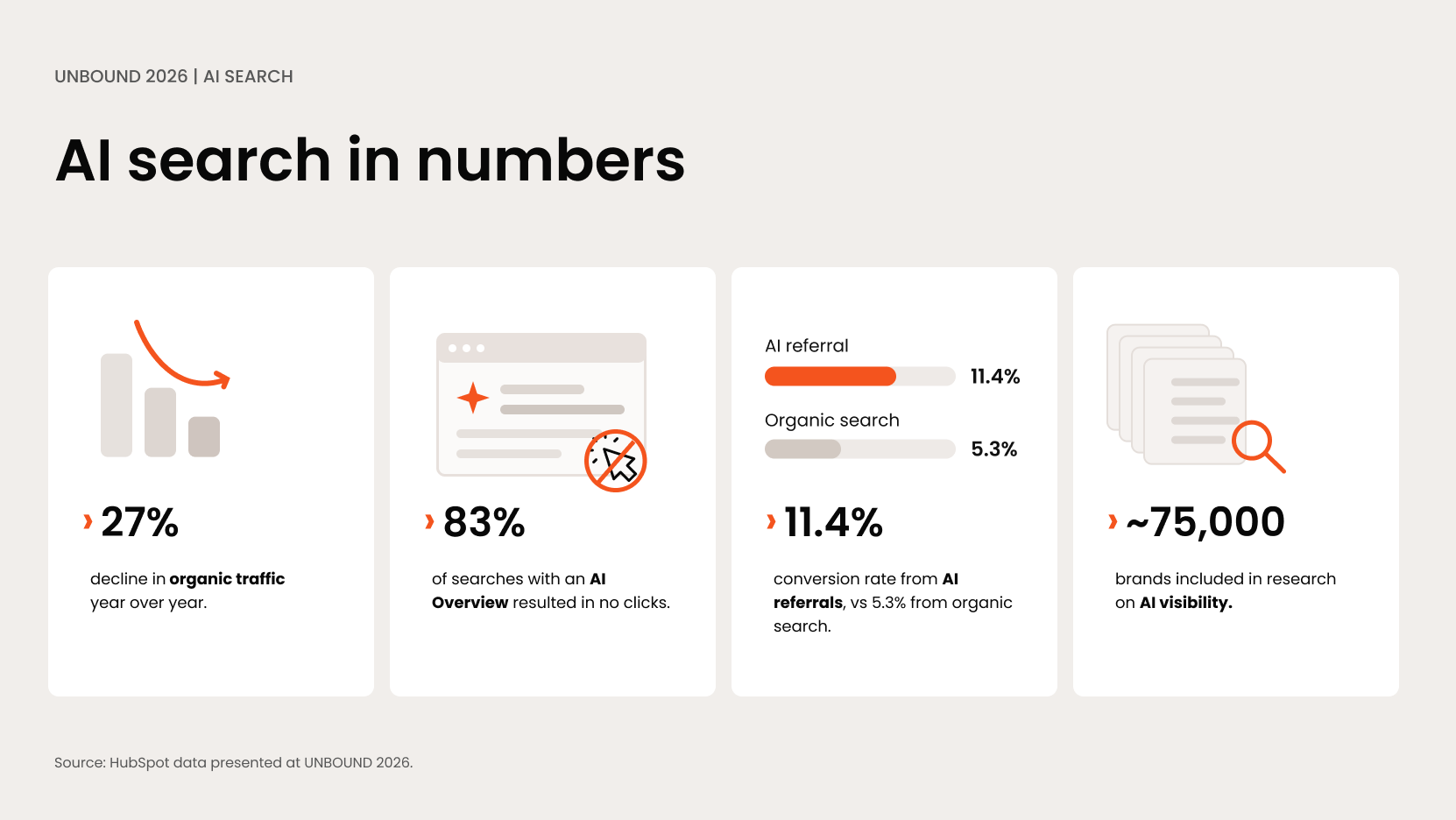
- 27% decline in organic traffic across HubSpot's customer base year over year
- 83% of searches with an AI Overview resulted in no clicks
- 11.4% conversion rate from AI referral traffic, compared with 5.3% from organic search
- ~75,000 brands included in research examining the relationship between brand mentions and visibility in AI-generated answers
These figures reflect the specific datasets and research presented at UNBOUND rather than universal benchmarks for every B2B company. But they point towards a change worth preparing for: visibility inside AI-generated answers is becoming increasingly important alongside ranking in traditional search.
SEO and AEO aren't competing disciplines. They're stacked. SEO helps content rank in traditional search. AEO helps companies and their content get cited and represented accurately in AI-generated answers. Many of the foundations overlap: clear structure, direct answers, credible evidence and distinct points of view make information easier for people and machines to understand.
One finding presented at UNBOUND deserves particular attention. Research across roughly 75,000 brands suggested that the frequency with which a brand is mentioned across the web correlates strongly with its appearance in AI-generated answers.
AEO isn't only about optimising your own website. It also involves whether independent sources corroborate what you say about yourself.
For B2B marketers, that means creating clear, actionable information, supporting important claims with evidence, and building credibility beyond your own website.
Why doesn't more information make B2B buying easier?
AI makes information easier to find, but complex B2B decisions still require buyers to evaluate alternatives, understand risk, build internal agreement and justify decisions to other stakeholders.
That means marketers need to ask different questions:
- Does our content help someone understand their situation?
- Does it help them compare approaches?
- Does it address other stakeholders' concerns?
- Does it explain important trade-offs and risks?
- Does it give an internal champion something credible to bring into the next meeting?
As producing information gets easier, helping people make sense of it becomes more valuable. The goal isn't more information. It's reducing uncertainty and helping customers move forward.
If customers can already find plenty of information, prioritise content that helps them compare alternatives, evaluate risk, and build internal agreement.
Why does human judgment matter more as AI makes production easier?
As AI lowers the cost of producing competent-looking work, someone still has to decide what should be created, whether the reasoning holds up and whether the output actually helps the customer.
This theme ran through several UNBOUND sessions. Kieran Flanagan and Kipp Bodnar discussed taste and continuous learning. Richard Seroter challenged attendees not to outsource their thinking.
At Zooma, we use the term "generalist specialist": someone with enough depth to understand a discipline well and enough breadth to see how it connects to the wider business. AI makes that combination more valuable.
A marketer still needs to understand the commercial consequences of a decision. A seller needs to understand how credibility is built before a conversation. A technical specialist needs to understand the customer context that the system is supposed to support.
AI can give all of them access to more information. But access to an answer doesn't confer the expertise to judge whether it's good.
If AI saves your team time in production, reinvest some of that capacity in customer understanding, expertise, critical thinking, and better decision-making.
Why is the biggest AI opportunity organisational?
Successful AI adoption in established B2B companies is an organisational challenge because AI depends on how knowledge is captured, maintained, shared, governed and turned into action.
Consider the questions AI adoption creates:
- Who owns customer knowledge?
- Who keeps the context AI uses current?
- What happens to something learned in a sales meeting?
- Does that insight reach content, service or product decisions?
- Which information should be trusted?
- Who is accountable when it changes?
These aren't primarily technology questions. They are questions about how an organisation learns, remembers and makes decisions.
UNBOUND showed plenty of examples of individuals, teams and specific workflows using AI. What we didn't see was a complete example of an established, complex B2B company applying these principles across marketing, sales, service and the wider customer relationship.
That's the case we want to see next: legacy systems, different markets, conflicting definitions, governance, adoption and all.
For established B2B companies, AI readiness therefore isn't only about choosing technology. It also means deciding how customer knowledge is captured, who owns it, how it stays current and how insights move across the organisation.
What should established B2B companies do next?
Start using AI. Experiment. Test agents. Explore AI search. Find small use cases where the outcome can be understood and evaluated. But don't confuse access to AI with readiness for AI.
The bigger work is making organisational knowledge useful:
- Capture what you learn about customers.
- Improve the quality of your CRM and data.
- Make ownership and responsibilities explicit.
- Connect insights across marketing, sales and service.
- Create content that is clear, credible and consistent.
- Give people enough expertise and time to challenge what AI produces.
- Run bounded AI experiments to learn where better context produces better outcomes.
Then use AI to amplify those foundations. Access to capable AI will keep becoming more ordinary. What won't be ordinary is having relevant, reliable knowledge to give it, people capable of judging what comes back, and an organisation able to turn that combination into better decisions for customers.
The AI advantage won't come from access to the same tools. It will come from what your organisation knows, remembers and can do with them.
