
- Learn
- The B2B Enablement Hub
- How long does it take to see results from HubSpot optimisation?

HubSpot optimisation shows results on two clocks: operational results, such as clean data, working pipelines, usable reporting and teams following the agreed process, typically appear 4–8 weeks after the optimised setup is live and your teams are onboarded. Commercial results, where you start to see some numbers, typically follow within one to two of your sales cycles.
Why the timeline question matters more in 2026
Many B2B companies in 2026 are not buying HubSpot for the first time. They already have a portal that is underused, built on a standardised setup, or no longer matches how the business works. The question has shifted from "how long until we launch?" to "how long until this investment starts paying off?"
That is a different question from implementation time. If you want to know how long it takes to go from kickoff to launch, read How long does a HubSpot implementation actually take? This article is about what happens after launch: when you can expect to see a difference, and what decides whether you see it sooner or later.
Takeaway: time to launch and time to results are two separate timelines, and a realistic plan needs both.
What are the two clocks of HubSpot results?
Operational results come first, and commercial results come second, because the second depends on the first. You cannot win more deals from a pipeline your sales team doesn't trust.
Operational improvements can become visible before any change in revenue or retention, depending on what you are fixing. That is why we agree a baseline and milestones for both clocks before the work starts.
Clock 1: Operational results (4–8 weeks)
Operational results are changes in how your teams work and how reliable your data is. In my experience, they show up 4–8 weeks after the optimised setup is live and the teams are fully onboarded. That is when you can see how well the processes work in practice, where teams are getting comfortable, and where bottlenecks need to be resolved.
Typical operational results:
- Contact and company records are clean enough that sales trusts them.
- Deal pipelines reflect your actual sales process, so stages mean the same thing to everyone.
- Reporting can be pulled in minutes instead of being rebuilt by hand in spreadsheets.
- Marketing-to-sales lead handoff happens inside HubSpot, with a clear owner and next step.
- Teams follow the agreed process instead of working around the system.
Clock 2: Commercial results (1–2 sales cycles)
Commercial results are changes in revenue-related outcomes: qualified opportunities, conversion rates, win rates, sales cycle length and retention. A good rule of thumb is one to two of your own sales cycles. If your typical deal takes three months, look for commercial movement within three to six months. If you sell industrial equipment with a 6–18 month cycle, as many manufacturing companies do, the commercial clock is correspondingly longer. Anyone promising overnight revenue impact from a platform change is overselling.
Takeaway: measure operational results in weeks and commercial results in sales cycles, never the other way around.
What does a realistic results timeline look like?
A realistic timeline starts at go-live, not at kickoff, and stacks operational milestones before commercial ones.
| Phase | When (from go-live) | What you should see | What to measure |
|---|---|---|---|
| Onboarding | First weeks | Teams trained on their own portal, not a demo | Logins, completed training, open questions |
| Operational results | 4–8 weeks | Clean data, working pipelines, usable reports, process adherence | Data quality, pipeline accuracy, adoption per team, handoff speed |
| Early commercial signals | Within the first sales cycle | More leads followed up, better-qualified opportunities | MQL-to-SQL conversion, follow-up speed, opportunity volume increase |
| Commercial results | 1–2 sales cycles | Higher win rate, shorter cycle, marketing-influenced pipeline | Win rate, cycle length, pipeline by source, retention |
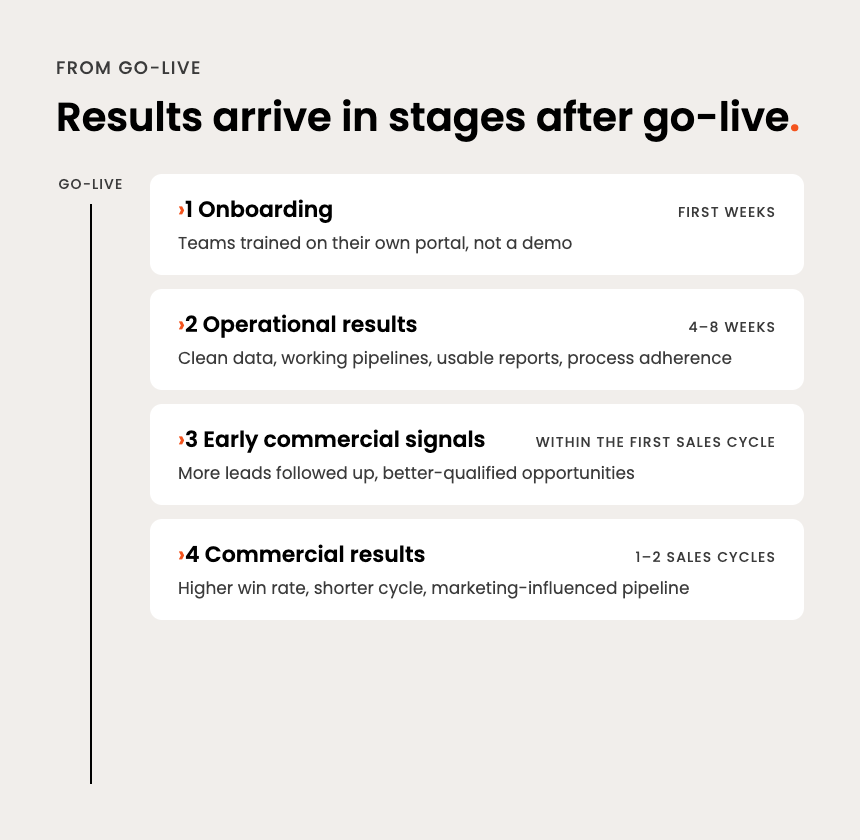
The exact weeks depend on scope. Fixing pipeline stages and reporting in Sales Hub moves faster than rebuilding a data model across Marketing Hub, Sales Hub and Service Hub.
What speeds up or slows down results?
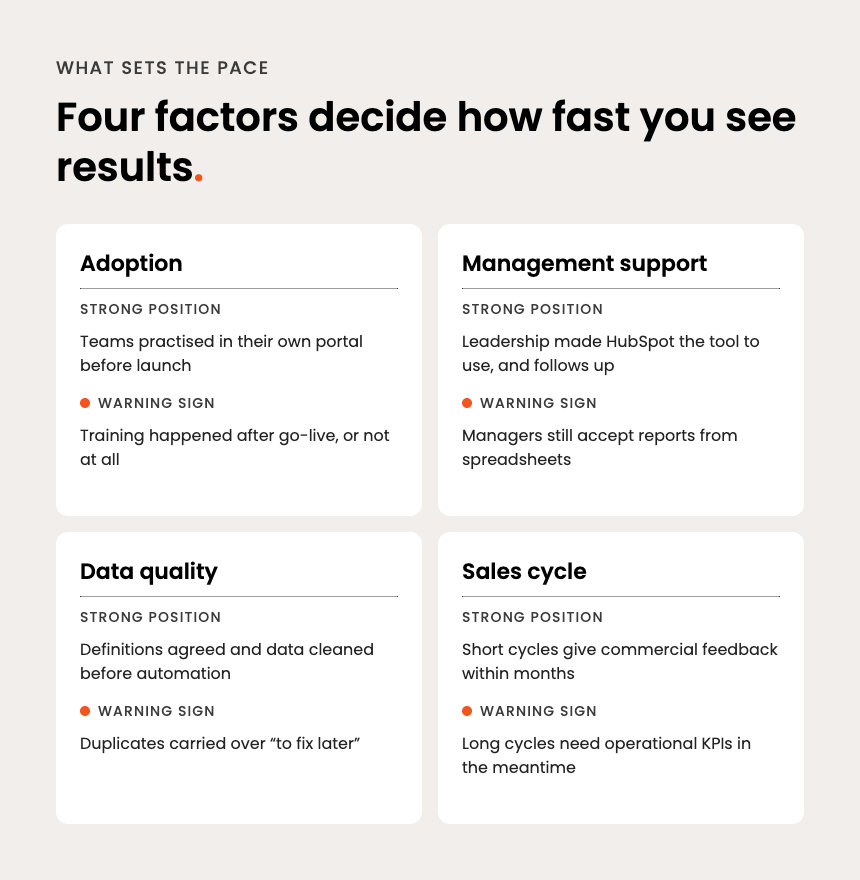
Four factors decide where in the range you land: adoption, management support, data quality and the length of your sales cycle. Here is how to tell whether each one is working for you or against you.
| Factor | Strong position | Warning sign |
|---|---|---|
| Adoption | Teams learned HubSpot before launch and practised in their own portal with real data | Training happened after go-live, in a demo environment, or not at all |
| Management support | Leadership has made HubSpot the tool to use and follows up on it | Managers still accept reports from spreadsheets and email |
| Data quality | Definitions (Lead, MQL, SQL, Customer) are agreed and data cleaned before automation | Duplicates and conflicting fields carried over "to fix later" |
| Sales cycle | Short cycles give commercial feedback within months | Long cycles mean you need operational KPIs to judge progress in the meantime |
Adoption
Adoption is the single biggest accelerator. People adopt new ways of working when they have time to learn the system before they are expected to work in it, and when they can see how it makes their own work easier. That is why we train teams in their real portal, with their own setup, before launch, so go-live is not a shock.
Management support
Without management support, teams fall back into familiar habits and results stall. There needs to be a clear direction from management that this is now the tool to use, and that people are measured on what happens in HubSpot.
Data quality
Bad data invalidates every other number. If your reports pull from duplicated or inconsistent records, you won't see operational results, because nobody will trust the dashboards that should show them.
Sales cycle length
Your sales cycle sets the floor for commercial results. No optimisation can make a 12-month buying process show revenue impact in six weeks. What it can do is give you trustworthy leading indicators while you wait.
Takeaway: if results are slow, check adoption and management support before you blame the platform.
Dare to ask: questions for your HubSpot partner
The best way to test a partner's timeline is to ask questions that force specifics.
- "Which results do you expect in the first 4–8 weeks, and which only after one or two of our sales cycles?"
- "What baseline will we measure against, and when do we set it?"
- "How and when will you train our teams?"
- "What do you need from our management team for adoption to stick?"
- "What happens if we are not seeing operational results at the agreed checkpoint?"
A partner who answers with one timeline for everything, or promises revenue impact within weeks, hasn't separated the two clocks.
When this timeline doesn't apply
The 4–8 week and 1–2 sales cycle ranges assume a scoped optimisation of an existing HubSpot portal with teams available to learn it. They don't apply in these situations:
- You are implementing HubSpot from scratch. Add the implementation itself first; a core launch typically takes 8–16 weeks before the results clock starts.
- The fix is small and technical. A single broken workflow or report can show results within days. Don't wait weeks to judge it.
- The setup doesn't match how the business works. If the portal was built on a standard template rather than your real processes, optimisation may not be enough. You may need to redesign the architecture first.
- Your teams have no time to learn. If people can't be released for training, expect the operational clock to run slower, regardless of how good the setup is.
Key takeaways
- Set a baseline for both operational and commercial KPIs before any optimisation work starts. It is low effort and makes every later result provable.
- Expect operational results 4–8 weeks after the optimised setup is live and teams are onboarded, and judge progress against those first.
- Expect commercial results within one to two of your own sales cycles, and plan reporting around that horizon.
- Secure visible management support before launch. It is the cheapest way to speed up adoption.
- Clean data and agree on definitions before automating. Skipping this step is the most common reason results stall.
