
- Learn
- The B2B Enablement Hub
- What happens after the initial project — do you offer ongoing support?

Yes. After the initial project, we offer ongoing support in two models: ad hoc help that you call on when a problem comes up, or a rolling arrangement with an agreed number of weekly hours. In both, your team owns the day-to-day work. Our support adds capacity and specialist knowledge, not life support for a system you can't run.
Why ongoing support matters now
Ongoing support matters because a HubSpot launch is the start of how your teams work, not the end of a project. A core implementation typically takes 8–16 weeks to launch. Operational results usually show within 4–8 weeks after that, and commercial results within one to two sales cycles. Most of the questions, fixes and improvements arrive in that period after go-live, when people start using the system for real.
What has changed in 2025–2026 is the pace of the platform itself. HubSpot releases new features and AI capabilities continuously, and B2B companies keep adding markets, teams and use cases. The question buyers ask is no longer "will the agency disappear after launch?" but "what kind of help will we need, and how do we avoid paying for help we don't need?"
What ongoing support models does Zooma offer?
We offer two models under our Advice and Support offering. The difference is how predictable your need for help is.
Model 1: Ad hoc support. You contact us when you face a problem that needs our help. We estimate the work, plan it based on the availability of our team, deliver it, and invoice you monthly for the hours actually worked. There is no fixed commitment.
Model 2: Rolling support. We agree a number of hours per week dedicated to you. Those hours are invoiced as a retainer, and we meet regularly to go through your open issues, the support you need and your priorities. If you don't use all the hours in a month, they are saved for the following months.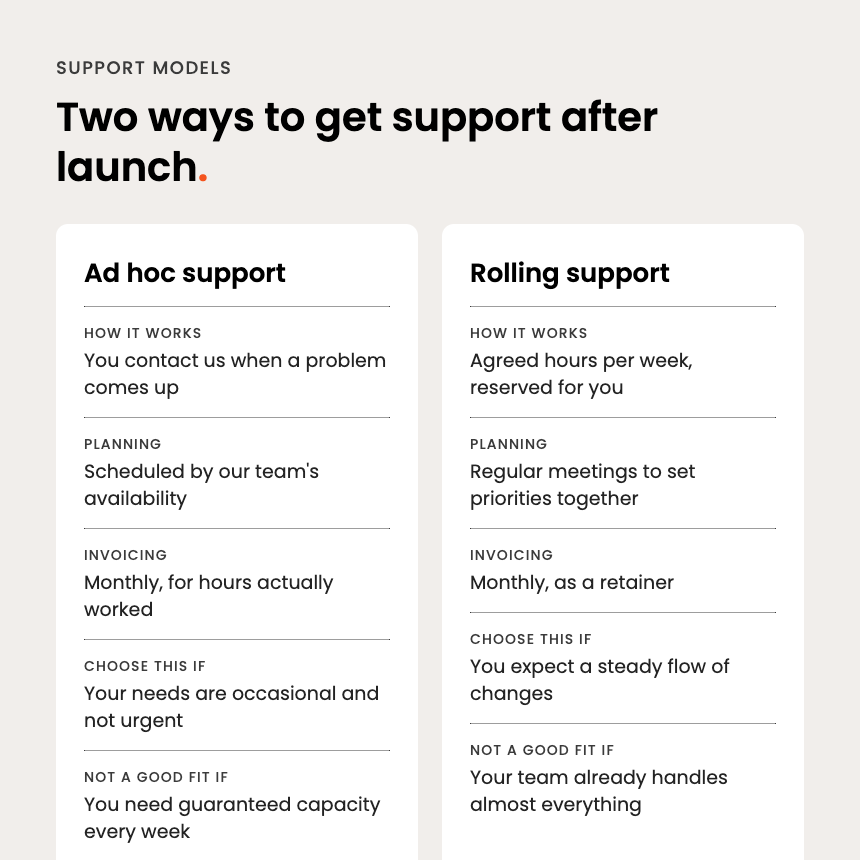
Choose ad hoc support if you mainly need a safety net. Choose rolling support if you know you will keep developing your HubSpot setup, for example with new automation, reporting or campaigns, and want a team that already knows your portal and priorities.
What does ongoing support actually cover?
Ongoing support covers anything that builds on the foundation from the initial project. In practice, the requests I see most often fall into five groups:
- Troubleshooting: a workflow that stopped behaving, a broken integration or data that doesn't look right.
- Optimisation: improving existing pipelines, lead handoff, automation and dashboards once you see how people use them.
- New capabilities: adding Service Hub, new reports, new automation or features HubSpot has released since launch.
- Training: refreshing skills for existing users or helping you train new colleagues.
- Strategic advice: periodic reviews of what's working and where to invest next.
What it doesn't cover is the daily operation of your system. Day-to-day tasks, such as updating records, running standard campaigns and maintaining pipelines, should be owned by your team. That is a deliberate choice: we design the initial project so your people can handle the basics themselves.
How does support change over time?
Support is usually highest right after launch and then decreases as your team becomes more self-reliant. In the first weeks after go-live, people run into real situations the training didn't cover, and that is when a quick answer prevents bad habits forming.
As your team gains confidence, the requests shift from "how do I…?" to "can we also…?". That is a healthy sign. It means support is moving from fixing to developing.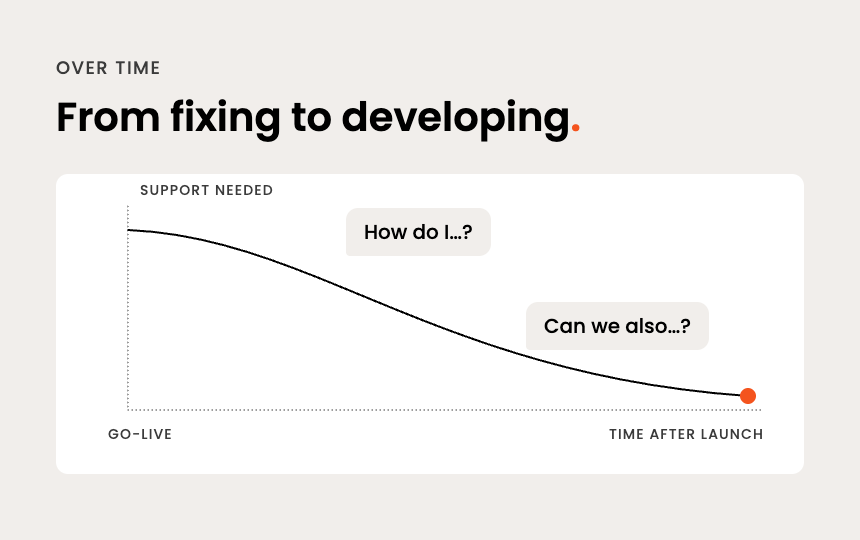
The goal of ongoing support is that your need for us shrinks over time, while the value of each request grows.
What happens when we expand to new teams or markets?
Expanding is faster than the original project, because the foundation is already in place. When you add a new market, business unit or team, we build on the data model, processes and naming you already use, instead of starting over.
In many cases, your own team can handle parts of the onboarding and training themselves, because they have done it before. Our role is then to handle what's genuinely new: local requirements, new pipelines or integrations, and making sure the expansion doesn't break what already works.
When ongoing support isn't the right answer
Ongoing support isn't always the right answer. Here are the exceptions I'd point out to any client:
- If you need a full rebuild, support hours won't fix it. If your setup doesn't reflect how your business works, patching it hour by hour costs more than a scoped project. Plan a new project instead.
- If you need more hands for daily work, consider hiring. Support adds specialist capacity. If the real gap is someone to run campaigns or update the CRM every day, an internal hire is usually the better investment.
- If your team never learned the basics, start with training. Buying support to do routine tasks for you creates the dependency you wanted to avoid.
- If your needs are rare, don't commit to a retainer. Ad hoc support is the better choice when months pass between requests.
Actionable takeaways
- Before the initial project ends, agree in writing what your team will own and where you expect to need outside help.
- Choose ad hoc support if your needs are occasional, and rolling support if you expect a steady stream of improvements.
- Expect more support in the first weeks after launch, and plan for that need to decrease.
- Review your support arrangement every few months and adjust the hours to how much change you are actually making.
- Use support for development and specialist problems, not for daily operations your team should own.
