
- Learn
- The B2B Enablement Hub
- How do I know if our marketing and sales teams are misaligned?

Your marketing and sales teams are misaligned if the following signs show up: sales doesn’t use what marketing produces, leads wait for follow-up, the teams define “qualified” differently, CRM data conflicts, and nobody can say what marketing contributes to revenue. If two or more are true, misalignment is already costing you revenue.
This checklist is for marketing and sales leaders at B2B companies where the two teams depend on each other. If one person runs both functions, the signs look different. I cover that under the exceptions.
Why is misalignment hard to see from the inside?
It is hard to see because each team can look successful on its own numbers. Marketing reports leads and engagement, sales reports pipeline and closed deals, and both dashboards look fine. The gap sits between them at the handover, where nobody's report looks.
In 2026, that handover carries more weight than before. Buyers do more of their research before they contact sales, so the moment marketing passes a lead to sales decides more of the outcome.
The five signs, and how to check each one
Each sign below comes with a question to ask your team. Ask marketing and sales separately, then compare the answers.
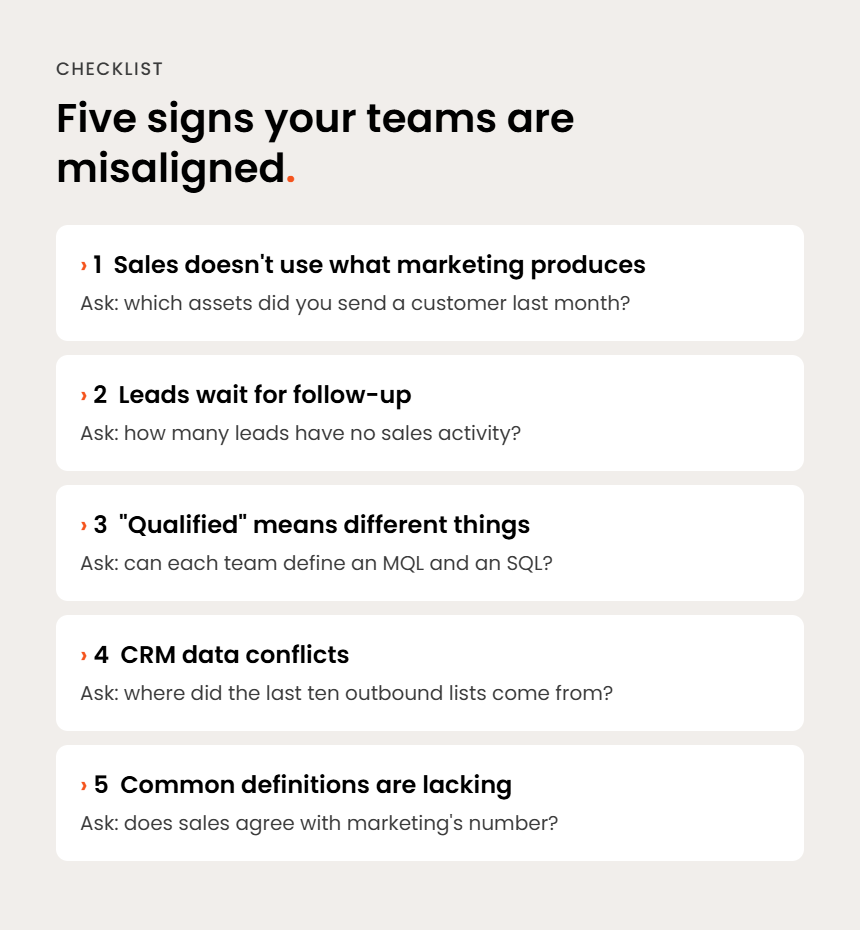
1. Sales doesn’t use what marketing produces
This is the clearest sign, and the one I see most often when I start with a new client. A clear sign is when marketing produces content, campaigns, or materials that sales doesn’t use, while sales falls back on its own traditional methods and marketing gets little feedback on why.
Questions to ask: "Which three marketing assets did you send to a customer last month?"
2. Leads wait for follow-up
Leads that marketing hands over sit in an inbox or a pipeline stage until they are no longer active. Nobody is clearly responsible for the first contact or for how fast it should happen.
Questions to ask: “How many of last quarter’s marketing leads have no recorded sales activity?”
3. "Qualified" means different things
Marketing calls a lead qualified when it matches a profile and has shown interest. Sales calls it qualified when there is a real buying need. Both are reasonable. The problem is that they aren't the same, and nobody wrote down which one counts.
Questions to ask: “Can each team write its definition of an MQL and an SQL in one sentence each?"
4. CRM data conflicts
The number of contacts, companies, or open deals depends on who you ask and which system they check. Sales reps build their own prospect lists because they don’t trust the shared ones.
Questions to ask: "Where did the last ten lists come from?"
5. Do sales and marketing use the same figures to measure marketing’s impact on pipeline and revenue?
If sales and marketing use different definitions or disagree on the figures, they lack a shared view of marketing’s contribution to pipeline and revenue.
Questions to ask: “What did marketing contribute to revenue last year, and does sales agree with that number?”
Aligned team vs. warning sign
| Area | Aligned team | Warning sign |
|---|---|---|
| Content | Sales uses marketing content and tells marketing what works. | Sales builds its own material. |
| Follow-up | Every handed-over lead has a named owner and a response time. | Leads sit untouched. |
| Definitions | MQL and SQL are written down and shared. | Each team uses its own meaning. |
| Data | One shared view of contacts, companies and deals. | Numbers differ by system and team. |
| Revenue | Both teams report the same pipeline numbers. | Nobody can state marketing's contribution. |
| Service | Service sends customer feedback to marketing and sales. | Service hears problems nobody else sees. |
My colleague Stellan Björnesjö puts the threshold plainly in his guide to aligning marketing, sales and service in practice: two or more of these signs are costing you pipeline.
What causes the signs?
The signs are symptoms of three foundation gaps: definitions, processes, and goals. Misaligned definitions, processes, and goals are another strong indicator, especially when teams depend on each other but operate as separate functions rather than working toward shared outcomes.
There is one more test: ask marketing, sales and service separately who your priority customers are, what matters to them and why they choose you. Different answers mean you need a shared commercial understanding before anything else.
The takeaway: misalignment is rarely about attitude. It is a gap in definitions, processes and goals, and it can be fixed.
Where this applies, and where it doesn't
- Small teams. If one person owns both marketing and sales, look for gaps between that person and service or delivery instead.
- New setups. In the first months after a reorganisation or a new CRM, some of these signs are normal. Reassess again after one full sales cycle.
- Account-based selling. If you sell to a small number of named accounts, reps building their own lists may be deliberate. The question is whether marketing helped build them.
- Not a people problem. Don't start by replacing people. Start with definitions and handovers.
Actionable takeaways
- This week. Run the five questions above with one marketing lead and one sales lead in the same room.
- This week. Ask each team to write down its definition of a qualified lead, and compare the answers.
- This month. Agree on one shared definition of an MQL and an SQL and who acts on each.
- This quarter. Set up one shared dashboard both teams review together, with a step where sales tells marketing why leads or content didn’t work.
