B2B enablement connects the people, processes, content, data and technology that help a company market, sell and serve customers effectively. Its aim is to build a capability the organisation can sustain and improve itself.
That capability matters when customer understanding, responsibilities and information are spread across teams. Shared definitions and ways of working help those teams turn customer needs into coordinated action.
I’m writing for CEOs, CMOs, sales directors and digital transformation leads at mid-sized and large B2B companies. If you sell a simple product through one channel with one team, most of this effort is more than you need.
Why is B2B enablement on the agenda in 2026?
It is on the agenda because the cost of disconnected teams has become visible. Through 2025 and 2026, many B2B companies have started formalising marketing-sales alignment as Revenue Operations (RevOps), with shared data and KPIs. At the same time, buyers increasingly research suppliers through AI assistants and search before they speak to sales, a shift I describe in your buyers are elsewhere: what should your marketing do?.
Both shifts punish the same weakness. If marketing, sales and service each tell a different story, use different definitions and keep different data, buyers notice it, and leadership can’t measure it.
What does "enablement" actually mean here?
Enablement means making your organisation able to do something it couldn't do reliably before, and able to keep doing it without outside help. In our words, B2B enablement helps your company turn customer understanding into better decisions and more targeted marketing, sales and service.
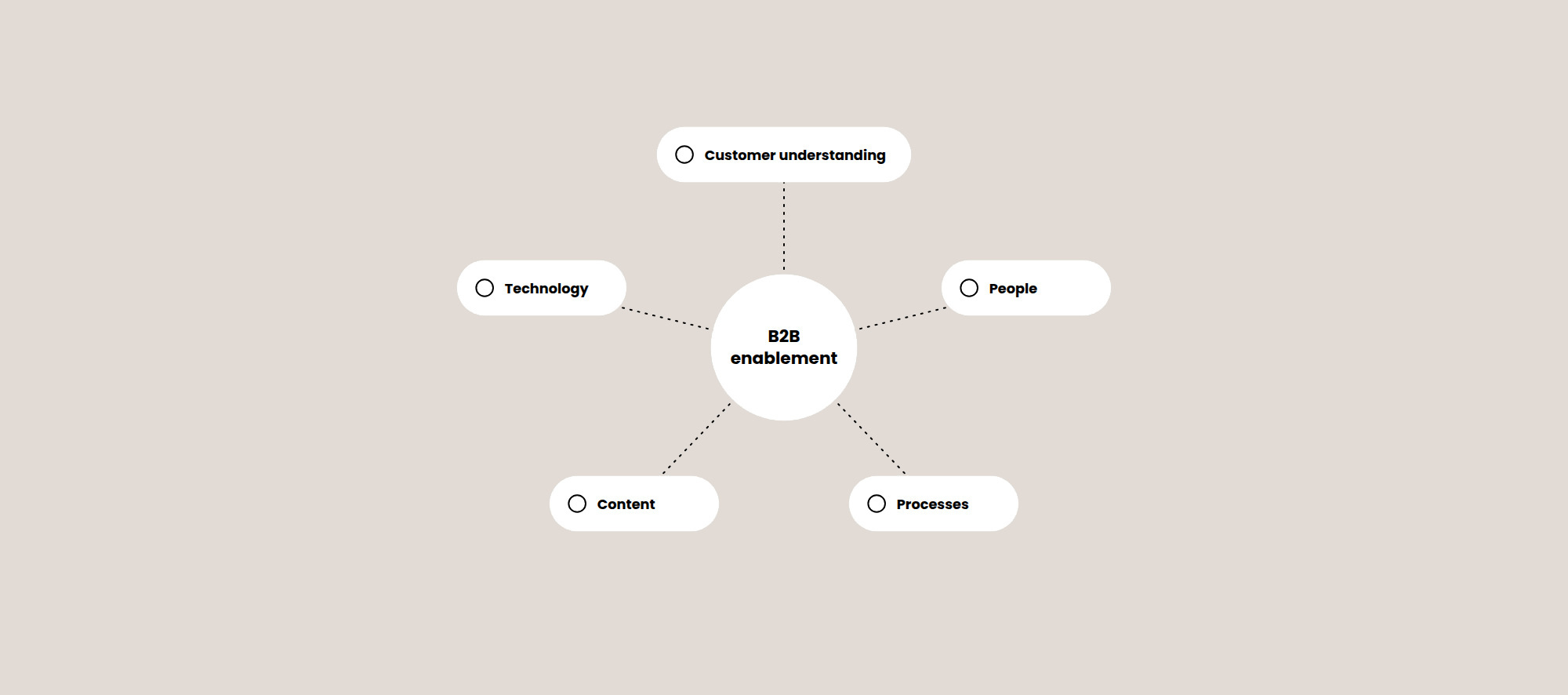
In practice, it connects five things:
- Customer understanding. A shared, validated view of who your priority customers are, what matters to them and why they choose you.
- People and responsibilities. Who owns each step from first contact to renewal.
- Processes and definitions. What a qualified lead is, what happens next and who acts on it.
- Content and evidence. What each buying role needs to see in order to move forward.
- Technology. A CRM and platform, often HubSpot, is set up to support all of the above.
My colleague Sheila Ghamkhar, project manager at Zooma, often adds an element leadership teams often overlook: shared terminology. Enablement, as she puts it, aligns "people, processes, terminology, decisions, and ways of working" so everyone works toward the same goals.
What is an example of B2B enablement?
Consider an industrial supplier whose marketing team generates application enquiries, but whose sales team receives too little context to follow them up effectively. After a sale, service has to ask the customer for information already collected by sales.
In this illustrative example, an enablement initiative connects the work:
- Agree what a qualified enquiry means. Marketing and sales define the customer fit and application information needed for a useful conversation.
- Make the handover usable. The enquiry reaches a named sales owner with the requirements, relevant history and an agreed next action.
- Carry the context into onboarding. Service receives the agreed scope, customer goals and responsibilities.
- Review the outcome together. The teams examine follow-up, customer feedback and progress using shared definitions and reliable data.
- Build internal capability. Named owners learn to maintain the process, reports and supporting workflows.
The change is a connected way of working that the company can sustain. A campaign, a CRM or a training session may contribute, but none of them on its own describes the whole initiative.
How is B2B enablement different from generic marketing services?
Generic marketing services improve specific activities. Enablement improves the system those activities run in. A campaign, a website, or a content plan can be excellent and still fail to generate revenue because the lead handoff, definitions, or the data behind them don’t work.
| Generic marketing services | B2B enablement | |
|---|---|---|
| Improves | Specific activities: campaigns, content, brand | The connected system across marketing, sales and service |
| Measured on | Reach, engagement, leads | Pipeline, conversion, retention and self-reliance |
| Changes | What marketing produces | How the company wins and keeps customers |
| Ends with | Delivered assets | A capability your team can sustain |
To be fair to the counter-view
The obvious objection is that enablement is just a new label for good marketing. There’s something to it: skilled marketers have always cared about sales. But caring isn’t the same as owning. When nobody owns definitions, handoffs, and shared data, even the best campaigns fail to fix these issues. Enablement makes that accountability explicit.
Why does disconnection stall growth?
Disconnection stalls growth because each team optimises its own part, while the whole becomes slower and more expensive. Marketing produces leads that sales doesn’t trust. Sales promises what service can’t deliver. Nobody can show which activities actually create revenue.
The difference is between "doing digital" and having a system that compounds. A connected system improves every quarter because each team learns from the others. A disconnected one has to be pushed every quarter by individuals working around it.
The takeaway: growth that depends on individual heroics doesn’t scale, while success based on shared definitions, data and responsibilities does.
What does this look like in a customer project?
Zooma's work with Interwheel combined a new brand, a HubSpot-based website and training for sales and service teams. It provides a documented example of strategy, implementation and team capability being developed together. Read the case for the project scope and reported outcomes.
Do you need B2B enablement? A quick self-check
You probably need enablement, rather than more marketing activity, if two or more of these are true.
| Symptom | What it usually means | Typical first step |
|---|---|---|
| Sales doesn’t follow up on marketing leads | No shared definition of a qualified lead. | Agree on definitions and a handoff or alignment. |
| Sales doesn’t use marketing content. | Content isn’t built from sales and customer input. | Map content to buying stages with sales input. |
| CRM data and marketing data disagree. | Several sources of truth. | Define data ownership and one source of truth. |
| Nobody can state marketing's revenue influence. | Teams measure differently. | Agree on shared KPIs and a baseline. |
| HubSpot or your CRM is paid for but underused. | Platform set up without clear processes. | Review the setup against how you actually sell. |
| Service hears problems marketing never sees. | No feedback loop from service. | Add service to the shared review. |
At Zooma, we hold a simple position: enablement is only finished when you no longer need us for it. That is also why self-reliance is one of the four levels we use to measure success in an enablement engagement. That doesn’t rule out a long-term partnership. It means the partnership is a choice based on value, not a dependency.
Where this applies, and where it doesn’t
- It applies to companies with several teams involved in winning and keeping customers, long sales cycles, and buying groups with multiple roles, typical in manufacturing, industrial tech, energy, professional services, and technology.
- It applies less to small companies where one person runs marketing and sales. You need clarity, not a formal programme.
- It doesn’t fix a product, pricing or market problem. If customers don’t want what you sell, better alignment only helps you find out faster.
- If you only need capacity, such as more content or more campaigns, a marketing agency or an extra hire is the better fit.
Actionable takeaways
- This week (low effort, high impact). Ask your marketing, sales and service leads separately who your priority customers are and why they buy. Different answers are your clearest sign of disconnection.
- This month (low effort). List the five most important terms in your commercial process, such as lead, MQL, SQL and customer, and confirm whether every team defines them the same way.
- This quarter (medium effort). Agree on one shared dashboard that marketing, sales and service all use in the same meeting.
- Before you invest in new technology. First, please clarify definitions, ownership, and data. Technology amplifies whatever process it is given.
Related definitions
These terms explain parts of a B2B enablement initiative:
- Lead handover: transferring responsibility with the context and next action clearly defined.
- CRM adoption: using the CRM consistently in everyday work.
- Customer onboarding: helping a new customer start successfully.
- Self-reliance: the ability to operate and improve your own processes and platforms.
For the concise definition and further examples, see B2B enablement in Zooma's glossary. To understand the delivery approach, explore Zooma's methodology.
Is enablement the right next step?
If you're weighing whether your growth problem is effort or disconnection, we're more than willing to talk it through.