
- Learn
- The B2B Enablement Hub
- What is Online vs Digital?

"Online" means being connected to the internet. "Digital" means using technology, data and connected systems to create value, whether or not anything is connected at that moment. When B2B teams treat the two as the same thing, they set the wrong requirements, and marketing, sales, service, and IT end up working towards different definitions of success.
Over the years, I've asked many B2B leaders how they define "online" and "digital". The answers vary, and that is a problem. If a leadership team can't agree on what the words mean, it can't agree on what to build or how to measure it. In this article, I explain the difference, show what happens when it's blurred and suggest how to build a more digital mindset in your teams.
What is the difference between online and digital?
Online describes a state: being connected to the internet. Digital describes a way of working: using technology, data and connected systems to create value for customers and the business.
| Online | Digital | |
|---|---|---|
| What it describes | Being connected to the internet | Using technology, data and connected systems to create value |
| Depends on a live connection | Yes | No. It can work offline and synchronise later |
| Typical example | A website, a web form, an online meeting | A field service app that stores data locally, or shared customer data that connects marketing, sales and service |
| The question it answers | Can people reach this over the internet? | Does this create value for the people using it? |
Can something be digital without being online?
Yes. An audio file stored on physical media is digital but not online. The reverse matters just as much: having a website doesn't make a company digital. Being online is one possible feature of a digital service, not its definition.
Why does mixing up online and digital cause problems?
Because the word you choose shapes the requirements. If you call something an online service, the team will build it to depend on an internet connection, even when the people using it often don't have one.
Here's an example from a manufacturer's service organisation. The company described its maintenance app as an "online service", so the project team made an internet connection mandatory. Yet its technicians often work at customer sites without reliable connectivity. When the connection failed, they couldn't access instructions or record their work.
Viewing the app as a digital service rather than an online one would have led to a different requirement: store information locally on the device and synchronise when a connection becomes available.
The takeaway: when a team defines a digital service as an online service, connectivity becomes a fixed requirement instead of a design decision, and the people the service is meant for pay the price.
The same confusion appears at a strategic level. When marketing thinks "digital" means online campaigns and IT thinks it means systems and infrastructure, short-term campaigns and long-term systems pull in different directions.
How do you build a digital mindset in your teams?
Start from outcomes, not channels. At Zooma, we focus less on "doing digital things" and more on thinking about outcomes across every team, every day, with our customers' needs in mind.
In practice, that means aligning teams around shared outcomes and building curiosity about how systems connect, how data moves between them and how each action supports the overall strategy. A digital mindset asks, "What does the person using this need to achieve, and in what situation?" before it asks, "How do we get this online?"
When does the distinction matter less?
For purely web channels, such as a campaign landing page or a webinar, "online" is the correct term, and nothing is lost by using it. The distinction matters most when you set requirements for services, processes, and systems used across teams, in the field, or by customers in different situations.
Actionable takeaways
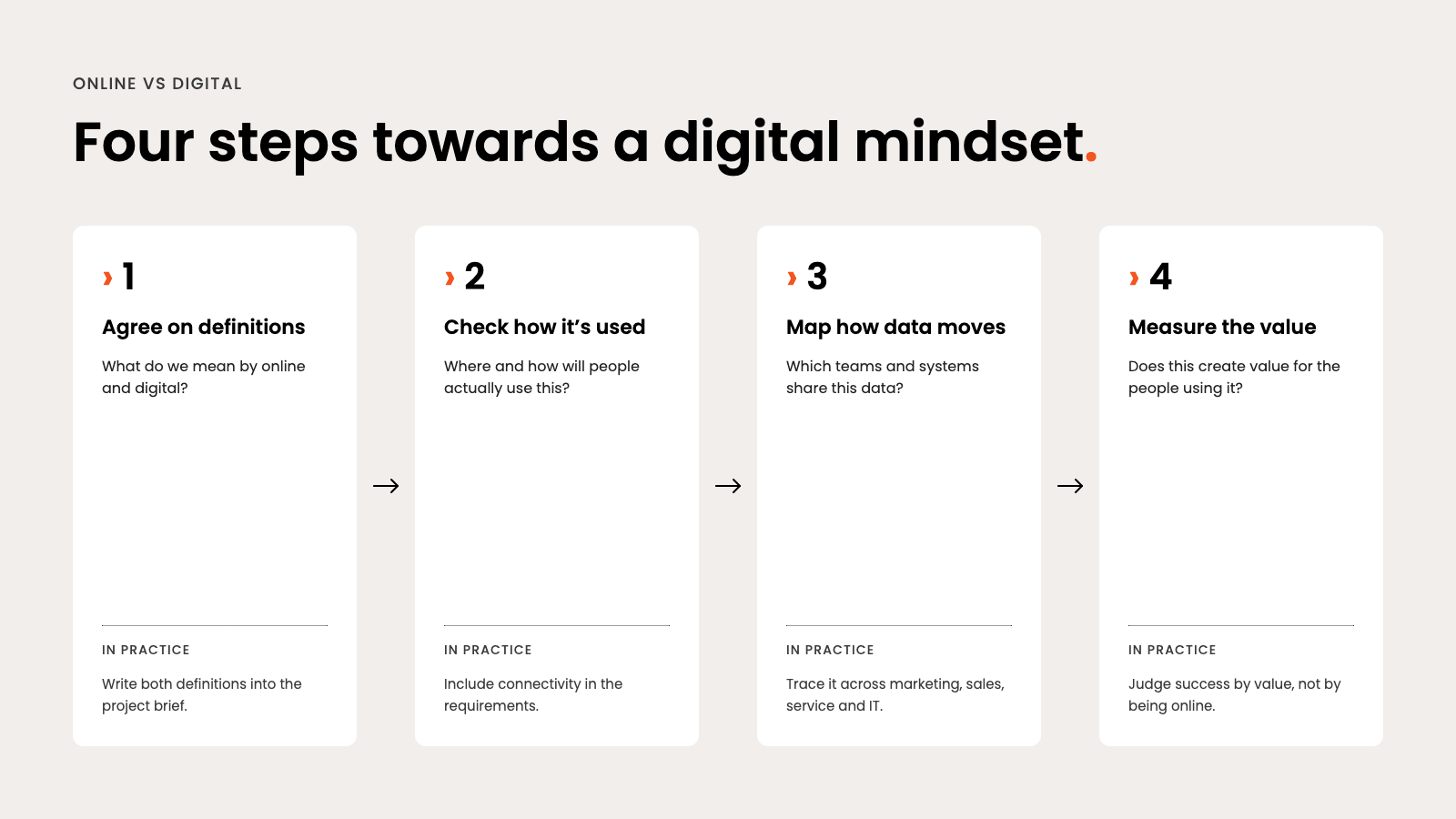
- Agree on what "online” and "digital” mean at the start of every project, and write the definitions into the brief so marketing, sales, service, and IT share them.
- Before writing requirements, ask where and how the service will actually be used, including whether users will always have a reliable connection.
- Map how data moves between teams and systems, so each team can see how its work supports the shared outcome.
- Measure digital initiatives by the value they create for users, not by whether they are available online.
Do you want to discuss how to move from being online to becoming truly digital?
This article was first published on 8 June 2017 and updated in October 2026.
