
- Learn
- The B2B Enablement Hub
- How B2B companies should create and promote a LinkedIn newsletter (step-by-step)

A LinkedIn newsletter is a recurring publishing format that allows B2B companies to distribute long-form content to followers and subscribers. Unlike traditional email newsletters, LinkedIn newsletters are created, hosted, and delivered within LinkedIn, triggering notifications via both the platform and email. This format reduces reliance on feed visibility by ensuring subscribers are alerted whenever a new edition is published.
This article explains when LinkedIn newsletters make sense for B2B companies, how to set one up, and what determines whether it drives sustained engagement.
How is a LinkedIn Newsletter different from a LinkedIn post or article, and when should I use one?
LinkedIn posts, articles, and newsletters differ primarily in length, formatting options and distribution mechanics. We've listed the key differences below:
LinkedIn post
Typical length: ~150 words
Content options: Text, images, video, link
Subscription option?: No
Notifications: No notifications, posts visible in feed and on company page
Content lifespan: Short-lived feed visibility (days to weeks)
Ideal for: Short-term engagement
LinkedIn article
Typical length: ~500–800 words
Content options: Text, images, video, links plus blog-style formatting and embeds
Subscription option?: No
Notifications: No notifications, posts visible in feed and on company page
Content lifespan: Longer discoverability via profile
Ideal for: Standalone thought leadership pieces
LinkedIn newsletter
Typical length: ~1000+ words
Content options: Same as LinkedIn articles
Subscription option?: Yes
Notifications: Subscribers get notified on LinkedIn and email
Content lifespan: Longer discoverability via profile and newsletter archive
Ideal for: Recurring contact with a dedicated audience
Using these content formats in practice
When adding these content types to your output:
- Use LinkedIn posts for quick updates or attention-grabbing content
- Use LinkedIn articles when you need more depth without a recurring format
- Use LinkedIn newsletters for subscription-based distribution and building long-term audience retention
When a LinkedIn newsletter makes sense (and when it doesn't)
LinkedIn newsletters can be effective for B2B marketing, but they're not suitable for every company.
When it makes sense
Your company should consider starting a LinkedIn newsletter if:
-
You have a decent-sized, engaged audience on LinkedIn. If your existing and potential customers already spend time on LinkedIn, you have a large existing base of possible subscribers.
- You have the resources and leadership buy-in to spend time on it. It may take months to build a committed audience, so giving up after 2 newsletters won't generate many benefits.
- You can commit to a consistent publishing cadence. A regular publishing schedule is important to subscribers. Irregular and inconsistent updates will harm engagement.
- You plan to produce knowledge-based content. Users subscribe to newsletters for insights and knowledge from publishers they trust. Newsletters filled with self-promoting marketing content won't attract many subscribers.
- You want a content distribution channel that is less dependent on feed algorithms. Although it takes time, building a loyal and engaged subscriber base will reduce your vulnerability to unpredictable algorithm changes.
When it doesn't
If these statements are correct for your company, LinkedIn newsletters probably aren't for you:
- Your audience isn't on LinkedIn. LinkedIn has over 300 million active users across geographies and industries, but the biggest demographic is high-earning, university-educated professionals between 25 and 40 who are looking for content related to their job or industry. If this isn't your target audience, other platforms will be more effective.
- You lack internal ownership. As a long-term project, newsletters benefit from a comitted project owner who is in it for the long haul. It can't become just another low-priority task for the marketing team.
- You want (or need) short-term results. Building a dedicated subscriber base takes time. Users need proof of quality content, consistently delivered, before signing up. If you want a quick win to boost traffic or conversions, look into other channels.
- Your content is mostly promotional. If you lack the capabilities or sources of information needed to produce quality knowledge content and focus only on promoting your company, few users will see value in subscribing.
How to create a LinkedIn newsletter
Practical guide
Follow these steps to set up your newsletter and publish the first edition.
-
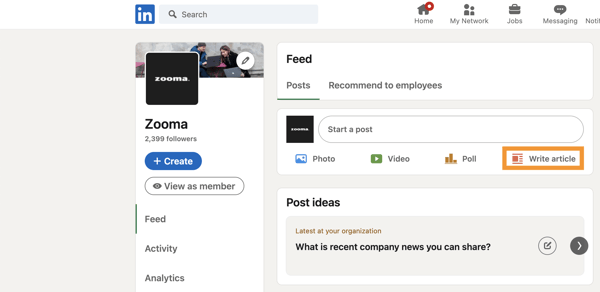
Go to your LinkedIn company page and click “Write article” option ín the 'Start a post' box.
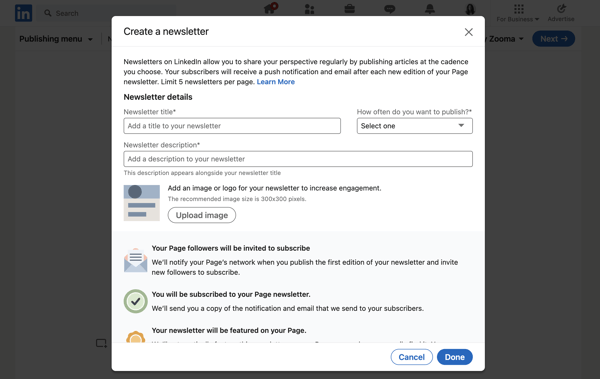
- Navigate to the publishing menu and select 'Create a newsletter'. Here, you will:
- Choose a title for your newsletter
- Specify the publishing cadence (how often newsletters will be released)
- Write a short description
- set a header image for the newsletter page.
- Create the first edition of the newsletter in the blog-style content editor. Once the first edition is published, the newsletter page is automatically created and added to your LinkedIn page.
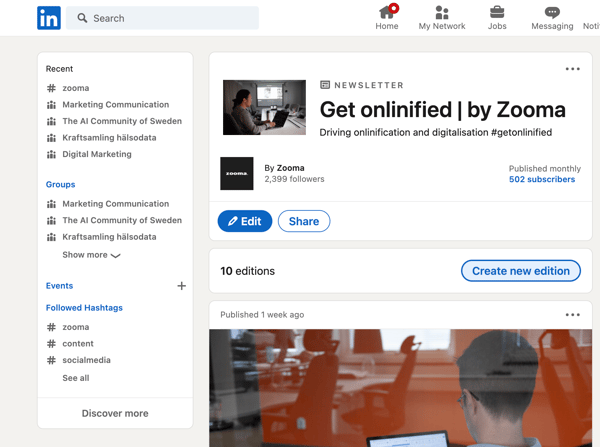
- Once the first edition is published, page followers will receive a notification and email inviting them to subscribe. Subscribers receive notifications in the same way when future editions are published. Now, you can start promoting your newsletter across channels and building your subscriber base.
Strategic considerations
Before launching the newsletter, make sure you have answered these questions:
- Should it be published from your company page, or a personal page? Most company LinkedIn newsletters are published from the company page. However, if there is a well-known figure with a strong personal brand at the company (like a founder or CEO), publishing the newsletter from their personal profile could help you reach a larger audience.
- What is the best publishing cadence for my LinkedIn newsletter? There is no ideal cadence that suits all companies. The best schedule depends on several internal factors :
- Team resources. Choose a publishing cadence that your team can handle and commit to over time.
- Additional communication activity. If your marketing team is publishing a lot of other content types at a high rate, a high-frequency newsletter may overwhelm your audience.
- The amount of valuable content you have to share. A monthly newsletter with high-value insights is better than a daily newsletter with limited value.
- What is the level of demand for newsletters in your audience? Before committing to a LinkedIn newsletter, research if any other newsletters are successfully targeting the same audience. If there are, there is a demand you can compete for. If few newsletters target your audience, there may be an opportunity to fill the gap. Validate your research by using your knowledge of your audience or asking them directly to find out their level of demand.
- How many newsletters should you prepare before launching? Prepare several editions before launching the newsletter. For a weekly or monthly newsletter, three to four prepared editions provide a buffer that will help you keep to your chosen publishing cadence.
LinkedIn newsletter metrics you should track to measure performance
Metrics available in LinkedIn
LinkedIn's built-in newsletter analytics tools are basic, but give you the key figures to understand how your newsletter is performing. Track these metrics to understand the popularity and engagement of the newsletters you are creating:
- Article views
- Definition: The number of times a user (both subscribers and non-subscribers) viewed one of your articles in LinkedIn or in a subscription email.
- What it tells you: A high number of views suggests the newsletter topic and content is attractive to your audience.
- New subscribers
- Definition: The number of members who subscribed to your newsletter in a given date range.
- What it tells you: Strong subscription growth suggests that readers find your content valuable.
- Engagement:
- Definition: The number of engagements on your newsletter editions, including reactions, comments and reposts.
- What it tells you: Engagement indicates how strongly readers respond to your content. If users are taking the time to engage with the content or share it with their network, you are delivering something valuable.
- Subscriber demographics:
- Definition: Personal details about your subscribers. LinkedIn tracks their job title, locatoin, industry, seniority, company size and company name.
- What it tells you: If the listed demographics match your target audience, you are reaching it effectively.
-
Subscribers
-
Definition: The individual LinkedIn users who subscribe to your newsletter.
-
What it tells you: If these individuals belong to your target audience, your newsletter is effectively reaching it.
-
Other metrics not available in LinkedIn (and how to track some of them)
- Link clicks:
- Definition: The number of clicks on each of the specific links in your newsletter.
- What it tells you: Which parts of your newsletter were most interesting and valuable to your readers.
- How to track it: Use a UTM tag builder to add tags to the link URL, allowing you to follow the link performance in your analytics tool.
- Newsletter open rate
- Definition: The percentage of subscribers who opened the newsletter email.
- What it tells you: How effective your newsletter title and topic was.
- How to track it: There is no reliable workaround to find open rates for LinkedIn newsletters. If this metric is highly important to you, consider using another newsletter tool.
- Unsubscribes
- Definition: The number of users who have ended their subscription to the newsletter.
- What it tells you: A rising unsubscribe rate may indicate that the content is not meeting subscriber expectations.
- How to track it: Track your total number of subscribers on a regular basis, subtract the number of new subscribers gained during that given time frame, and you'll find the number of users that have unsubscribed.
In conclusion, LinkedIn gives you the basic, top-line figures to track performance, but the granular metrics provided by most dedicated newsletter tools are missing. You have to decide whether LinkedIn’s distribution advantages outweigh its limited analytics capabilities.
LinkedIn newsletter best practices (based on our experience)
These lessons come from our own experience running a LinkedIn newsletter and may help you avoid some common mistakes.
-
Tip off your readers about interesting knowledge: Email is a personal, exclusive channel. Alongside your own repurposed content, you should add content from across the web or insights from internal discussions that are interesting or useful — I usually ask colleagues for tips and input during creation. Stop thinking of your newsletter as a new way to share blogposts. The most successful newsletters provide insights and knowledge that readers cannot easily find elsewhere.
- Keep the tone personal: When a user subscribes, they give you direct access to a very personal, vital part of their life — their email inbox. You should appreciate this level of trust and adapt your content accordingly. Skip the corporate, formal tone you may use elsewhere. Write your newsletter as if you are speaking directly to a trusted colleague, not publishing corporate marketing copy.
-
Keep an eye on the calendar: Calendar events can be useful focus points to position your newsletter around. If budget season is approaching, provide content that helps subscribers set their budget priorities. If a peak period in your industry is coming up, tailor your content to those needs. The regular publishing schedule of our newsletter has given us the chance to be timely in a way that is more difficult on other publishing platforms. Aligning newsletter topics with upcoming industry events and seasonal priorities makes your content more timely and relevant.
- Commit and stay consistent: In my experience, this is the most important factor for LinkedIn newsletter success. It takes time to build trust, demonstrate value and convince readers to let you into their inbox. Before starting, realise this is a long-term project — for a monthly newsletter, you should commit to consistent releases for a year. It may take a few months for your audience to realise this new content channel is here to stay, so be patient. We noticed a big uptick in engagement and subscribers once our monthly newsletter had been going for a few months. Consistency is one of the strongest drivers of newsletter growth.
TL;DR: LinkedIn newsletters for B2B companies
- A LinkedIn newsletter allows B2B companies to distribute recurring content directly to subscribers via LinkedIn and email notifications.
- Compared with posts and articles, newsletters offer a subscription-based distribution model that reduces reliance on feed algorithms.
- LinkedIn newsletters work best for companies with an active LinkedIn audience, a clear editorial focus, and the ability to publish consistently.
- Before launching a newsletter, decide whether it should be published from a company page or a personal profile and choose a sustainable publishing cadence.
- Preparing several newsletter editions before launch helps maintain consistency during the early stages.
- Key metrics to track include article views, subscriber growth, engagement, and subscriber demographics.
- LinkedIn’s analytics tools are limited, so additional metrics such as link clicks may require external tracking. Other newsletter tools have better analytics tools, but the LinkedIn platform is low-friction and gives easy access to your audience.
- The most successful newsletters focus on valuable insights, maintain a personal tone, and publish consistently over time.
See this advice in action—subscribe to Zooma's LinkedIn newsletter
If this guide is too theoretical, see how we put our learnings into practice by subscribing to 'Enabling what's next' — Zooma's LinkedIn newsletter.
We use the newsletter to share our monthly insights and learn more about newsletters as a publishing platform. Subscribe to get our internal knowledge delivered straight to you — and feel free to get inspiration for your own LinkedIn newsletter.
